
A single administrative oversight in your MARPOL Annex I documentation can trigger a $50,000 fine and an immediate 48-hour transit delay. In the high-pressure environment of the 2026 Panama Canal, the cost of uncoordinated maintenance isn’t just a line item; it’s a direct threat to your vessel’s charter schedule. You already know that every hour spent waiting for a disposal barge at Balboa or Cristobal is an hour of lost revenue. Managing ship tank cleaning panama logistics while adhering to the Panama Canal Authority’s strict 48-hour notification rule requires more than just labor; it requires absolute technical precision.
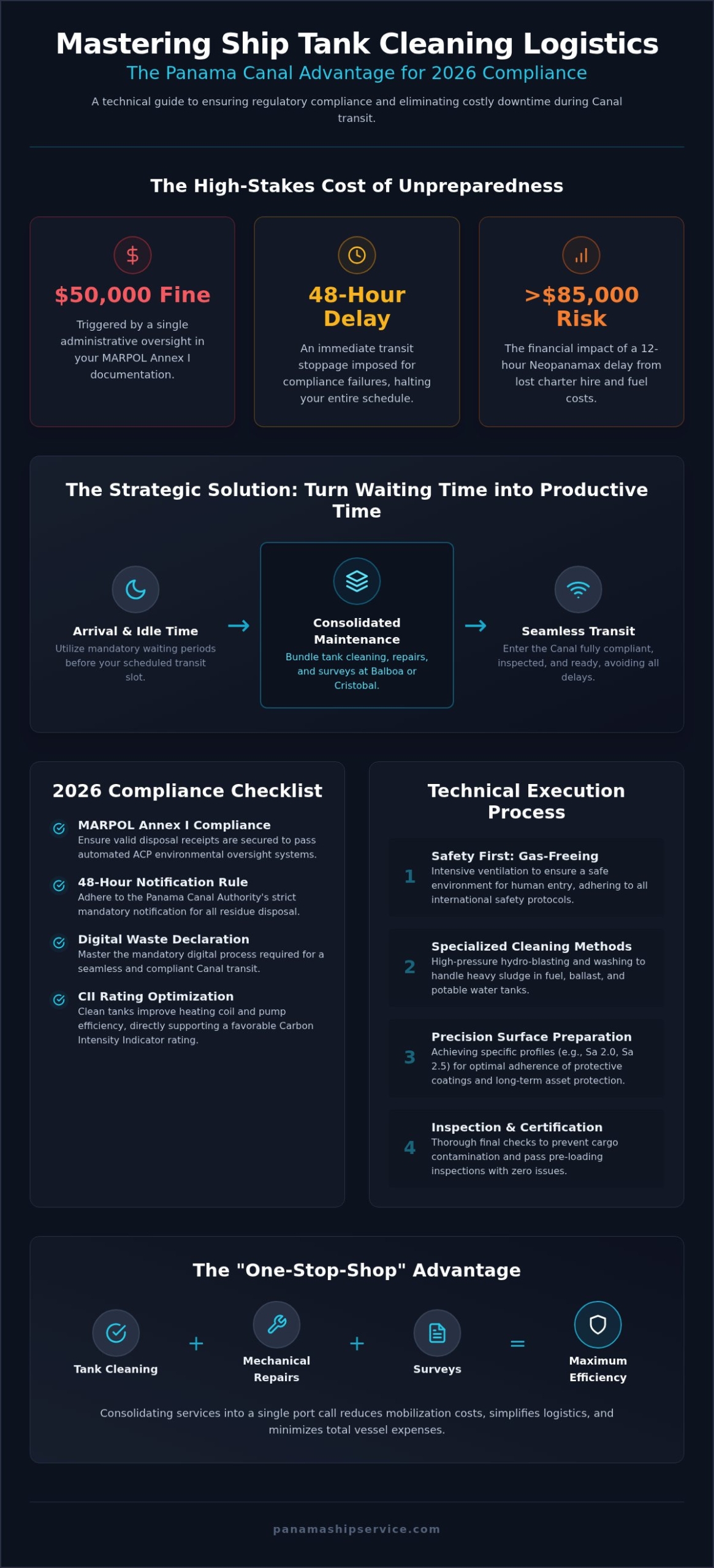
We’ll show you exactly how to master these logistics to ensure your vessel arrives ready for inspection or cargo changeover with zero downtime. This guide covers the latest ACP automated environmental oversight systems, technical standards for handling high-viscosity sludge, and the mandatory digital waste declaration process. By aligning your technical requirements with MARPOL compliance, you can delegate the complexity of waste management and focus on a seamless Canal transit. We’ve structured this information to help you navigate the 2026 regulatory landscape with confidence and efficiency.
Key Takeaways
- Learn how to eliminate vessel downtime by strategically scheduling maintenance within your transit window at either Balboa or Cristobal.
- Ensure full MARPOL Annex I compliance and secure valid disposal receipts to avoid the severe fines associated with 2026 ACP documentation errors.
- Master the technical requirements for ship tank cleaning panama, including gas-freeing protocols and specialized surface preparation for fuel and ballast tanks.
- Understand the 48-hour notification rule and the mandatory digital waste declaration process required for seamless residue disposal in the Canal zone.
- Discover the logistical advantages of a “one-stop-shop” approach that bundles tank cleaning with mechanical repairs and surveys to reduce total vessel expenses.
Why Schedule Ship Tank Cleaning During a Panama Canal Transit?
Scheduling maintenance at the Panama Canal is a tactical decision that separates efficient operators from those facing mounting overhead. Because vessels often face mandatory waiting periods before their scheduled transit slot, this idle time represents a prime opportunity to address technical requirements without extending the voyage. By performing ship tank cleaning panama services during these windows, you consolidate husbandry tasks into a single logistical event. Panama offers a unique geographical advantage with certified disposal facilities situated at both the Pacific (Balboa) and Atlantic (Cristobal) terminals. This ensures your schedule remains intact regardless of your transit direction.
Consolidating cleaning with other services reduces mobilization costs and simplifies communication. Instead of managing multiple vendors across different ports, you can address sludge removal, fuel tank cleaning, and cargo preparation in one stop. This proactive approach doesn’t just save time; it optimizes the vessel’s overall performance. Clean tanks ensure that heating coils and pumping systems operate at peak efficiency, which is vital for maintaining a favorable Carbon Intensity Indicator (CII) rating under 2026 standards.
Minimizing Vessel Downtime in the Canal Zone
In 2026, a 12-hour transit delay for a Neopanamax vessel carries a financial risk exceeding $85,000 in lost charter hire and fuel costs. Aligning your cleaning schedule with the Canal’s arrival window eliminates the need for additional off-hire periods. Instead of docking specifically for maintenance, you utilize the time your vessel is already stationary. This approach is even more effective when you coordinate cleaning with mechanical ship repairs panama. It allows for a comprehensive maintenance overhaul while awaiting your pilot. It’s about maximizing every hour spent in Panamanian waters to protect your bottom line.
Preparation for Cargo Changeover and Inspections
Stringent international standards and heightened environmental scrutiny make professional tank preparation a necessity for cargo changeovers. Whether you’re transitioning from crude to refined products or preparing ballast tanks for inspection, the cleaning must be absolute. Using professional ship tank cleaning panama services ensures your vessel meets all MARPOL Annex I regulations, which is critical for passing pre-loading inspections. Thorough removal of residues reduces the risk of cargo contamination and prevents costly insurance claims or vessel detentions. We handle the technical complexity of gas-freeing and sludge removal so your crew can focus on safe navigation and transit preparation.
Technical Methods for Marine Tank Cleaning and Surface Preparation
Executing ship tank cleaning panama projects involves more than just residue removal; it requires a deep understanding of vessel architecture and chemical interactions. Different tanks present unique technical challenges. Fuel oil tanks often contain heavy, unpumpable sludge that must be heated and agitated, while ballast tanks accumulate silt and marine growth that can compromise structural integrity over time. Potable water tanks demand specialized, food-grade cleaning procedures to maintain strict hygiene standards. Regardless of the tank type, the process always begins with intensive gas-freeing and ventilation. This ensures the environment is safe for human entry, adhering to international safety protocols for confined spaces and atmospheric monitoring.
Surface preparation is a critical phase, especially when cleaning is a precursor to coating repairs. Achieving a specific profile, such as Sa 2.0 or Sa 2.5, ensures that protective coatings adhere properly and provide long-term protection against corrosion. If you’re unsure which technical method fits your current maintenance window, you can consult with our technical team for a site-specific evaluation. This level of technical precision prevents premature coating failure and protects your vessel’s long-term asset value during its stay in Panamanian waters.
Hydro-Blasting and High-Pressure Washing
High-pressure water jetting is the most efficient way to strip away heavy sludge and oxidation without damaging the underlying steel. This method is highly effective for large surface areas in cargo and ballast tanks. By using water as the primary medium, we significantly reduce the environmental footprint and the complexity of residue disposal compared to traditional solvent-based methods. Hydro-blasting is a MARPOL-friendly method for scale removal. It provides a clean, salt-free surface that is ideal for immediate inspection or follow-up repair work.
Chemical Cleaning and Degreasing Strategies
For complex residues like lubricating oils or heavy fuel oil (HFO), mechanical washing alone is often insufficient. In these cases, we utilize chemical circulation and specialized degreasing strategies. We prioritize biodegradable cleaning agents that simplify the disposal logistics while providing the necessary solvency to break down tough hydrocarbons. Hot water washing is a standard component of this process, particularly for HFO tanks where residues must be heated to approximately 50-60° Celsius to remain pumpable. These procedures align with the global standards established by the International Maritime Organization (IMO) to prevent marine pollution. Using the right combination of temperature and chemical action ensures that tanks are certified clean for their next cargo or inspection without unnecessary delays.
Navigating MARPOL Regulations and Sludge Disposal in Panama
Compliance with international environmental standards is the most critical aspect of ship tank cleaning panama operations. In 2026, the Panama Canal Authority (ACP) has intensified its oversight, utilizing automated systems to cross-reference digital waste declarations with vessel tank sensors. Mismanaging a single MARPOL Annex I document now carries a financial risk of $50,000 in fines and a mandatory 48-hour transit delay. Operators must ensure that all oily residues, sludge, and bilge water are handled according to the strict protocols outlined in the Panama MARPOL reception facility regulations. This regulatory environment leaves no room for administrative error.
Securing a valid disposal receipt is not just a formality; it’s your primary defense during ACP spot checks. These inspections occur on 95% of transiting vessels to verify Garbage Management Plans and Oil Record Books. A clerical error in these records can result in an immediate $10,000 fine. For a deeper understanding of these requirements, you can review our guide on MARPOL disposal panama. We manage the entire documentation trail to ensure your vessel remains compliant throughout its stay in the Canal zone.
Handling Slops and Sludge Residues
The transfer of residues from a vessel to a barge or shore facility is a high-stakes logistical maneuver. We coordinate these transfers at both Balboa and Cristobal, ensuring that all equipment meets the technical standards for high-viscosity sludge. In 2026, high-viscosity residues must be heated to 50-60° Celsius to maintain pumpability and prevent transfer delays. Our protocols focus on:
- Strict adherence to the mandatory 48-hour notification rule for all waste disposal services.
- Prevention of accidental discharge through the use of certified hoses and spill containment systems.
- Full compliance with local environmental laws enforced by the Aquatic Resources Authority of Panama (ARAP) and the Panama Maritime Authority (AMP).
Gas-Free Certification and Safety Inspections
Before any hot work or manual tank entry can begin, the vessel must secure a gas-free certificate. This document verifies that the tank atmosphere is free of explosive vapors and has sufficient oxygen levels for safe entry. The certification process involves rigorous testing of the lower explosive limit (LEL) and toxic gas concentrations. Gas-freeing must be certified by a recognized marine chemist in Panama. This step is mandatory to protect the safety of the crew and contractors and to satisfy port authority safety requirements before repairs commence.
Strategic Logistics: Coordinating Cleaning at Balboa and Cristobal Ports
Choosing between the Pacific and Atlantic entrances is the first tactical decision in ship tank cleaning panama planning. Balboa and Cristobal offer distinct infrastructure and logistical advantages. Your choice should align with your transit direction and the specific waste disposal requirements of your voyage. Efficient coordination is the only way to prevent barge standby fees, which can exceed $400 per hour in 2026 if the vessel isn’t prepared for the transfer. We manage these timelines to ensure that technical teams and disposal barges are positioned exactly when your vessel reaches the anchorage.
Success depends on a tight communication loop between the Master, the local agent, and the technical contractor. You must provide a final Declaration of Waste within the mandatory 48-hour notification window. This digital submission via the Single Window for Maritime Commerce (VUMPA) is a zero-tolerance requirement. Any discrepancy between declared volumes and actual tank levels can lead to immediate detention. We handle the complexity of these digital filings to protect your transit slot. Panama’s tropical climate, particularly the heavy rainfall between May and December, also impacts surface preparation. High humidity levels often require specialized dehumidification equipment during tank coating applications. Our teams monitor local weather patterns to adjust work shifts, ensuring that cleaning remains on schedule despite tropical conditions.
Operations at Balboa Port (Pacific Entrance)
For Northbound vessels, Balboa is the logical choice for maintenance. You can perform cleaning at the anchorage while awaiting your transit slot, which effectively eliminates idle time. This location is also ideal for bundling your cleaning requirements with underwater hull services. Consolidating these tasks at the Pacific mouth reduces mobilization costs and ensures the vessel is in peak condition before entering the locks. This strategic positioning allows you to complete essential husbandry tasks without deviating from your primary route.
Operations at Cristobal Port (Atlantic Entrance)
Southbound vessels typically utilize Cristobal for their technical needs. This port provides direct access to specialized disposal facilities located in the Colon region. Managing turnaround times here requires precise timing, as the Atlantic anchorages are often congested. We coordinate closely with the ACP to ensure that our personnel transfers and equipment deliveries happen within your allotted pre-transit window. To optimize your next transit, contact our logistics team to discuss the best port for your specific maintenance needs.
Partnering with Panama Ship Service for Efficient Maintenance
Panama Ship Service provides a centralized hub for all vessel husbandry needs. By utilizing our “one-stop-shop” model, you can bundle ship tank cleaning panama with mechanical repairs and underwater hull services. This approach eliminates the friction of managing multiple contractors and ensures that your vessel’s maintenance schedule is perfectly synchronized with its Canal transit window. Our 20 years of experience in the Canal zone means we understand the nuances of ACP regulations and port authority permits better than any third-party aggregator. We take full responsibility for the technical and administrative complexity so you don’t have to.
Consolidating your services also ensures fiscal responsibility. Instead of multiple administrative fees and fragmented billing, you receive a single, transparent invoice. This reduces your internal overhead and simplifies the cost management of your voyage. We maintain 24/7 responsiveness to handle emergency requests or last-minute cleaning needs, ensuring that even unexpected maintenance doesn’t derail your arrival at the locks. Our presence on both sides of the Canal allows us to deploy resources quickly, regardless of whether your vessel is at the Pacific or Atlantic anchorage.
Our Comprehensive Technical Approach
Our teams are specifically trained for hazardous confined space operations, utilizing advanced atmospheric monitoring and safety equipment. We don’t just clean; we verify. By integrating our cleaning services with marine surveys panama, we provide detailed post-cleaning condition reports. These reports serve as documented proof of readiness for cargo changeovers or inspections. Our focus is on getting it right the first time. In the high-stakes environment of 2026, where a single delay can cost over $85,000, there’s no room for second attempts.
How to Secure a Quote and Nominate Services
To provide an accurate Pro Forma Disbursement Account (PDA) for your cleaning requirements, we require specific vessel data. Providing this information early allows us to secure disposal barge availability and technical personnel within the mandatory 48-hour notification window. Please have the following details ready for our team:
- Tank capacities and the total surface area requiring cleaning.
- The type of the last cargo carried and the current residue state.
- Estimated volume of slops and sludge requiring MARPOL-compliant disposal.
- Your preferred port of operation (Balboa or Cristobal).
Timing is critical for maintaining your transit slot. We recommend nominating services at least 72 hours before arrival to ensure seamless coordination. To begin the nomination process and secure your maintenance window, contact Panama Ship Service to optimize your next Canal transit. Our technical experts are ready to provide the proficiency and reliability your fleet demands.
Optimizing Your 2026 Panama Canal Maintenance Strategy
Mastering your vessel’s maintenance schedule requires a proactive approach to both technical and regulatory hurdles. By aligning ship tank cleaning panama operations with your transit window, you eliminate idle time and protect your charter hire. Success in 2026 depends on precise digital declarations and strict adherence to MARPOL Annex I, II, and V standards. These aren’t just best practices; they’re operational necessities for avoiding the severe penalties and delays associated with ACP oversight.
Delegating these complexities to a veteran partner ensures your fleet remains compliant and on schedule. Panama Ship Service offers 24/7 operational support and over 20 years of localized expertise in the Canal zone. We provide the technical proficiency needed to manage specialized labor and environmental disposal without compromising your transit slot. Our one-stop-shop model reduces your administrative burden and optimizes fiscal responsibility through consolidated service invoicing.
Don’t let uncoordinated maintenance disrupt your voyage. Request a Quote for Ship Tank Cleaning in Panama to ensure your next transit is efficient and fully compliant. We’re ready to secure your vessel’s readiness at either Balboa or Cristobal.
Frequently Asked Questions
How long does a typical ship tank cleaning take in Panama?
A typical ship tank cleaning panama operation takes between 24 and 72 hours, depending on the vessel’s size and the residue’s complexity. Heavy fuel oil tanks often require more time for heating and sludge agitation compared to ballast or potable water tanks. We coordinate these timelines with your transit window to ensure the work is completed while you await your pilot, eliminating additional off-hire periods and maximizing operational efficiency in the Canal zone.
Can tank cleaning be performed while the vessel is at the Panama Canal anchorage?
Yes, tank cleaning can be performed while your vessel is at the Panama Canal anchorages in either Balboa or Cristobal. This is a strategic advantage that allows you to utilize waiting times for essential maintenance. We deploy technical teams and equipment via barge to the anchorage, ensuring that your maintenance schedule doesn’t interfere with your position in the transit queue or require a costly move to a quayside berth.
What documentation is required for MARPOL-compliant sludge disposal in Panama?
Vessels must provide a final “Declaration of Waste” and secure an ACP permit within 48 hours of the scheduled service. For full MARPOL compliance, you’ll receive a valid disposal receipt once the transfer is complete. This documentation is critical for your Oil Record Book and Garbage Management Plan. It’s your primary defense during ACP spot checks, which are conducted on 95% of transiting vessels to verify environmental compliance in 2026.
Is a gas-free certificate always necessary for tank cleaning?
A gas-free certificate is mandatory for any manual tank entry or hot work repair. This certification ensures the atmosphere is free of explosive vapors and has sufficient oxygen for technical teams. In Panama, this document must be issued by a recognized marine chemist following rigorous testing of the lower explosive limit (LEL). We manage this entire safety verification process to protect our personnel and your crew while ensuring compliance with local port authority safety regulations.
Can you perform tank cleaning on both the Pacific and Atlantic sides of the Canal?
Yes, we provide comprehensive cleaning services on both the Pacific (Balboa) and Atlantic (Cristobal) sides of the Canal. Our localized presence allows us to mobilize resources quickly regardless of your transit direction. Whether you’re a Northbound vessel awaiting Pacific entry or a Southbound vessel anchored in the Atlantic, we ensure that specialized labor and disposal barges are available to meet your vessel’s technical requirements without causing transit delays.
What are the common challenges of tank cleaning during a Panama Canal transit?
The primary challenges include the mandatory 48-hour notification rule and managing sludge viscosity in Panama’s tropical climate. High-viscosity residues must often be heated to 50-60° Celsius to remain pumpable for discharge. Additionally, heavy rainfall during the rainy season can impact surface preparation timelines for coating repairs. Overcoming these hurdles requires precise logistical coordination and a deep understanding of the Panama Canal Authority’s automated environmental oversight systems implemented in 2026.
Do you provide tank cleaning for chemical tankers and LPG carriers?
We provide specialized cleaning for various vessel types, including chemical tankers and LPG carriers. These operations require specific degreasing agents and technical protocols to prevent cargo contamination and ensure tanks are certified clean for inspection or changeover. Our teams are equipped for hazardous confined space operations and use biodegradable agents that simplify disposal logistics while meeting the stringent international standards required for these specialized technical maritime assets.
How do you ensure crew safety during confined space tank cleaning?
We ensure crew and contractor safety through a multi-layered protocol that includes continuous atmospheric monitoring and specialized personal protective equipment (PPE). Every confined space entry is supported by a dedicated safety standby and a clear communication loop with the vessel’s bridge. By utilizing gas-freeing procedures and rigorous LEL testing, we eliminate the risk of explosive environments. Our 20 years of experience in the Canal zone ensures that every operation adheres to global safety benchmarks.