
Cruise-ship waste doesn’t have one destination: crews separate and store garbage onboard, deliver some to port reception facilities, and may discharge only waste types permitted under applicable rules. For solid waste management on ships, MARPOL Annex V generally prohibits garbage discharge at sea, except for categories covered by regulations 4, 5 and 6, according to the International Maritime Organization.
It’s reasonable to wonder whether waste is simply dumped overboard, but disposal depends on the type of waste, how it has been handled and where the vessel is operating. Different rules apply to garbage, sewage, food waste and other ship-generated materials.
This article explains where cruise-ship waste goes and how crews collect, separate, store and dispose of it. It also outlines how international MARPOL requirements interact with Canadian and U.S. rules, and when port reception facilities and MARPOL disposal services fit into vessel operations.
Key Takeaways
- Trace how onboard sorting and storage determine whether waste is retained, processed or delivered to port reception facilities.
- Understand how discharge rules are monitored and what records, plans and inspections support compliance.
- See why the applicable requirements can change across international waters, U.S. waters, Canadian waters and Arctic regions.
- Learn how professional collection and disposal procedures help manage waste during vessel operations and port calls.
Where Do Cruise Ships Dump Their Waste?
Cruise ships sort, store and process garbage onboard, then deliver suitable waste to port reception facilities. Solid waste management on ships follows MARPOL rules, which restrict what crews may discharge into the marine environment.
MARPOL Annex V Garbage Requirements
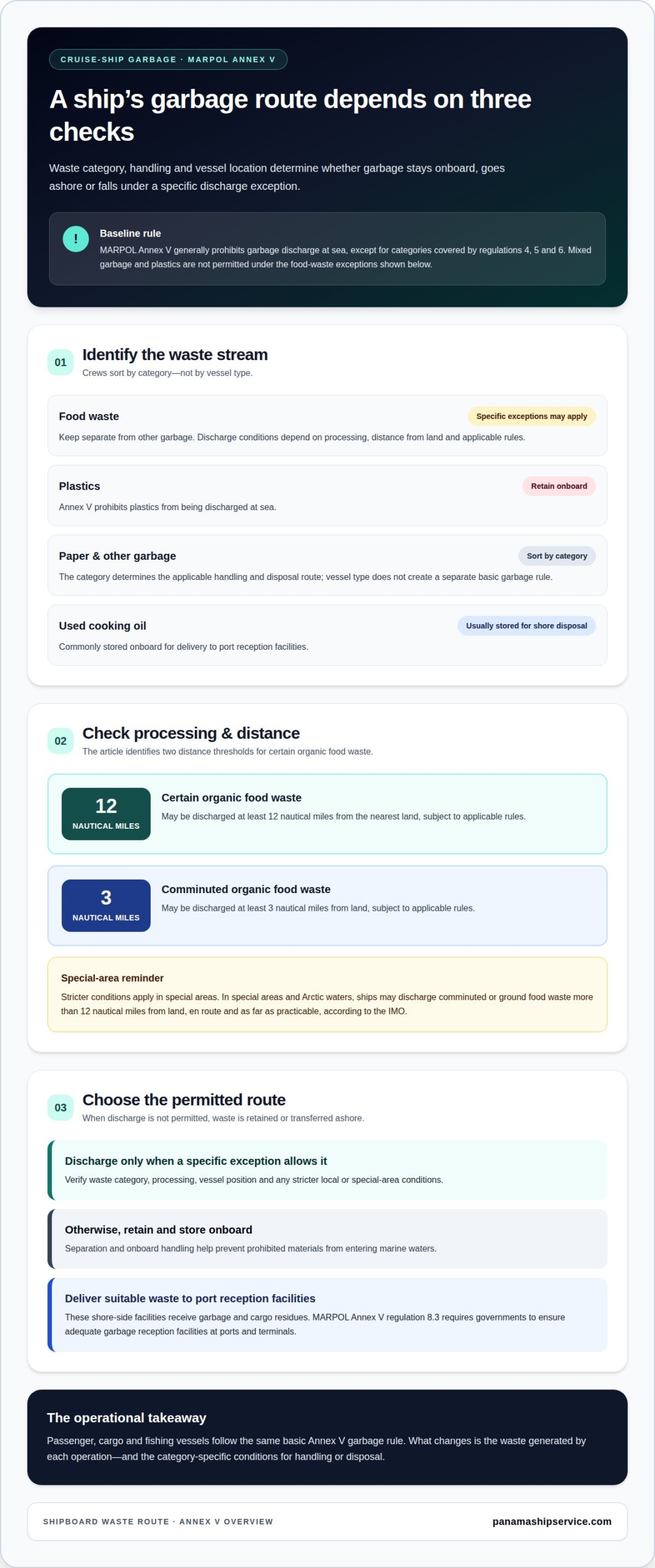
MARPOL Annex V sets international requirements for preventing pollution from ship garbage. The International Maritime Organization states that it generally prohibits garbage discharge at sea, except for categories covered by regulations 4, 5, and 6. This matters because a waste item’s category, treatment and location determine whether discharge is allowed. Otherwise, crews retain it onboard or deliver it to reception facilities.
Waste Categories and Vessel Differences
Annex V applies to all ships operating in the marine environment, including passenger ships, cargo ships and fishing vessels. It does not set a separate basic garbage rule for each vessel type. The main difference is the waste generated by each operation: passenger vessels may handle food and paper from onboard services, while cargo and fishing vessels produce different work-related waste. Crews must identify and handle garbage by category, rather than assume a vessel type makes discharge permissible.
At-Sea Discharge Conditions
Only specific waste categories may be discharged, and distance from land and processing affect the conditions. MARPOL Annex V permits certain organic food waste to be discharged 12 nautical miles from the nearest land; comminuted organic food waste may be discharged 3 nautical miles from land, subject to the applicable rules. These exceptions don’t allow mixed garbage or plastics to be dumped. In special areas, stricter conditions apply, so crews must account for the ship’s position and the waste category.
Types of Solid Waste Generated Aboard
Ship garbage includes food waste, paper, plastics and used cooking oil. Food scraps may be kept separate from other garbage, while cooking oil is commonly stored for delivery to port reception facilities. Plastics require particular care because Annex V prohibits their discharge at sea. Separating waste helps crews choose the appropriate onboard handling or shore disposal route and prevents harmful materials from entering marine waters.
Monitoring and enforcement of discharge rules
Discharge limits depend on the waste stream and the waters a vessel enters. Placards, onboard procedures and inspections make garbage and pollution controls visible and enforceable.
Discharge Placards for Garbage and Oil
Placards explain garbage and oil-discharge requirements to people aboard. Ships measuring 12 metres or more must display garbage-disposal placards for passengers and crew. In the United States, boats measuring 26 ft or more must prominently display written garbage and oil-discharge placards, each at least 5X9 inches. Clear notices help crews and passengers distinguish waste that must be retained from waste handled under specific rules.
International discharge rules vary by waste type. For sewage, international rules allow minimally treated sewage to be discharged beyond 3 nautical miles from shore; raw sewage may be discharged beyond 12 nautical miles. In U.S. navigable waters, untreated sewage discharge is prohibited within 3 nautical miles of shore. Greywater has no IMO treatment requirement, so national or regional rules determine its handling. Garbage rules remain distinct from sewage rules, and protected waters may impose additional limits.
Enforcement and Illegal Dumping Penalties
MARPOL Annex V regulation 9 allows port State control officers to inspect a foreign-flagged ship when clear grounds suggest its master or crew don’t know essential garbage-pollution procedures. Inspections can therefore focus on crew familiarity as well as the vessel’s practices. Correct separation, onboard handling and disposal records help show how waste was managed during a voyage.
In the United States, boats may not discharge garbage in lakes, rivers, bays, sounds or ocean waters less than 3 miles offshore. Illegal dumping can bring civil penalties up to $25,000, individual fines up to $250,000, organization fines up to $500,000, or imprisonment for up to 6 years. Port waste arrangements can support planned disposal during a call.
Canadian, U.S. and international ship-waste regulations
MARPOL sets international pollution controls, while Canada and the United States apply national rules in their waters. Requirements depend on the waste stream, vessel position and operating conditions, so sewage, greywater, oily water and garbage require separate disposal decisions.
For special areas and Arctic waters, ships may discharge comminuted or ground food waste more than 12 nautical miles from land, en route and as far as practicable, according to the International Maritime Organization. In Canadian Arctic waters, untreated sewage may be discharged only while the ship is underway and at least 12 nautical miles from land or ice. Canadian waters north of 60°N also restrict waste discharge to types permitted by the Canada Water Act.
Other ship-generated waste is subject to different controls. MARPOL Annex IV governs sewage discharge, while Annex I addresses oil and oily mixtures. The International Maritime Organization has no ship-specific greywater treatment requirements, so national or regional rules apply. Bilge water can contain oil, fuel and cleaning chemicals, making appropriate treatment important before disposal. The environmental impact depends on the waste’s contents and where it is released.
Port reception facilities provide a shore-side route for garbage and cargo residues. Under MARPOL Annex V regulation 8.3, governments must ensure adequate garbage reception facilities at ports and terminals. EU Directive 2000/59/EC also covers port facilities for ship-generated waste and cargo residues in European ports. Planning collection around a port call helps crews transfer retained waste instead of discharging it at sea.
Arctic operations require particular attention to location-specific rules. Canada incorporates the IMO Polar Code through its Arctic Shipping Safety and Pollution Prevention Regulations. For comminuted or ground food waste, the international rule above requires the vessel to be en route and to discharge as far as practicable from land. These limits help protect sensitive waters and species from harmful pollution.
Waste collection, handling, and disposal procedures
Professional handling reduces waste through separation, controlled onboard storage and routing suitable materials to recovery or port facilities. The appropriate route depends on the waste type, treatment method, vessel’s plan and applicable national rules.
Shipboard Waste Collection and Handling
Shipboard collection means identifying waste streams and keeping them contained for appropriate handling. This matters because mixed garbage can complicate treatment, storage and shore-side disposal. A professional waste plan sets out how collected waste is handled onboard, who handles it and where it goes. A written plan can help explain how waste is handled onboard, who handles it and where it goes.
For service planning, the vessel’s waste categories and intended disposal routes help define the work. Crews follow the onboard plan and keep waste separated as required. At port, retained waste can be delivered to reception facilities rather than released into the marine environment. Timing matters too: a planned transfer can align waste removal with a port call and other vessel operations.
Waste Reduction and Recycling Practices
Waste reduction starts by separating recoverable materials from garbage that needs treatment or disposal. Recycling depends on the material and the shore facilities available, so separation should be maintained during transfer. Food waste may be ground, mixed with water and discharged at sea only where applicable rules permit. Otherwise, it must remain onboard for an approved disposal route.
Incineration is another onboard treatment option for combustible garbage. Modern marine incinerators can convert up to 95% of combustible garbage into ash, reducing stored volume before ash disposal. Equipment selection must account for MARPOL Annex V and Annex VI. Used cooking oil can be stored separately for delivery to reception facilities, keeping it out of other waste streams.
For a coordinated approach, plan professional ship-waste handling around the vessel’s disposal needs and port schedule.
Panama Ship Service
Panama Ship Service helps vessel operators coordinate shipboard waste requirements with practical port and technical support. When waste must be retained for shore-side handling, its MARPOL Disposal service supports disposal planning as part of vessel operations. The company also provides Mechanical Ship Repairs, Underwater Hull Services and Marine Surveys, helping operators coordinate related needs with vessel schedules and operational requirements.
Turn to Panama Ship Service for professional support with ship-waste disposal or related vessel services at the Panama Canal. Share the vessel’s requirements and operational timing to discuss the next step.
Build waste planning into the next port call
Make waste handling part of the vessel’s operational plan, not a last-minute task. Align onboard collection, retained waste and shore-side arrangements with the vessel’s schedule and applicable requirements. This gives the crew a clear process and connects disposal decisions with the ship’s broader operational needs.
Panama Ship Service provides MARPOL Disposal alongside Mechanical Ship Repairs and Underwater Hull Services. These services can support vessel operations when waste handling and technical requirements need to be coordinated.
Move forward with a clear plan for solid waste management on ships. Contact Panama Ship Service today to discuss your vessel’s operational needs.
Frequently Asked Questions
What are the MARPOL Annex V rules for garbage disposal from ships?
MARPOL Annex V generally prohibits garbage discharge at sea, with limited exceptions for specified waste categories. The International Maritime Organization identifies the exceptions under regulations 4, 5 and 6. For example, plastics are prohibited from discharge, and waste cannot be treated as freely disposable simply because it has been processed. Regulation 7 addresses exceptions involving ship safety and accidental loss.
What are the requirements for ship garbage management plans and garbage record books?
Ships of 100 gross tonnage and above, or certified to carry 15 persons or more, must carry a garbage management plan. The plan explains onboard handling responsibilities and disposal routes. A Garbage Record Book must be retained for two years after its last entry. These records help maintain a traceable account of garbage handling and support review during inspections or operational handovers.
How do professional providers support the segregation, storage, and labeling of solid waste onboard?
Professional support can help coordinate waste streams with their intended treatment or disposal route. Clear separation helps keep materials such as plastics, food waste and used cooking oil apart during onboard storage and transfer. The vessel’s garbage management plan defines crew responsibilities, while required placards communicate disposal rules. Disposal support complements, rather than replaces, the ship’s onboard procedures.
How can ships arrange professional waste collection through port reception facilities?
Ships can plan shore-side collection around a port call by identifying the waste streams to be removed and coordinating the transfer with port reception facilities. Separate handling requirements may apply to garbage, oily mixtures and other waste, so clear descriptions help establish the appropriate route. Under MARPOL Annex V, governments must ensure adequate garbage reception facilities at ports and terminals.
What are the risks of improper solid waste management on ships?
Improper handling can allow harmful waste to enter the marine environment, where plastics may injure wildlife through ingestion or entanglement. Mixing waste streams can also complicate safe storage and proper disposal. Discharges that breach applicable rules can lead to inspections and legal penalties. Careful separation, controlled onboard storage and a clear disposal route help reduce environmental and compliance risks.
How much does ship waste collection and disposal at ports cost?
The cost depends on the waste type and volume, its handling or treatment needs, and the port arrangements involved. There is no single rate for every vessel or waste stream. A quote request provides the basis for a case-specific price. Sharing the vessel’s disposal requirements and port-call details helps define the work and the factors that affect the quote.