
For ship operators and charterers, the structural integrity of a vessel is paramount. Any compromise can lead to costly downtime, safety risks, and inspection failures. This guide explains the critical process of steel fabrication for marine vessels, from identifying common types of damage to choosing a certified and efficient repair partner at the strategic Panama Canal.
What is Steel Fabrication in the Maritime Industry?
Steel fabrication for ships is a highly specialized service that goes far beyond simple welding. It involves the cutting, shaping, and assembling of marine-grade steel to repair damage, modify structures, or install new components. The process is fundamental to maintaining a vessel’s structural integrity, ensuring it can withstand the immense forces encountered at sea and operate safely. The choice of material is critical; specific marine-grade steels are used for their strength, durability, and resistance to corrosion in harsh saltwater environments. It’s important to distinguish between urgent, unforeseen repairs and planned structural modifications, as each requires a different logistical approach.
Types of Structural Damage Requiring Fabrication
Our teams are equipped to handle a wide range of structural issues, including:
- Collision Damage: We expertly repair breaches and deformations in the hull, bulwarks, and superstructure resulting from contact with docks, other vessels, or submerged objects.
- Corrosion & Wear: Over time, steel degrades. We specialize in cropping and renewing wasted steel plates and internal structural members to restore the vessel’s original strength.
- Cracks & Fatigue: We identify and rectify stress-related failures in high-load areas of the vessel, preventing crack propagation and potential catastrophic failure.
Planned Modifications and Upgrades
Fabrication is also essential for vessel enhancements and retrofitting. Our services support:
- New Equipment Foundations: We fabricate and install robust foundations for new machinery such as exhaust gas scrubbers, ballast water treatment systems, cranes, and communication equipment.
- Structural Reinforcements: To meet new classification society rules, cargo requirements, or to strengthen ice-class vessels, we perform targeted structural reinforcements.
- Custom Fabrications: Our workshops produce a variety of custom components, including new ladders, access platforms, pipe supports, and container fittings, all built to exact specifications.
The Ship Steel Fabrication Process: From Assessment to Approval
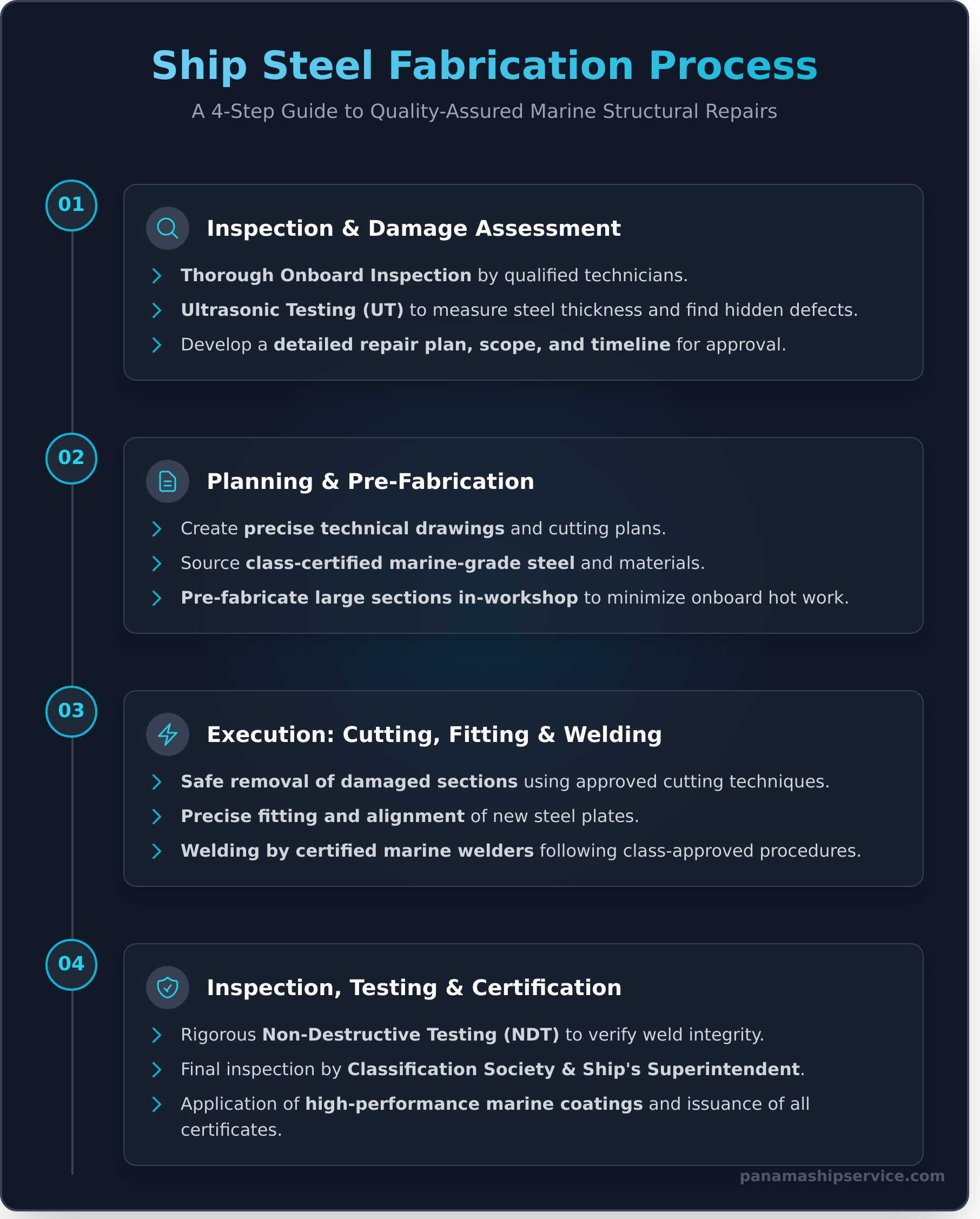
Our methodical approach to steel fabrication ensures the highest standards of quality, safety, and speed, minimizing disruption to vessel operations. The entire process is managed in close coordination with the vessel’s command and the attending classification society surveyors to guarantee compliance and a swift return to service.
Step 1: Onboard Inspection and Damage Assessment
The process begins the moment our qualified technicians board the vessel. They conduct a thorough visual inspection and use advanced tools like ultrasonic testing (UT) to accurately measure steel thickness and determine the full extent of the damage. Based on this data, a detailed repair plan, work scope, and timeline are developed and presented for approval.
Step 2: Planning, Procurement, and Pre-fabrication
Efficiency is key. We develop precise technical drawings and cutting plans to optimize material usage. All steel plates and materials are sourced from class-certified suppliers to ensure quality. Whenever possible, we pre-fabricate large sections in our fully equipped workshop. This parallel-processing approach significantly reduces the time required for hot work onboard, saving valuable time during the vessel’s transit or port stay.
Step 3: Execution: Cutting, Fitting, and Welding
Our certified teams execute the repair with precision. Damaged steel sections are safely removed using approved cutting techniques. New steel plates are then carefully fitted and aligned to ensure perfect integration with the existing structure. All welding is performed by certified marine welders, adhering to class-approved procedures and the vessel’s strict hot work permit system to ensure absolute safety.
Step 4: Inspection, Testing, and Final Certification
Quality assurance is non-negotiable. Upon completion of welding, we conduct rigorous non-destructive testing (NDT) to verify the integrity of every new weld. The repair is then presented for final inspection by the classification society surveyor and the ship’s superintendent. Once approved, our teams apply high-performance marine-grade coatings to protect the new steel from corrosion. All necessary documentation and certificates are issued, officially closing out the repair.
Choosing a Steel Fabrication Partner at the Panama Canal
The Panama Canal is a critical chokepoint in global shipping where delays are not an option. When structural repairs are required, you need a partner who can respond instantly with certified expertise. Choosing the right provider is essential to ensuring a fast, compliant, and cost-effective repair that keeps your vessel on schedule.
Essential Criteria for Your Provider
When selecting a fabrication service in Panama, demand the following:
- Location and Rapid Response: The provider must have the ability to deploy teams immediately to vessels at both the Balboa (Pacific) and Cristobal (Atlantic) anchorages.
- Verifiable Certifications: Ensure their welding procedures and welders are approved by major classification societies (e.g., ABS, DNV, Lloyd’s Register).
- 24/7 Availability: Shipping operates around the clock, and so should your repair partner. Emergency afloat repair capability is a must.
- Proven Track Record: The company should have extensive, demonstrable experience with your specific vessel type.
- ‘One-Stop-Shop’ Capability: A single point of contact for all technical services minimizes coordination hassles and streamlines the entire process. We encourage you to Verify our certifications and experience.
Why Trust Panama Ship Service for Your Fabrication Needs?
We are your expert, efficient partner for all marine technical services at the Panama Canal. Our primary goal is to resolve your structural issues and get your vessel back on schedule, safely and cost-effectively. We combine world-class technical expertise with unparalleled local knowledge to deliver solutions, not problems.
Our Commitment to Quality and Speed
When you partner with Panama Ship Service, you gain:
- Class-Approved Expertise: We maintain class-approved welding procedures and have certified welders on call 24/7.
- Strategic Deployment: Our strategic location allows for immediate deployment to either side of the Canal, minimizing response time.
- Streamlined Processes: From initial inspection to final certification, our processes are optimized for speed and efficiency.
- Clear Communication: We provide clear, constant communication and daily progress reports from start to finish.
Don’t let structural damage disrupt your voyage. Request a quote for your steel fabrication project now.
Frequently Asked Questions
What is a ‘doubler plate’ and when is it used for repairs?
A doubler plate is a piece of steel welded over a weakened or slightly damaged area as a temporary or, in some cases, permanent reinforcement. Its use is strictly regulated by classification societies and is typically reserved for situations where cropping and renewing the original plate is not feasible.
Can major steel repairs be done while the vessel is afloat?
Yes, many significant steel repairs, known as afloat repairs, can be completed safely while the vessel is at anchorage or alongside a berth. This requires highly skilled technicians, strict safety protocols (especially for hot work), and careful planning to avoid any compromise to the vessel’s stability or watertight integrity.
What is the difference between mild steel and marine-grade steel?
Marine-grade steel alloys are specifically formulated to resist corrosion in a saltwater environment and have specific strength and toughness properties required by classification societies for shipbuilding and repair. Mild steel lacks these critical characteristics and is not suitable for structural use on vessels.
How do you ensure the safety of the crew and vessel during hot work?
Safety is our top priority. All hot work is conducted under a strict permit-to-work system. This includes a comprehensive risk assessment, stationing a dedicated fire watch, having fire-fighting equipment on standby, ensuring proper ventilation, and isolating any flammable materials in the vicinity.
How quickly can your team be deployed for an emergency repair in Panama?
Our teams are on standby 24/7. For emergency calls at the Panama Canal, we can typically have an assessment team onboard the vessel within a matter of hours to evaluate the damage and begin formulating a rapid-response repair plan.
When your vessel’s structural integrity is on the line, trust the experts who understand the urgency and precision required. Panama Ship Service delivers certified, efficient, and reliable steel fabrication solutions designed to keep you moving. Get a Quote for Your Marine Steel Repair Needs today and put your transit in our hands.