
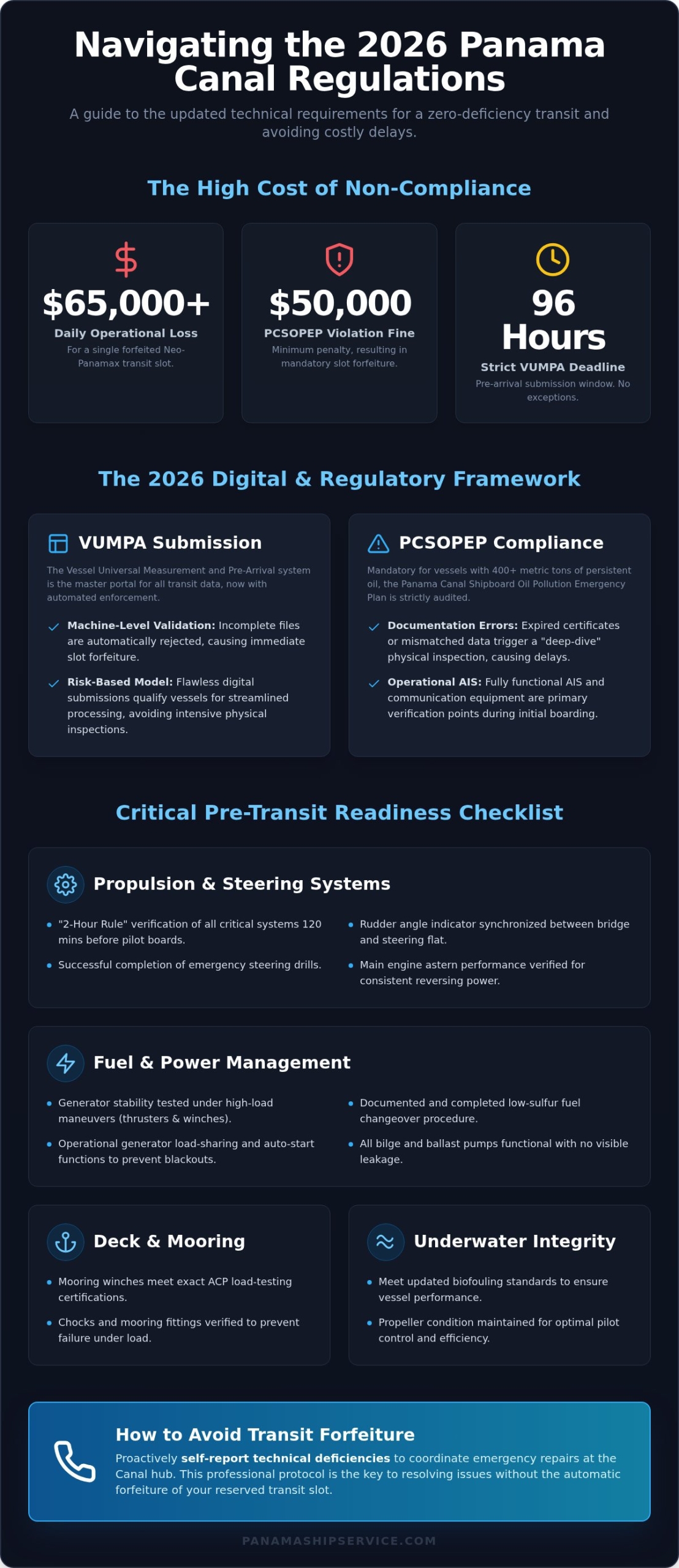
Forfeiting a Neo-Panamax transit slot in 2026 carries a staggering price tag of over $65,000 per day in operational losses. With the Panama Canal Authority now utilizing machine-level validation for VUMPA submissions and a strict risk-based inspection model, your pre-transit vessel inspection checklist must be flawless to avoid immediate rejection. You likely feel the pressure of these updated 2026 OP Notices and the looming threat of a $50,000 fine for PCSOPEP violations. It’s a high-stakes environment where a single equipment failure at the anchorage can result in the mandatory forfeiture of your slot.
We’ve developed this guide to ensure your vessel achieves a zero-deficiency ACP report and maintains its schedule. You’ll find a clear breakdown of the mandatory technical and regulatory requirements needed to minimize downtime. From engine room readiness to underwater hull integrity, this overview provides the operational clarity required to bypass costly delays and last-minute emergency repairs at the Canal hub.
Key Takeaways
- Master the 2026 risk-based inspection model to ensure your vessel qualifies for streamlined digital processing rather than intensive physical boarding.
- Utilize our comprehensive pre-transit vessel inspection checklist to verify main engine redundancy and steering gear performance before entering the canal anchorage.
- Identify the updated biofouling and propeller condition standards required to maintain pilot control and meet strict environmental compliance.
- Verify that all deck machinery, specifically mooring winches and chocks, meet exact ACP load-testing certifications to prevent equipment-related rejections.
- Learn the professional protocol for self-reporting technical deficiencies to coordinate emergency repairs without forfeiting your reserved transit slot.
Navigating the 2026 Panama Canal Transit Regulations
The Panama Canal Authority (ACP) has intensified its enforcement protocols in 2026 to ensure operational safety and environmental protection. The transition to a risk-based vessel inspection model on January 1, 2026, means that your entry into the Panama Canal depends on a precise digital and physical audit. The pre-transit inspection is the final technical hurdle; ACP boarders verify that the vessel’s physical condition matches the data submitted through official channels. They focus heavily on mechanical reliability, checking that steering systems and propulsion units meet the rigorous standards necessary for a safe transit. Updated regulations in OP Notice N-1-2026 and N-10-2026 mandate stricter adherence to navigation and technical standards. These notices outline the specific parameters for the pre-transit vessel inspection checklist, focusing on propulsion reliability and structural integrity.
VUMPA serves as the master portal for all 2026 transit data.
The VUMPA and PCSOPEP Framework
The Vessel Universal Measurement and Pre-Arrival (VUMPA) submission must be filed at least 96 hours before arrival at the anchorage. This deadline is strict. A machine-level validation system now automatically rejects incomplete files, leading to immediate slot forfeiture. Vessels carrying 400 metric tons or more of persistent oil must maintain an approved Panama Canal Shipboard Oil Pollution Emergency Plan (PCSOPEP). Documentation errors, such as expired equipment certifications or mismatched deadweight figures, often trigger a physical “deep-dive” inspection that can delay your schedule. You should also ensure that your vessel’s AIS and communication equipment are fully operational, as these are primary points of verification during the initial boarding.
The Cost of Non-Compliance in 2026
Failing to meet the requirements of your pre-transit vessel inspection checklist has severe financial consequences. A PCSOPEP violation carries a minimum fine of $50,000 and mandatory slot forfeiture. For Neo-Panamax operators, the daily cost of delay can exceed $65,000, not including the $15,000 base fine for general non-compliance. Technical readiness is your best insurance against Port State Control (PSC) delays. It ensures that the ACP views your vessel as a low-risk asset, potentially qualifying you for streamlined digital inspections in future transits. By delegating the complexity of these technical checks to a local partner, you can focus on core operations while ensuring your vessel stays on its tight schedule.
Critical Mechanical and Engine Room Readiness Checklist
While digital documentation is vital for the initial VUMPA validation, the physical readiness of your machinery determines whether you actually enter the locks. The ACP requires a strict “2-Hour Rule” verification, where all critical systems must be tested 120 minutes before the pilot boards. This is a non-negotiable part of your pre-transit vessel inspection checklist. Any failure during these live trials will likely result in a cancelled transit and the forfeiture of your reserved slot.
Propulsion and Steering Systems
Rudder angle indicator synchronization is a primary focus for ACP boarders. Any discrepancy between the bridge and the steering flat can lead to immediate transit suspension. You must perform emergency steering drills and verify main engine astern performance. Pilots rely on consistent reversing power for maneuvers within the tight confines of the locks. If your propulsion systems show signs of wear or lag, securing professional mechanical ship repairs before reaching the anchorage is essential. This technical rigour is supported by U.S. law on vessel inspections, which establishes the legal framework for these safety standards and ensures vessels conform to high operational benchmarks.
Fuel and Power Management
Generator stability is tested during high-load maneuvers, such as when bow thrusters and mooring winches operate simultaneously. You must ensure that generator load-sharing and auto-start functions are fully operational to prevent a total blackout in the channel. For vessels using low-sulfur fuel, the changeover procedure must be documented and completed well before entering the Canal waters to ensure compliance. You should also verify that all bilge and ballast pumps are functional. Any visible leakage or pump failure identified during the physical boarding will result in a deficiency report and possible delay.
Clear communication between the bridge and the engine room is the backbone of a safe transit. You must test the engine room telegraph and all emergency backup systems. A failure in the telegraph system during the physical boarding is one of the most common reasons for immediate slot forfeiture. If you suspect any mechanical or electrical instability during your pre-arrival trials, contacting a reliable technical partner for an immediate survey can save your transit window. Maintaining a proactive approach to your pre-transit vessel inspection checklist is the only way to ensure your vessel moves through the Canal without costly interruptions.
Underwater Hull and Propeller Condition Standards
The condition of your vessel’s hull and propeller significantly impacts maneuverability within the narrow lock chambers. In 2026, the Panama Canal Authority has tightened its stance on biofouling, viewing excessive marine growth as both a navigational risk and an environmental threat. A fouled hull increases hydrodynamic drag, which reduces transit speed and makes the vessel less responsive to pilot commands. This is why verifying hull cleanliness is a core component of any professional pre-transit vessel inspection checklist. Boarding officers look for signs of neglect that could compromise the safety of the canal’s infrastructure or other vessels in the convoy.
Hull Cleaning and Biofouling Compliance
Compliance with invasive species prevention protocols is mandatory for all 2026 transits. The ACP requires vessels to maintain hull integrity to prevent the transfer of non-indigenous marine life into the local ecosystem. Beyond regulatory compliance, professional in-water cleaning improves fuel efficiency and ensures your vessel can maintain the required transit speeds. If your vessel has been idle for an extended period before arrival, securing underwater hull services at the anchorage is a strategic move to prevent inspection delays. Identifying hull damage early, such as significant indentations or coating failures, prevents an ACP boarding officer from denying transit due to safety concerns.
Propeller and Rudder Inspections
The propeller’s condition directly dictates the effectiveness of astern maneuvers and pilot control. Propeller polishing reduces cavitation and improves responsiveness, which is critical when navigating the tight tolerances of the Neo-Panamax locks. During your pre-arrival checks, you should also verify rudder and pintle clearances to ensure steering precision. If there’s any suspicion of underwater damage, you may need a UWILD. A UWILD is a Class-approved underwater inspection in lieu of dry-docking. These inspections provide the high-resolution documentation required to satisfy both Class and ACP inspectors.
Maintaining these underwater standards ensures that your vessel doesn’t become a liability in the channel. A clean propeller and a smooth hull allow for the fine-tuned control that pilots demand during the most technical phases of the transit. By including these underwater checks in your pre-transit vessel inspection checklist, you eliminate the risk of being turned back at the last minute due to preventable hydrodynamic deficiencies. It’s much more cost-effective to resolve these issues at the anchorage than to face a mandatory slot forfeiture and the subsequent logistical nightmare of a delayed schedule.
Deck Machinery and Mooring Equipment Requirements
Operational deck machinery is the primary interface between your vessel and the Panama Canal’s infrastructure. While the engine room provides the power, your winches, windlasses, and mooring equipment facilitate the precise control required for lock entries. ACP boarding officers prioritize these systems because any failure during tug operations or lockage puts both the canal and the vessel at extreme risk. Including a rigorous audit of deck hardware in your pre-transit vessel inspection checklist ensures that your crew and equipment are ready for the high-tension environment of the transit.
Mooring System Integrity
Mooring winches and windlasses must undergo thorough load testing and brake lining inspections before arrival. ACP OP Notice N-1-2026 specifies the required strength and age parameters for mooring lines; any line showing excessive wear or sun degradation will be rejected. You should verify that emergency release mechanisms on towing winches are fully functional and that fairleads and rollers are well-greased and free-moving to prevent line snapping. Crew training is equally vital. Your team must be prepared to handle messenger lines efficiently, as delays in line transfer can cause the pilot to abort the maneuver, leading to costly idle time in the channel.
Navigation bridge equipment also falls under this physical audit. Boarding officers verify gyrocompass accuracy and radar functionality to ensure the vessel can safely navigate the tight bends of the Culebra Cut. A discrepancy in gyro readings can result in a mandatory tug escort at the operator’s expense. You should also verify that all bridge-to-deck communication systems are crystal clear, as pilots rely on instant feedback during the mooring process.
Safety and Sanitary Compliance
Sanitary and environmental compliance is a major focus for 2026 inspections. ACP inspectors will review your MARPOL records to ensure that sludge and garbage disposal are handled according to international and local standards. You must also present a valid deratting certificate and prove that pest control measures are active on board. Maintaining these records is just as critical as mechanical readiness. If you need to clear your tanks or dispose of waste before entering the locks, consult our guide on MARPOL disposal panama to ensure you meet all regulatory requirements without delaying your transit.
A zero-deficiency report on deck machinery demonstrates to the ACP that your vessel is a low-risk asset. If your internal audit reveals worn brake linings or compromised mooring lines, you don’t have to risk a rejection at the locks. You can delegate these technical issues to a local partner. Securing certified ship supplies and mechanical support at the anchorage allows you to resolve deficiencies before the official boarding takes place, keeping your schedule intact and your overhead predictable.
Resolving Inspection Deficiencies to Avoid Transit Forfeiture
Transparency is your most valuable asset when dealing with the Panama Canal Authority. If your internal audit using the pre-transit vessel inspection checklist reveals a critical mechanical or regulatory flaw, don’t attempt to hide it. Utilizing independent maritime safety and compliance audits from SeaFleet Backbone can help you identify these vulnerabilities before they jeopardize your transit. The ACP maintains a strict protocol for self-reporting deficiencies. Reporting an issue at least two hours before pilot boarding can often save your slot, as it allows the Authority to reschedule your transit rather than cancelling it due to a surprise failure in the channel. Surprising a pilot with malfunctioning steering gear or a dead engine is the quickest path to a $15,000 non-compliance fine and mandatory forfeiture.
When a deficiency is identified, the response must be immediate and systematic. Coordinating with a local agent who understands the urgency of the 2026 transit schedule is essential. You should follow these three critical steps to resolve the issue:
- Step 1: Immediately notify the ACP and your local agent of the technical status and your estimated time of repair.
- Step 2: Mobilize a team for mechanical ship repairs in Panama. You need technicians who can board at the anchorage without delay.
- Step 3: Conduct on-site repairs at the Balboa or Cristobal anchorage. PSS specializes in rapid-response repairs that occur while the vessel is at anchor, ensuring you meet the next available transit window.
The Role of Marine Surveys
ACP inspectors frequently require objective validation before they’ll clear a vessel for transit after a repair. Utilizing third-party marine surveys panama provides the necessary technical documentation to satisfy boarding officers. These surveys validate that the repair meets international standards and ACP-specific requirements. Beyond mechanical fixes, surveyors also conduct draft and bunker surveys to ensure your cargo and fuel levels perfectly match your VUMPA data. This eliminates the risk of paperwork discrepancies triggering a secondary, more intensive physical inspection.
Final verification and re-testing are the last hurdles. You must prove the system remains stable under load and conforms to the 2-hour rule mentioned in previous sections. Once the technical partner and the surveyor sign off, the ACP can restore your vessel’s low-risk status. This proactive approach to the pre-transit vessel inspection checklist ensures that even an unexpected failure doesn’t turn into a multi-day operational disaster. By delegating the repair logistics to experts at the Canal hub, you protect your schedule and your bottom line.
Securing Your 2026 Transit Window
Success in the Panama Canal requires more than just submitting paperwork; it demands a rigorous physical audit. By following a comprehensive pre-transit vessel inspection checklist, you address the technical deficiencies that trigger costly slot forfeitures and ACP fines. We’ve covered the critical nature of mechanical redundancy, hull biofouling compliance, and the importance of self-reporting deficiencies to protect your schedule. Technical readiness is your best insurance against the high stakes of a Neo-Panamax delay.
Panama Ship Service acts as your strategic partner at the Canal hub. We provide 24/7 technical support at both the Balboa and Cristobal entrances, utilizing Class-approved surveyors and certified mechanics to resolve issues before they become delays. As a one-stop-shop for mechanical repairs, ship supplies, and MARPOL-compliant disposal, we ensure your operations remain efficient and predictable. Our team is positioned to handle the technical complexity so you can focus on your core voyage objectives. Don’t leave your transit to chance when expert support is available around the clock. Ensure your vessel is transit-ready with Panama Ship Service and maintain your momentum through the locks.
Frequently Asked Questions
What are the most common technical reasons for Panama Canal transit rejection?
Steering gear failure, engine room telegraph malfunctions, and poor mooring winch condition are the primary causes for rejection. These mechanical flaws prevent the pilot from maintaining precise control during lock entries. ACP boarders also frequently reject vessels due to faulty gyrocompasses or discrepancies between the bridge and steering flat indicators. Addressing these items on your pre-transit vessel inspection checklist before arrival is the only way to avoid immediate slot forfeiture.
How far in advance should I conduct my pre-transit inspection?
You should initiate your internal inspection at least 72 hours before reaching the anchorage to allow time for technical remediation. While the ACP physical boarding occurs shortly before transit, identifying mechanical or structural issues early ensures you can coordinate with local technicians for repairs. This window aligns with the VUMPA data verification period, allowing you to update documentation if any equipment status changes during your final trials.
What is the 2026 requirement for mooring line specifications?
ACP OP Notice N-1-2026 mandates that mooring lines must be in excellent condition, with no visible fraying or sun degradation. For Neo-Panamax vessels, specific breaking strength and diameter requirements apply based on the vessel’s displacement. Lines must be fitted with certified messenger lines of at least 12 millimeters in diameter. Using lines that exceed five years of age or lack proper certification often results in a mandatory tug escort requirement at the anchorage.
Can I perform underwater hull cleaning while waiting at the Panama Canal anchorage?
Yes, you can perform underwater hull cleaning at the designated anchorages in Balboa or Cristobal. However, you must utilize a service provider that uses debris collection systems to comply with local environmental regulations. Cleaning the hull before the official inspection improves your risk profile and ensures the vessel meets the speed requirements for the channel. This proactive step helps maintain the responsiveness the pilot needs during technical lock maneuvers.
What happens if a vessel fails the ACP inspection after the pilot boards?
If a critical system fails after the pilot is on board, the vessel is usually ordered to anchor or moved to a safe location via tug escort. The operator is responsible for all tug fees, which are substantial, and the transit slot is typically forfeited. You’ll then be required to undergo a secondary inspection by the ACP once repairs are verified by a Class surveyor or a certified technical partner.
Does the Panama Canal Authority require specific AIS or navigation equipment updates for 2026?
The 2026 regulations require AIS systems to be fully integrated with the vessel’s gyrocompass and speed log to provide real-time, accurate data to the ACP traffic management system. Radar units must be operational on both X-band and S-band frequencies. Any lag in data transmission or failure in the AIS Pilot Plug will lead to a transit delay. These navigation tools are essential for safe passage through the Culebra Cut.
How do I report a known mechanical deficiency to the Cristobal Signal Station?
You must report any known mechanical deficiency via VHF Channel 12 or 16 to the Cristobal Signal Station as soon as the issue is identified. Provide the vessel name, your current position, and a brief description of the technical limitation. Early communication allows the ACP to adjust the transit schedule, which may prevent a total slot loss. Always follow up this verbal report with a written notification through your local agent.
Are there specific MARPOL disposal requirements for vessels transiting the Canal?
Vessels must maintain updated MARPOL disposal records and ensure that all sludge and oily water separators are fully functional. The ACP strictly prohibits any discharge within Canal waters, and inspectors verify that waste storage capacities are sufficient for the duration of the transit. Utilizing a certified pre-transit vessel inspection checklist helps verify that your garbage management plan and oil record book are current and ready for a physical audit.