
Maintenance and repair operations typically account for 10% of a vessel’s total operating expenses, yet for older ships, that figure often spikes to 30%. This surge is rarely due to the primary mechanical quote alone. Instead, it’s driven by the hidden costs of ship repair that emerge once the vessel is already in the yard. You likely expect some variance in your budget, but seeing a final invoice that is double the initial estimate is a frustration no fleet manager should have to face. From unexpected scope creep during mechanical overhauls to logistical bottlenecks at transit hubs like Panama, the true price of a repair is often invisible until it’s too late.
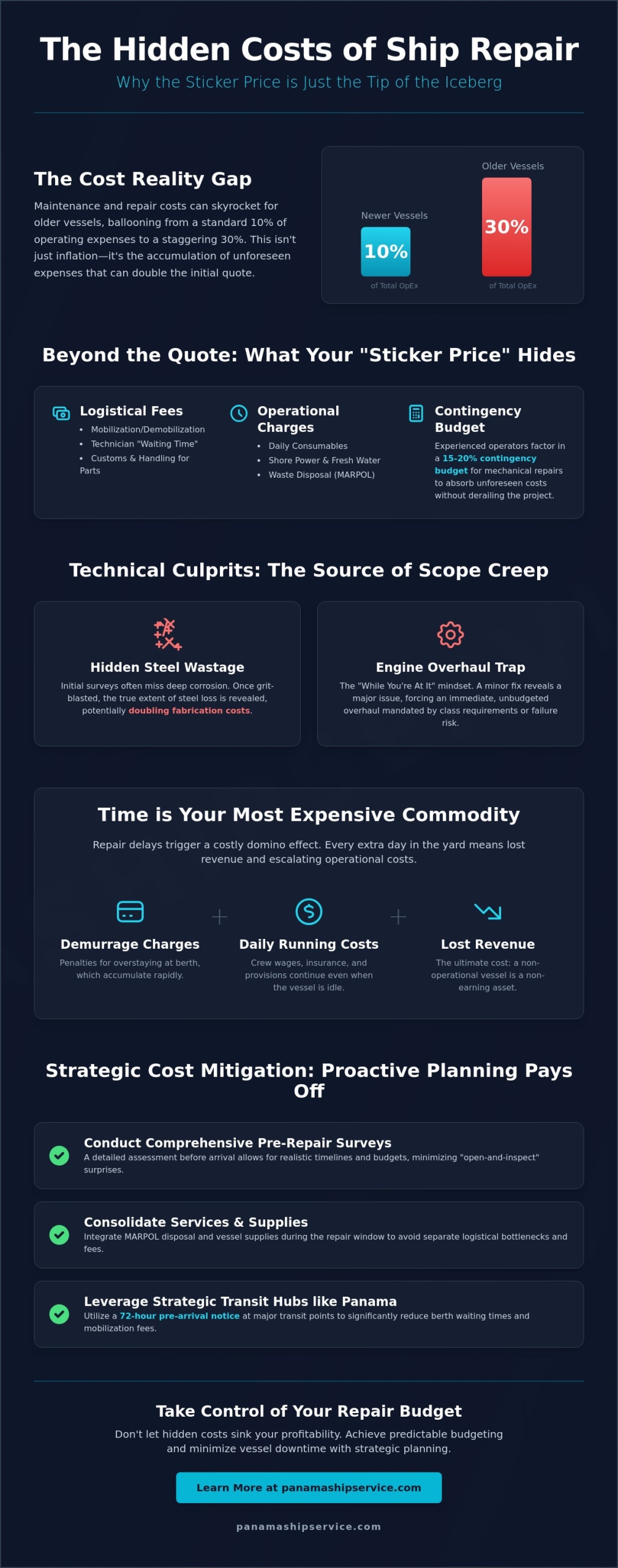
We recognize that in the maritime industry, time is your most expensive commodity. This guide identifies these invisible expenses and provides strategies to mitigate them before they erode your profitability. You’ll learn how to achieve predictable budgeting, minimize vessel downtime, and navigate volatile Panama Canal surcharges to ensure your next repair cycle protects your bottom line. By addressing technical issues and logistical hurdles proactively, you can maintain operational efficiency without the sting of unforeseen financial penalties.
Key Takeaways
- Learn to distinguish between a low-ball “sticker price” and a comprehensive budget that accounts for auxiliary services and mobilization.
- Identify how hidden corrosion and engine scope creep can inflate structural and mechanical repair costs once a vessel is opened up.
- Understand the critical link between repair timelines and the hidden costs of ship repair, specifically regarding demurrage and daily running costs.
- Evaluate the financial benefits of integrating MARPOL disposal and vessel supplies during repair windows to avoid separate logistical bottlenecks.
- Discover how strategic planning and 72-hour pre-arrival notices at transit hubs can significantly reduce berth waiting times and mobilization fees.
Beyond the Quote: Why the ‘Sticker Price’ of Ship Repair is Often Misleading
The initial contract for a vessel overhaul is rarely the final word on the project’s total expense. In the maritime industry, the hidden costs of ship repair are defined as the indirect and unforeseen expenses that arise after the initial agreement is signed. While a shipyard quote might look competitive on paper, it often represents only the baseline labor and facility fees. Technical superintendents frequently discover that the most significant financial drains are the logistical, regulatory, and technical variables that surface only once a project is underway. Relying on a “sticker price” without accounting for these factors is a risk that leads to severe budget overruns and operational delays.
A primary driver of these costs is the “open-and-inspect” nature of heavy maintenance. During the process of dry-docking and repair, opening a tank or disassembling a main engine often reveals deeper structural corrosion or mechanical wear that was invisible during a surface inspection. This discovery forces a shift from a fixed-price model to a time-and-materials basis. Given the current volatility in global supply chains, the impact of inflation on raw materials and the extended lead times for specialized spare parts can further inflate costs. Experienced operators recognize that they must factor in a 15-20% contingency budget specifically for mechanical ship repairs to maintain fiscal control.
The Psychology of the Low-Cost Quote
Low-ball estimates often secure contracts by omitting essential auxiliary services. These quotes frequently ignore mobilization and demobilization fees for specialized equipment or the “waiting time” charges incurred when a technician is ready but the vessel is not. Many of these inaccuracies stem from a lack of detailed pre-repair marine surveys panama. Without a comprehensive assessment before arrival, the shipyard cannot provide a realistic timeline or cost. This lack of data creates a cycle of delays where specialized tools must be sourced at the last minute, often at premium rates.
Ancillary Services: The Small Fees That Add Up
Daily operational charges for consumables, waste disposal, and utility connections like shore power and fresh water can add thousands to a final invoice. Additionally, customs duties and handling fees for imported spare parts are often billed as pass-through costs with an added administrative margin. Scope creep is the expansion of repair requirements following initial mechanical disassembly. Managing these hidden costs of ship repair requires a proactive approach to procurement and a strict verification process for every line item added to the work scope during the project.
Technical Culprits: Unforeseen Expenses in Mechanical and Structural Repairs
Steel wastage remains one of the most unpredictable variables in any major maintenance project. What begins as a simple plate replacement often escalates into a major fabrication project once hidden corrosion is exposed. When a tank is opened or a section of the hull is grit-blasted, the actual steel loss frequently exceeds the initial ultrasonic gauging results. Steel fabrication costs can easily double once the full extent of wastage is visible to the surveyor. These technical surprises are primary drivers of the hidden costs of ship repair, turning a routine stop into a financial burden.
Operators often fall into the “While You’re At It” trap during engine work. A minor repair to a cylinder head might reveal that the entire unit is approaching a mandatory overhaul window. If the vessel is already out of service, class requirements or the risk of future failure may mandate an immediate, unbudgeted overhaul. This technical scope creep is compounded by the high cost of non-destructive testing (NDT). If initial repairs fail quality checks, the expense of re-work, additional testing, and the resulting Demurrage charges for a delayed departure can be staggering.
Mechanical Scope Creep in Marine Diesel Engines
Engine maintenance rarely stops at the initial work order. Disassembly often identifies worn liners, pitted valves, or bearing clearances that were not visible during operation. The impact of poor fuel quality on fuel injection systems also adds layers of complexity to the repair process. Effective mechanical ship repairs panama must account for specialized tooling availability to ensure that these secondary discoveries do not lead to weeks of additional downtime. Our team recommends a thorough pre-inspection to identify these risks early.
Underwater Surprises: Fouling and Hull Integrity
Heavy biofouling does more than just increase fuel consumption; it hides structural cracks, pitting, and rudder damage from the naked eye. Propeller and rudder issues often remain undetected until the vessel is inspected by divers or lifted. There is a significant cost difference between routine underwater hull services and emergency structural welding required once a crack is finally found. Regular propeller polishing is a preventative investment that avoids the much higher corrective costs of fuel loss and mechanical vibration. If you are concerned about your vessel’s efficiency, a professional marine survey can provide the data needed to plan effectively.
Electrical system failures represent another layer of risk. The heavy vibration and moisture associated with mechanical work can trigger faults in legacy wiring or control systems. These failures often occur just as the vessel is preparing for sea trials, leading to last-minute delays and specialized labor fees. Managing the hidden costs of ship repair requires a technical partner who understands that structural integrity and mechanical reliability are inseparable.
The Cost of Time: Demurrage, Logistics, and Panama Canal Transit Delays
In the maritime industry, the repair invoice is frequently the smallest part of the financial equation. The Daily Running Cost (DRC) represents the true burden of an idle vessel. While a shipyard might quote for labor and parts, the owner continues to pay for crew wages, insurance, and interest on the hull regardless of whether the ship is moving cargo. If a technical failure keeps a ship in port beyond its scheduled window, demurrage penalties create a financial ripple effect that impacts the entire supply chain. These are the hidden costs of ship repair that many operators fail to quantify during the initial planning phase.
Logistical bottlenecks in Panama, such as port congestion and limited berth availability, further complicate these timelines. Missing a scheduled panama canal history transit slot due to a repair overrun can result in waiting for days or paying exorbitant auction fees to regain a position. Understanding the Top Cost Drivers in Ship Maintenance is essential for any superintendent trying to protect the bottom line in a high-stakes environment like the Panama Canal. Every hour of delay increases the risk of missing the next fixture, leading to massive opportunity costs.
Logistics and Mobilization in the Panama Hub
Mobilizing specialized technicians to Balboa or Cristobal involves more than just travel expenses. You must account for launch boat fees, crane hire, and the logistical “last mile” required to get tools and personnel onto the vessel. Sourcing ship supplies panama canal locally is a critical strategy to avoid international freight delays and customs hurdles. Every hour spent waiting for a part to clear customs is an hour of lost revenue that will never be recovered.
Transit Delays and Opportunity Costs
The opportunity cost of a late cargo delivery or a missed charter can be devastating to a fleet’s annual profitability. For this reason, a 24/7 emergency repair capability is often more cost-effective than a lower hourly rate from a slower provider. Panama’s strategic location can either save or sink a budget based on repair speed and the ability to return to the transit queue without delay. Efficient execution isn’t just about technical skill; it’s about minimizing the time your capital is tied up in port. We focus on rapid mobilization to ensure your vessel meets its transit window and remains on schedule.
Compliance and Environmental ‘Surprises’: MARPOL and Regulatory Penalties
Environmental compliance is not just a legal obligation; it is a significant budgetary variable. Regulatory penalties and waste management fees are often overlooked when calculating the hidden costs of ship repair. In the United States, corporate MARPOL violations can result in fines of up to $250,000 per violation per day. These staggering figures make the cost of proper disposal look like a minor line item. Beyond the risk of fines, the administrative burden of documenting compliance and paying for Class Approval fees to certify repairs adds layers of expense that rarely appear in an initial shipyard quote.
Modern regulations require strict management of sludge, slops, and oily water during any maintenance period. As of January 1, 2026, ships must also comply with enhanced IMO Data Collection System (DCS) reporting for fuel oil consumption. This shift toward data-driven verification means that every repair affecting engine performance or fuel systems must be meticulously documented. Integrating MARPOL disposal panama into your initial repair plan is the only way to ensure that waste handling does not become a bottleneck that prevents your vessel from sailing on schedule.
Waste Management and Environmental Levies
Improper garbage or chemical disposal at the Panama Canal carries a high price in the form of environmental levies and potential detention. Sustainable “Green” repairs, such as using bio-friendly paints or advanced disposal methods for hazardous materials, often carry a higher upfront cost but prevent long-term regulatory liability. Specialized tank cleaning is another critical factor; it prevents costly delays during inspections by ensuring that surveyors can safely access structural areas. Documentation and certification fees are the administrative price of compliance that must be budgeted from day one.
Class and Flag State Surveys
Surveyors from classification societies often introduce unexpected requirements during a repair window. You might be ordered to perform additional thickness measurements or rectify “Conditions of Class” before the vessel is legally permitted to sail. Coordinating these surveyor visits with your repair progress is essential to avoid expensive standby fees. If you want to avoid these regulatory surprises that drive up the hidden costs of ship repair, you need a partner who understands the local enforcement landscape. Contact us today to secure a comprehensive vessel compliance and repair service that keeps your fleet moving without penalty.
Strategic Cost Mitigation: Consolidating Services at the Panama Canal
Mitigating the hidden costs of ship repair requires a shift from reactive maintenance to strategic consolidation. When multiple vendors are contracted for different tasks, mobilization fees and administrative overlaps multiply. A “One-Stop-Shop” approach eliminates these redundancies. By using a single provider for mechanical repairs, underwater hull services, and ship supplies, you reduce the logistical footprint of your stay. This centralized management ensures that resources are allocated efficiently, preventing the scheduling conflicts that often lead to unbudgeted downtime. Local expertise in Panama acts as the best insurance against the logistical hurdles that typically drive up final invoices.
Effective pre-arrival planning is the most powerful tool for protecting your bottom line. Submitting a 72-hour notice before arrival significantly reduces berth waiting times and allows for the pre-staging of parts and personnel. This proactive coordination is especially critical at the Panama Canal, where congestion can turn a minor delay into a week-long setback. Combining essential repairs with your scheduled transit waiting time maximizes productivity. Instead of the vessel sitting idle while waiting for its slot, technical teams can complete critical work, turning necessary downtime into a period of high operational value.
Integrated Technical Solutions
Bundling mechanical repairs with underwater hull cleaning provides a superior return on investment. A clean hull improves fuel efficiency, while simultaneous engine work ensures the vessel operates at peak performance upon transit. Consolidating these services, along with MARPOL compliance and ship supplies, reduces administrative overhead. You deal with a single point of contact and receive a consolidated invoice. This clarity simplifies the auditing process and makes it easier for technical superintendents to track expenditures against the original budget. It’s a pragmatic way to manage the hidden costs of ship repair without sacrificing quality.
The Panama Ship Service Efficiency Framework
Our framework leverages 24/7 availability to ensure that “waiting time” is always “repair time.” We understand that the high-stakes environment of the canal requires immediate action. Our local network provides instant access to specialized spare parts and non-destructive testing (NDT) experts, bypassing the international freight delays that often plague fixed-price contracts. By delegating these complexities to an experienced local partner, you gain the insurance of technical proficiency and logistical speed. Don’t let unforeseen expenses erode your profitability. Minimize your vessel downtime and hidden costs with Panama Ship Service today.
Secure Your Fleet’s Profitability through Strategic Maintenance
Protecting your vessel’s bottom line requires moving beyond the “sticker price” of a shipyard quote to address the operational realities of the maritime industry. Managing the hidden costs of ship repair isn’t just about technical skill; it’s about anticipating regulatory hurdles and logistical bottlenecks before they cause a delay. By prioritizing pre-arrival planning and consolidating technical services at a strategic hub, you turn potential downtime into a period of high productivity.
Panama Ship Service provides a comprehensive solution for international fleet managers. We operate 24/7 at both ends of the Panama Canal, offering a single point of contact for mechanical repairs, marine surveys, MARPOL disposal, and ship supplies. Our decades of experience with international class standards ensures your vessel remains compliant and operational without the sting of unforeseen financial penalties. Contact Panama Ship Service for a transparent, comprehensive repair quote to safeguard your schedule and your budget. We look forward to ensuring your next transit is efficient and cost-effective.
Frequently Asked Questions
What are the most common hidden costs in commercial ship repair?
The most frequent hidden costs of ship repair include mobilization fees, disposal charges for hazardous waste, and unquoted consumables like shore power and fresh water. Many operators also overlook the cost of administrative certifications and specialized technician standby time. These expenses often emerge after the initial contract is signed, especially when “open and inspect” clauses reveal deeper structural corrosion or mechanical wear that requires immediate attention.
How can I avoid scope creep during a mechanical engine repair?
Avoiding scope creep requires a comprehensive pre-repair marine survey and a highly detailed technical work order. You shouldn’t rely on a surface-level inspection before a major overhaul. By identifying worn components and structural wastage before the vessel arrives at the yard, you can lock in fixed-price agreements for a larger portion of the work. This proactive approach reduces the likelihood of expensive secondary discoveries during the disassembly phase.
Why are mobilization fees so high in the Panama Canal region?
Mobilization fees in Panama reflect the complex logistics of transporting specialized personnel and heavy equipment to vessels at anchor or in transit. Charges for launch boats, crane hire, and barge transport are necessary to bridge the “last mile” between the shore and the vessel. Because the Panama Canal is a high-demand strategic hub, the availability of these support assets is limited, which often necessitates premium rates for rapid response and 24/7 service.
Does MARPOL compliance significantly increase repair budgets?
MARPOL compliance adds specific line items for sludge and oily water disposal but prevents the catastrophic expense of regulatory fines. Failure to manage waste according to international standards can lead to daily penalties reaching $250,000 in certain jurisdictions. While specialized tank cleaning and certified disposal services increase the immediate repair budget, they are essential investments that protect the owner from legal liability and potential vessel detention.
Can underwater inspections help reduce the overall cost of a dry-docking?
Underwater inspections identify biofouling, structural cracks, and propeller damage that allow for more accurate repair budgeting before the ship enters dry-dock. Knowing the exact state of the hull allows you to pre-order steel and specialized coatings, reducing the time the vessel spends out of service. This data-driven approach transforms “unforeseen” technical issues into planned maintenance tasks, significantly lowering the risk of budget-breaking surprises once the ship is out of the water.
How does vessel downtime compare to the actual cost of repairs?
Vessel downtime often represents a higher financial burden than the actual repair invoice due to the Daily Running Cost (DRC) and missed charter opportunities. For a ship waiting at the Panama Canal, the cost of a missed transit slot can include massive auction fees or days of lost revenue. Minimizing the time spent in port is the most effective way to protect your bottom line, making repair speed as important as the hourly labor rate.
What should I look for in a ship repair quote to ensure there are no surprises?
A transparent quote must include specific line items for mobilization, utility connections, waste management, and customs handling for spare parts. You should also look for a clear “open and inspect” protocol that defines how additional work will be priced if new issues are discovered. Ensure the quote accounts for the contingency budget typically required for mechanical overhauls to avoid the frustration of a final invoice that exceeds the initial estimate.