
Miscalculating your arrival window by less than 15 days at the panama canal now results in a 100% cancellation fee for long-term slots, a strict policy implemented on January 6, 2026. In an industry where container ships represent over 60% of the 14,000 annual transits, there’s no room for technical non-compliance or scheduling errors. You understand that navigating this critical shortcut is increasingly difficult as the Panama Canal Authority shifts toward dynamic, value-based pricing and complex environmental surcharges. The pressure to maintain efficiency while managing Neo-Panamax dimensions has never been higher.
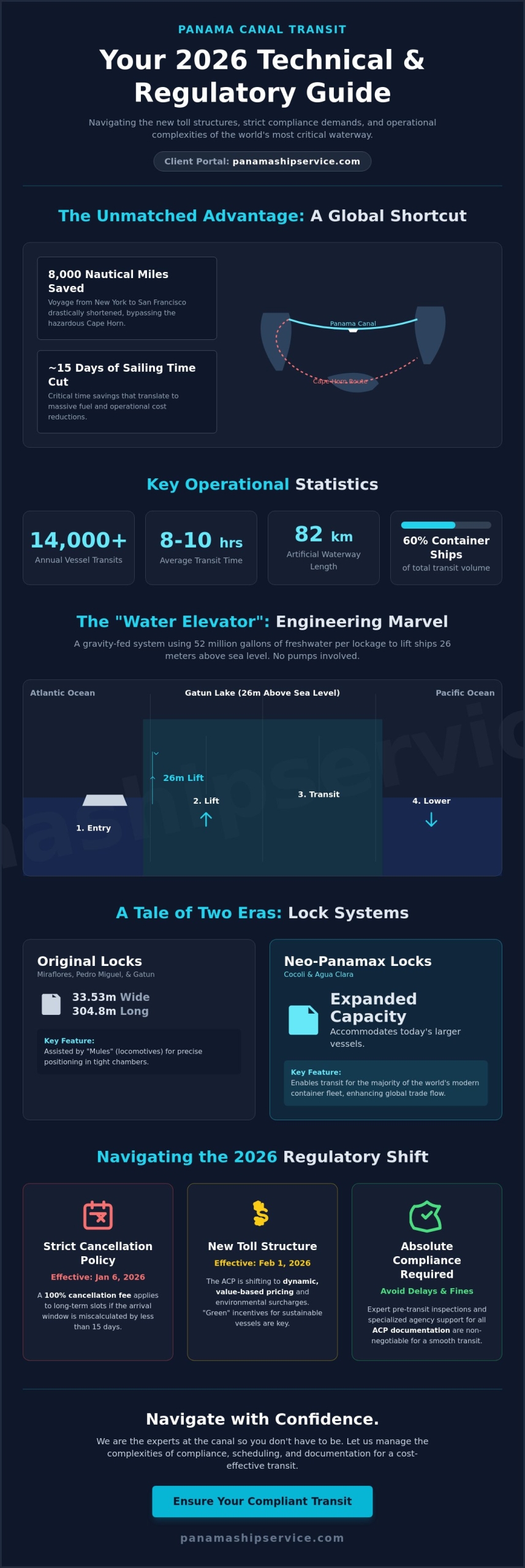
This guide provides the technical and strategic roadmap you need to master the February 1, 2026, toll structure and the latest “green” incentives for sustainable vessels. You’ll learn how to navigate the lock system mechanics, identify key regulations, and implement strategies that minimize vessel downtime. We’ll break down the operational requirements for 2026 to ensure your transit is both compliant and cost-effective. We are the experts at the canal so you don’t have to be.
Key Takeaways
- Master the engineering behind the “water elevator” system that uses gravity-fed freshwater to lift ships 26 meters above sea level.
- Quantify the strategic advantage of the panama canal by analyzing how it cuts 8,000 nautical miles from major trade routes.
- Prepare for Neo-Panamax transits by understanding the specific operational capacities of the Cocoli and Agua Clara locks.
- Eliminate the risk of technical non-compliance by utilizing expert pre-transit inspections and specialized agency support for ACP documentation.
What is the Panama Canal? An Operational and Geographic Overview
The Panama Canal is an 82-kilometre artificial waterway that bisects the Isthmus of Panama. It serves as a vital bridge between the Atlantic and Pacific Oceans, fundamentally altering global trade since its completion in 1914. Recognized as one of the Seven Wonders of the Modern World, it remains a masterpiece of maritime engineering. It’s not just a historical landmark; it’s a living, breathing operational hub that requires constant technical synchronization. For mariners, understanding the panama canal begins with its unique geography and the strict oversight of its governing body. Every year, over 14,000 vessels rely on this passage to avoid the hazardous journey around Cape Horn.
The Geography of the Isthmus
Panama’s unique S-shape creates a counterintuitive navigation experience. While you move from the Atlantic to the Pacific, your vessel actually travels from the northwest to the southeast. This “north-to-south” reality is critical for bridge teams to visualize during passage planning. The canal’s entry and exit points are anchored by two major logistics hubs: the Port of Cristobal on the Atlantic side and the Port of Balboa on the Pacific side. These ports handle massive cargo volumes and serve as essential staging areas for vessel services. Ship operators must account for these geographic nuances when scheduling crew changes or mechanical repairs. Efficiency starts with knowing exactly where your vessel sits in relation to these key maritime centers.
The Role of the Panama Canal Authority (ACP)
The Panama Canal Authority (ACP) is the autonomous legal entity responsible for the waterway’s administration. Created by the Panamanian Constitution, the ACP has a clear mandate to manage, operate, and maintain canal resources. Their oversight extends beyond simple traffic management; they are responsible for environmental protection and the management of the freshwater Gatun Lake. The ACP sets all tolls and navigation regulations, ensuring that every vessel class meets specific safety and environmental standards before entering the locks. They operate with a high degree of transparency but demand absolute compliance. Failure to meet ACP technical specifications can lead to significant delays or heavy fines. We act as your trusted partner to ensure your vessel meets every ACP requirement, from bunker surveys to MARPOL disposals.
Operational Impact on Global Trade
The canal’s role as a global shortcut is unmatched. By cutting through the isthmus, ships save approximately 8,000 nautical miles on a voyage from New York to San Francisco. This efficiency is why container ships account for over 60% of the canal’s total volume. In January 2026 alone, the canal saw a 2.8% increase in traffic, proving its continued relevance despite changing global trade patterns. Managing this volume requires a sophisticated booking system and a tiered toll structure that prioritizes environmental performance. As a mariner, you aren’t just navigating a waterway; you’re participating in a high-stakes logistics engine where timing is everything. We provide the expert oversight needed to keep your transit on schedule.
How the Panama Canal Works: The Engineering of the Lock System
The Panama Canal operates as a massive water elevator, a feat of engineering that has remained largely unchanged in principle for over a century. Ships aren’t moved through the isthmus by engines alone; they’re lifted 26 metres above sea level to reach the interior highlands. This process relies entirely on gravity-fed freshwater. No pumps are used to move the 52 million gallons of water required for each lockage. Instead, water flows from higher elevations into the lock chambers through large culverts. A full passage typically takes between 8 and 10 hours, depending on traffic and vessel type. The most challenging segment is the Culebra Cut, the narrowest point of the canal, where constant dredging is required to maintain the necessary depth and width for safe navigation. This 12.6-kilometre stretch through the Continental Divide is a critical bottleneck requiring precise pilotage.
The Original Locks: Miraflores, Pedro Miguel, and Gatun
The original system consists of three sets of locks: Miraflores and Pedro Miguel on the Pacific side, and Gatun on the Atlantic side. Each lock chamber measures 33.53 metres wide and 304.8 metres long. To ensure precision, silver locomotives known as “mules” assist in guiding vessels through these tight spaces. These locomotives provide the necessary tension to keep ships centered, preventing hull damage against the concrete walls. Because the original locks feature a double-lane configuration, the Panama Canal Authority (ACP) can manage simultaneous two-way traffic, maximizing daily transit capacity. This setup allows for a steady flow of Panamax-class vessels even during maintenance windows. The system’s reliability depends on these mechanical workhorses, which have been updated to handle modern tonnage.
Gatun Lake: The Heart of the Canal
At the heart of the system lies Gatun Lake. This 425-square-kilometre reservoir serves as both a transit path and the primary water source for the locks. Its depth directly dictates the maximum allowable draft for transiting vessels. Because the system is freshwater-dependent, rainfall patterns in the surrounding rainforest are critical. During periods of low precipitation, the ACP may implement draft restrictions to conserve water. Protecting the surrounding watershed is vital for maintaining these levels. The rainforest acts as a natural sponge, regulating the flow of water into the lake and preventing siltation. If your vessel requires a technical draft survey before entering the lake, our team provides the expert data needed to ensure compliance with current lake levels. We are experts at the Panama Canal so you don’t have to be.
Efficiency in this environment is not just about speed; it’s about technical compliance and water management. Every drop of water used in the locks is a resource that must be managed against the needs of the local population and the environment. As a mariner, navigating the Panama Canal means respecting this balance while maintaining a tight operational schedule. We provide the rapid response and specialized services required to navigate these engineering complexities without fuss.
The Strategic Importance of the Canal in Global Shipping
The strategic value of the panama canal is best measured by the sheer volume of resources it saves. For a vessel traveling from New York to San Francisco, the canal eliminates approximately 8,000 nautical miles compared to the hazardous route around Cape Horn. This massive distance reduction is the backbone of modern “just-in-time” delivery models. Shorter routes translate directly into lower fuel consumption and reduced operational costs. In an era of high-stakes logistics, these savings allow carriers to maintain competitive pricing while meeting tight delivery windows. The canal isn’t just a shortcut; it’s a vital component of global supply chain resilience that enables the rapid movement of goods between the world’s largest markets.
Primary trade routes relying on this passage include the US East Coast to Asia and the West Coast of South America to Europe. These lanes carry everything from liquefied natural gas (LNG) to perishable agricultural products. Because timing is everything in these sectors, any disruption at the isthmus has an immediate ripple effect on global commodity prices. We understand the pressure to keep these routes moving. Our role as your trusted partner is to ensure your vessel transits without technical delays, protecting your bottom line and your schedule.
Economic Impact on Global Trade
The canal facilitates roughly 5% of all global maritime trade. This concentrated flow of cargo has triggered a “Panama Canal effect” on port infrastructure worldwide. Ports along the US Gulf and East Coasts have invested billions to deepen channels and upgrade cranes to handle the larger vessels that now pass through the expanded locks. Beyond global logistics, the waterway is the engine of the Panamanian economy. Toll revenues and maritime services contribute significantly to Panama’s national GDP, funding critical infrastructure and social programs. The Panama Canal Authority manages this economic powerhouse with a focus on long-term sustainability and operational reliability.
Environmental Benefits and the Blue Economy
Decarbonization is the defining challenge of 21st-century shipping. By providing significantly shorter routes, the canal helps the maritime industry avoid millions of tons of CO2 emissions annually. The ACP actively encourages these efforts through its “Green Connection” environmental recognition program. This initiative offers preferential slots or recognition to vessels that demonstrate superior energy efficiency. To stay compliant with these evolving standards, operators must prioritize environmental management. Proper waste handling is a key part of this responsibility. You can refer to our MARPOL compliance guide to ensure your vessel meets all local and international discharge regulations during transit. We provide the expert disposal services you need to maintain your “green” standing without slowing down your operations.
The Neo-Panamax Era: Expansion and 21st-Century Capacity
The 2016 Expansion Project transformed the panama canal from a century-old marvel into a modern logistics powerhouse. This $5.25 billion investment introduced the “Third Set of Locks,” consisting of the Cocoli complex on the Pacific side and Agua Clara on the Atlantic. Unlike the original miter gates that swing open, these new systems utilize massive rolling gates that slide across the chamber. This design allows for easier maintenance and increased operational reliability because the gates can be serviced in their recesses without flooding the chamber. The expansion was specifically engineered to accommodate Neo-Panamax vessels, pushing the canal’s capacity from 5,000 TEUs to a maximum of 15,000 TEUs. This shift has fundamentally changed how global fleets are designed and deployed, forcing ports worldwide to deepen their berths.
Panamax vs. Neo-Panamax Specifications
Panamax vessels are limited to a length of 294.13 metres and a beam of 32.31 metres. In contrast, Neo-Panamax ships can reach 366 metres in length and 51 metres in beam, with a maximum draft of 15.2 metres. A major operational difference lies in guidance. While original locks use locomotives to center the ship, Neo-Panamax transits rely on high-powered tugboats to position the vessel. This method places significant mechanical stress on hull structures, fenders, and propulsion systems. The increased load often leads to a higher demand for mechanical ship repairs in Panama. We provide the technical expertise to handle these complex repairs, ensuring your larger vessels remain seaworthy and compliant with current standards.
Water-Saving Basins Technology
Water scarcity is the primary threat to canal operations, especially during the dry season from January to May. The expansion addressed this through the implementation of water-saving basins. Each lock chamber is connected to three basins that utilize gravity to recycle 60% of the water used during each transit. This means that despite the larger chamber size, a Neo-Panamax lockage uses 7% less freshwater than a transit through the original locks. This technology is essential for maintaining draft levels when rainfall is below historical averages. By conserving millions of gallons daily, the system ensures that the panama canal remains operational even during severe climate events. This efficiency is a cornerstone of the waterway’s 2026 sustainability goals.
If your vessel requires technical support or underwater hull services during its next transit, contact us for a rapid response quote. We are experts at the canal so you don’t have to be.
Navigating the Canal: Practical Guidance for Ship Operators
Successful transit through the panama canal in 2026 requires more than just a confirmed booking. It demands a proactive technical strategy. ACP boarding officers are increasingly stringent regarding vessel readiness. A single failed inspection can result in your vessel being sent back to the anchorage, triggering massive slot cancellation fees and operational delays. Specialized agency services are no longer a luxury; they are a necessity for managing the digital documentation and real-time coordination required by the ACP. Having underwater hull services on standby ensures that any fouling or structural concerns are addressed before they trigger a transit denial. We are experts so you don’t have to be.
Minimizing Vessel Downtime
Steering and propulsion failures remain the leading causes of transit rejection. If an issue is identified while waiting at the Pacific or Atlantic anchorages, every hour counts. We offer 24/7 mechanical ship repairs to resolve these critical failures without losing your place in the queue. Coordinating logistics at anchor can be difficult and frustrating. We streamline this process by delivering ship supplies at the Panama Canal directly to your vessel, from engine parts to essential provisions. This “one-stop-shop” approach eliminates the need to coordinate with multiple vendors, reducing the risk of communication breakdowns. Efficiency is our priority because we know that for ship owners, timing is everything.
Regulatory Compliance and Surveys
Compliance in 2026 extends beyond mechanical readiness to environmental stewardship. Vessels must pass specific marine surveys in Panama to verify bunker quality and draft accuracy. Additionally, MARPOL Annex compliance is strictly monitored during the approach. Masters must ensure all oil record books and waste disposal logs are up to date. To ensure vessel readiness for ACP boarding officers, masters should follow this essential checklist:
- Test steering gear and emergency power systems 48 hours before arrival.
- Verify all navigation lights and signals are fully operational and meet ACP standards.
- Confirm the vessel meets the current dynamic draft restrictions for Gatun Lake.
- Ensure all MARPOL disposal documentation and seals are ready for immediate inspection.
- Verify that all mooring winches and bitts are in optimal working condition for lockage.
Operating at the panama canal requires a partner who understands the high-stakes nature of the shipping industry. We provide the rapid response and technical expertise needed to ensure your vessel transits without fuss. Our team remains in constant daily communication with your crew to manage every detail of the process. Put your transit in our hands and experience the confidence that comes with working with a trusted partner.
Mastering Your Transit Strategy for 2026
The 2026 operational landscape at the panama canal demands absolute technical precision. From managing Neo-Panamax dimensions to adhering to the new value-based toll structures, there is no room for error. You’ve seen how water-saving technologies and strict ACP regulations now dictate your vessel’s schedule. Success in this high-stakes environment depends on proactive readiness and a rapid response to mechanical failures. Don’t let technical non-compliance or scheduling oversights lead to the 100% cancellation fees implemented on January 6, 2026.
With over 20 years of maritime expertise, we act as your indispensable one-stop-shop. We provide 24/7 mechanical repairs and MARPOL-compliant disposal to ensure your vessel stays in the water and on schedule. Our team handles the difficult and frustrating details so you can focus on your cargo. Streamline your Panama Canal transit with our expert technical services. Put your vessel in the hands of a trusted partner who understands that timing is everything. We are experts so you don’t have to be.
Frequently Asked Questions
How long does it take for a ship to transit the Panama Canal?
A full transit takes an average of 8 to 10 hours from one ocean to the other. However, ship operators must account for the total Canal Waters Time (CWT), which typically ranges from 24 to 30 hours. This total includes the time spent at anchor while waiting for a scheduled slot and the administrative processing required before entering the first set of locks.
What is the difference between Panamax and Neo-Panamax ships?
The primary difference lies in the vessel dimensions and the lock systems they utilize. Panamax vessels are built to the specifications of the original 1914 locks, with a maximum beam of 32.31 metres. Neo-Panamax ships are much larger, reaching up to 51.25 metres in beam, and they exclusively use the expanded Cocoli and Agua Clara locks. Unlike smaller vessels, Neo-Panamax ships rely on high-powered tugs for guidance instead of locomotives.
How much does a typical Panama Canal transit cost?
Transit costs are determined by the Feb 1, 2026 toll structure and vary based on vessel type and capacity. A large container ship can pay over $1 million when including the freshwater surcharge and reservation fees. Beyond the base tolls, mandatory charges for tugs, line handlers, and security inspections typically increase the total invoice by 10% to 20%. These costs are designed to reflect the dynamic value of the waterway.
Who currently owns and operates the Panama Canal?
The Republic of Panama owns the canal, and the Panama Canal Authority (ACP) operates it as an autonomous government entity. Since the official transfer of authority on December 31, 1999, the ACP has held full responsibility for administration, maintenance, and infrastructure projects. This agency ensures that the panama canal remains a neutral and efficient resource for the global maritime community.
Why does the Panama Canal use freshwater instead of seawater?
The system uses freshwater because the locks are gravity-fed from Gatun Lake, which is a freshwater reservoir 26 metres above sea level. Introducing seawater would require massive pumping infrastructure and would cause irreversible ecological damage to the local watershed. This freshwater dependency means that operations are directly tied to seasonal rainfall, necessitating the strict water-saving protocols implemented in the Neo-Panamax locks.
What happens if a ship breaks down during canal transit?
Vessels that experience mechanical failure are immediately assisted by ACP tugs and towed to a safe anchorage to clear the navigation channel. The ship owner is responsible for all towing expenses and may face heavy fines for obstructing traffic. We provide 24/7 mechanical repairs and technical support to resolve these issues at the anchorage, helping you avoid prolonged downtime and additional ACP penalties.
How many ships pass through the Panama Canal every day?
The waterway handles an average of 34 to 40 transits per day across both the original and expanded lock systems. This volume is managed through a precise booking system that balances traffic demand with the available water levels in Gatun Lake. In January 2026, the canal saw a 2.8% increase in traffic, confirming its status as a critical artery for over 14,000 vessels annually.
Does the Panama Canal operate 24 hours a day?
Yes, the panama canal operates 24 hours a day, 365 days a year, regardless of holidays or weather conditions. Night transits are common and require specialized lighting and expert pilots to navigate the Culebra Cut and lock chambers safely. Maintenance is performed on a rolling basis to ensure that at least one lane remains open in the original locks at all times, maintaining constant global trade flow.