
A single oversight in technical compliance can cost a vessel owner upwards of $60,000 in daily detention fees and lost transit slots at the panama canal. As we look toward 2026, the margin for error has vanished. You understand that timing is everything in this industry; even a minor delay in MARPOL documentation or a sudden mechanical failure can derail your entire operational budget. It’s a frustrating environment where costs continually increase and regulations like the ACP’s updated water management fees, finalized in late 2024, add new layers of complexity.
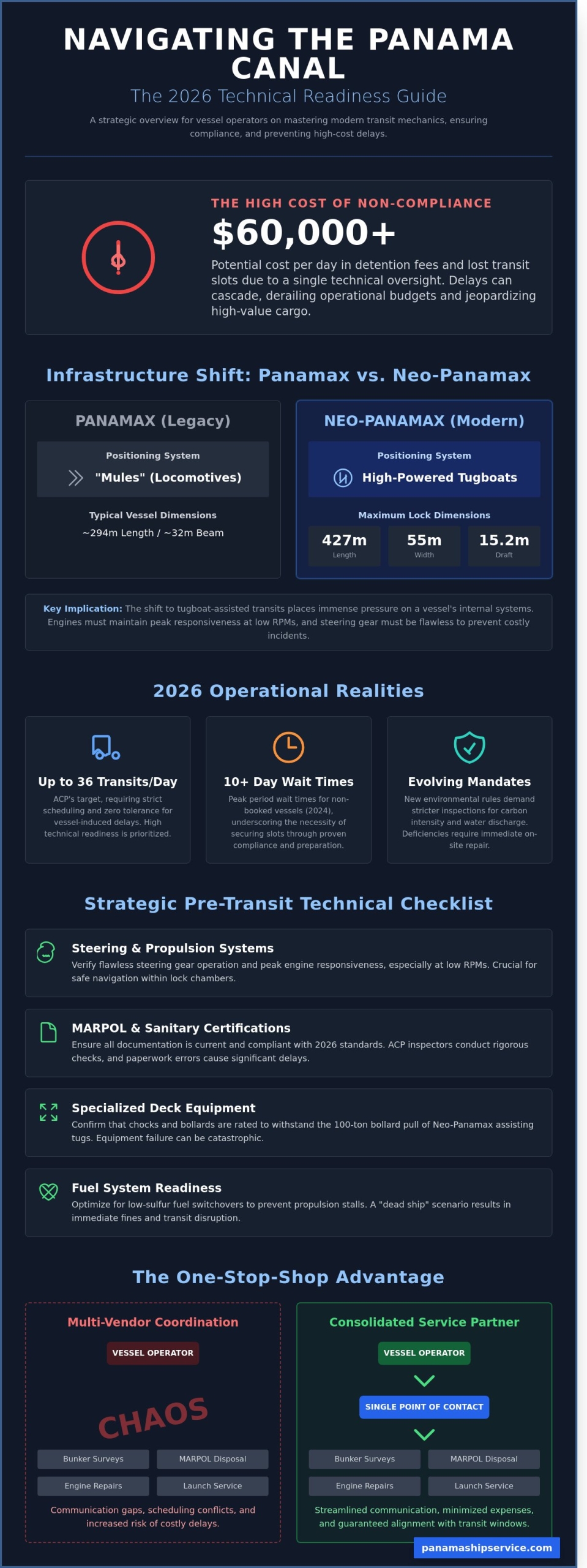
We are experts so you don’t have to be. This operational guide provides the strategic insights necessary to master the modern transit mechanics and technical requirements of the canal. You’ll learn how to navigate the latest MARPOL and ACP regulations while planning for essential services that prevent high-cost emergency repairs. We’ll explore the specific technical protocols and service strategies that ensure full regulatory compliance and minimize vessel downtime, positioning you with a trusted partner at the Panama Canal for every mile of the journey.
Key Takeaways
- Navigate the operational shift in Neo-Panamax transit mechanics and understand how fluctuating water levels will impact your vessel’s draft restrictions.
- Quantify the true cost of delays and learn professional strategies to manage the risks of missed panama canal transit slots.
- Implement a rigorous technical audit and compliance check to verify that your steering, propulsion, and sanitary certifications meet 2026 standards.
- Discover how a consolidated “one-stop-shop” approach to technical services can minimize vessel expenses and eliminate the frustrations of multi-vendor coordination.
The Panama Canal in 2026: Navigating Modern Operational Realities
The panama canal operates under a strict water management strategy that balances Gatun Lake levels with the heavy demands of Neo-Panamax traffic. By 2026, the Panama Canal Authority (ACP) expects to maintain a steady flow of up to 36 transits per day, provided rainfall patterns remain predictable. This operational environment requires a delicate balance between the water-intensive Panama Canal expansion project locks and the traditional locks that have served the industry for over a century.
2026 marks a definitive turning point in transit slot auctions and technical scheduling. The ACP is refining its Long-Term Slot Allocation (LoTSA) methodology, which prioritizes vessels that demonstrate high technical readiness and environmental compliance. Misjudge your timing and you lose your slot; in the shipping industry, lost time is lost profit. We are experts so you don’t have to be. We manage these technical schedules to ensure your vessel meets every ACP requirement before arrival.
The ACP continues to enforce rigid technical standards to prevent mechanical failures that could block the channel. Modern vessel operators now rely on a ‘One-Stop-Shop’ advantage to survive these pressures. Instead of coordinating with multiple vendors for bunker surveys, MARPOL disposals, and engine repairs, a single point of contact ensures all services align with the transit window. This integrated approach eliminates the communication gaps that lead to costly delays at the locks.
The Impact of Global Trade Shifts on Canal Transit
Changing trade routes directly affect wait times at the Balboa and Cristobal ports, where congestion can spike without warning. In 2024, wait times for non-booked vessels reached 10 days during peak periods, making technical readiness vital for high-value cargo. The panama canal serves as a precision-timed maritime bridge in 2026 global logistics.
Regulatory Evolution: What Mariners Need to Know
New environmental mandates require stricter vessel inspections for carbon intensity and water discharge. ACP inspectors now demand immediate repairs for any deficiency found during pre-transit checks. Understanding the history of the Panama Canal helps mariners appreciate why these rigid technical standards exist to protect this infrastructure. We provide rapid response teams for on-site repairs to keep your transit on track.
Infrastructure and Mechanics: Understanding Neo-Panamax Operations
The panama canal expansion, completed in 2016, introduced the Cocoli and Agua Clara locks, fundamentally changing how global trade moves. These Neo-Panamax chambers are 427 meters long and 55 meters wide, allowing the passage of vessels with a 15.2-meter tropical freshwater draft. Unlike the century-old Panamax locks that utilize “mules” or locomotives for positioning, Neo-Panamax transits rely almost entirely on high-powered tugboats. This mechanical shift places immense pressure on a vessel’s internal systems. Engines must maintain peak responsiveness at low RPMs, and steering gear must be flawless to prevent hull contact with the lock walls during tight maneuvers.
Navigation protocols within these locks are rigid. Once a vessel enters the approach channel, the ACP pilot assumes operational control of the ship’s movements. While your crew remains at their stations, they must execute pilot orders with zero margin for error. To ensure your vessel meets all current technical requirements, you must stay updated with the official Panama Canal Notices to Shipping. These documents detail everything from mandatory mooring configurations to specific engine room manning requirements during transit. We are experts so you don’t have to be, and we ensure your vessel’s hardware aligns with these strict ACP mandates.
Neo-Panamax vs. Panamax: Technical Distinctions
Neo-Panamax vessels require specialized deck equipment, including heavy-duty chocks and bollards that can withstand the 100-ton bollard pull of assisting tugs. The impact of these larger hulls extends to the port infrastructure at both the Balboa and Cristobal entrances, where deeper berths and larger cranes are now standard. Mechanical failure points often involve the steering gear or propulsion stalls during fuel switchovers. If your ship isn’t optimized for the low-sulfur requirements within the panama canal, you risk a “dead ship” scenario, which leads to immediate fines and transit delays.
Water Management and Draft Restrictions
Gatun Lake acts as the heart of the canal, but its water levels are vulnerable to seasonal shifts. Heading into 2026, the ACP is implementing advanced water-saving basins that recycle 60 percent of the water used in each lockage. Despite this, dry seasons often trigger draft restrictions. A reduction of just one foot in draft can force a container ship to leave approximately 350 TEUs behind, directly slashing the profitability of the voyage. Precision is your only defense against these losses. You need accurate marine surveys in Panama to verify your actual displacement and ensure you’re loading to the maximum allowable limit. If you need to verify your vessel’s compliance before arrival, our technical team can provide a comprehensive pre-transit review.
The High Cost of Delay: Risk Management and Technical Readiness
A missed transit slot in 2026 represents a critical financial failure for ship owners and operators. With daily hire rates for Neo-Panamax vessels often exceeding $80,000, every hour of idling at anchorage drains the bottom line. Beyond lost time, the panama canal reservation system is unforgiving. Missing a scheduled window can force a vessel into the auction market, where slot prices have previously surged past $1 million during periods of high demand. Operators must adhere strictly to the official Panama Canal Notices to Shipping to ensure compliance with the latest 2026 safety and equipment regulations.
Technical readiness is the only way to mitigate these risks. Mechanical failure within the locks triggers immediate ACP intervention. This results in mandatory towing fees, steep administrative penalties, and severe reputational damage with charterers. Emergency repairs in Panama are a strategic necessity because the costs of a mid-transit breakdown far outweigh the investment in proactive maintenance. We are experts so you don’t have to be; we focus on identifying vulnerabilities before they become canal-blocking crises.
Preventative Maintenance: Hull and Propeller Health
The economic case for propeller polishing is clear. A fouled propeller reduces propulsion efficiency, forcing the engine to work harder during the 8 to 10 hour transit. This increases fuel consumption by 5% to 12% depending on the severity of the biofouling. Regular underwater hull services in Panama reduce hydrodynamic drag and ensure your vessel meets strict environmental standards regarding invasive species transfer. Removing marine growth before entering the canal system ensures peak performance and prevents costly transit delays.
Mechanical Integrity and Emergency Preparedness
The most common causes for ACP-mandated delays include steering gear malfunctions and main engine starting issues. The panama canal environment demands high maneuverability, putting immense stress on hydraulic and mechanical systems. Utilizing specialized mechanical ship repairs in Panama allows operators to address these faults while at anchorage. It’s a simple calculation of risk: a proactive 24-hour repair window can save a 10-day operational delay. Our rapid response teams provide the technical expertise needed to secure your transit slot and keep your schedule on track.
Strategic Pre-Transit Checklist for Vessel Operators
A successful Panama Canal transit depends on mechanical precision and strict adherence to schedule. Vessel operators must conduct a rigorous technical audit before arrival. This includes verifying the performance of steering systems, propulsion units, and deck machinery like winches and windlasses. Any mechanical failure during transit doesn’t just cause delays; it results in heavy fines and potential loss of your slot. We’ve seen that 15% of transit delays stem from preventable mechanical issues that a pre-arrival check would have caught.
Logistical efficiency is equally critical. Instead of managing multiple vendors at different stages, smart operators consolidate their ship supplies at the Panama Canal into a single delivery window. This strategy eliminates the need for multiple port calls, reducing your overall port stay and minimizing administrative overhead. Efficiency is the only way to protect your margins when costs continually increase.
Environmental and MARPOL Compliance
Meeting international and local environmental standards is non-negotiable. Vessels must have updated MARPOL and sanitary certificates ready for inspection upon arrival. Managing waste like sludge, slops, and garbage requires specific protocols to avoid detention. You must ensure all documentation for MARPOL disposal in Panama is accurate and reflects current discharge volumes. Additionally, international health standards require valid fumigation and pest control records. A missing Deratting Certificate can halt your transit immediately, so verify these documents 48 hours before reaching the Panama Canal waters.
Survey and Inspection Readiness
Class-approved underwater inspections (UWILD) are vital for maintaining insurance coverage and verifying hull integrity before entering the locks. We recommend scheduling these alongside your draft and bunker surveys to ensure cargo and fuel accuracy. Coordinating with a one-stop provider allows you to handle technical inspections, bunker verification, and condition surveys simultaneously. This approach saves time and ensures a unified reporting structure for the ship owner. We are experts in these technical requirements so you don’t have to be. Our team manages the details to keep your vessel moving without friction.
Minimize your vessel expenses and ensure a seamless crossing with our expert technical support. Contact Panama Ship Service today to coordinate your pre-transit inspections and logistics.
Why Panama Ship Service is Your Trusted Partner at the Canal
Navigating the panama canal requires more than just a vessel and a crew; it demands a partner who understands the high stakes of maritime logistics. For over 20 years, Panama Ship Service has operated within this difficult and frustrating environment, providing the local expertise needed to keep global trade moving. We’ve built our reputation on a simple promise: We are experts so you don’t have to be. Our team manages the technical complexities while you focus on your core operations.
The shipping industry moves fast, and delays are expensive. That’s why we prioritize a proactive approach. We don’t just react to problems; we anticipate them. By maintaining constant daily communication with ship owners and charterers, we ensure that every technical detail is addressed before it impacts your schedule. Our goal is to provide a calm, expert presence that alleviates the anxiety of a complex transit.
Consolidated Technical Solutions
Our “One-Stop-Shop” philosophy is designed to minimize vessel expenses by eliminating the need for multiple contractors. Whether your ship requires mechanical ship repairs, steel fabrication, or underwater cleaning, you deal with a single point of contact. This consolidation reduces administrative overhead and removes the logistical friction that often leads to costly delays. We offer a full suite of services including:
- Rapid response for emergency mechanical and steel repairs.
- Specialized underwater hull cleaning and propeller polishing.
- Comprehensive bunker and draft surveys.
- Consolidated invoicing to simplify financial reporting.
In a recent case, a bulk carrier faced a critical propulsion issue just 14 hours before its scheduled transit slot. Our team mobilized immediately, performing an emergency mechanical intervention that allowed the vessel to pass through the panama canal without losing its window. This rapid response saved the owner significant late fees and prevented a major disruption to their delivery schedule.
Putting Your Transit in Expert Hands
Managing a transit involves strict adherence to international standards and local mandates. We prioritize MARPOL compliance and environmental stewardship, ensuring your vessel meets all waste disposal and safety regulations. Our deep-rooted local knowledge allows us to liaise effectively with the Panama Canal Authority, anticipating specific requirements before they become obstacles. We handle the paperwork and the technical hurdles so your crew can focus on navigation.
Don’t leave your schedule to chance in one of the world’s most demanding waterways. Trust a partner with two decades of proven reliability at the isthmus. Get a comprehensive quote for your next Panama Canal transit today and experience the efficiency of a truly expert maritime service.
Secure Your Vessel’s 2026 Transit Success
Navigating the panama canal in 2026 requires more than just a reservation. It demands technical precision and strict adherence to Neo-Panamax mechanics. You can’t afford the steep costs associated with transit delays or equipment failure. Success hinges on a proactive approach to maintenance and a thorough pre-transit checklist. With over 20 years of operational excellence at the canal, we understand the specific pressures ship owners face every day. Our team ensures your vessel remains compliant and operational throughout the entire crossing.
Panama Ship Service offers 24/7 emergency mechanical and underwater repair teams to handle any unforeseen issues immediately. We provide MARPOL-compliant disposal and class-approved surveys to keep your documentation in perfect order. We’re the experts so you don’t have to be. By partnering with us, you gain a reliable ally dedicated to minimizing your expenses and maximizing efficiency. Trust our seasoned team to manage the technical complexities of your transit while you focus on your fleet’s broader goals.
Minimize your vessel expenses and secure your transit, contact our experts today
We’re ready to help you navigate the future of maritime logistics with confidence and reliability.
Frequently Asked Questions
How long does it take to transit the Panama Canal in 2026?
A standard transit through the panama canal in 2026 takes between 8 and 10 hours from deep water to deep water. Total time in canal waters, which includes waiting at anchor, typically averages 24 to 30 hours depending on your scheduled slot. These times reflect the ACP’s Long-Term Slot Allocation System designed to stabilize traffic flow and ensure predictable schedules for all vessel types.
What are the main causes of vessel delays at the Panama Canal?
Vessel delays primarily stem from fluctuating water levels in Gatun Lake and scheduled maintenance at the locks. In 2024, the ACP reduced daily transits to 22 vessels during peak drought, creating backlogs that can persist if weather patterns shift. Technical deficiencies found during pre-transit inspections also cause immediate cancellations. You’ll lose your window if your vessel isn’t compliant with the latest OP’s Notice to Shipping.
Is underwater hull cleaning mandatory for all vessels transiting the canal?
Underwater hull cleaning isn’t mandatory for every vessel, but it’s strictly regulated under the ACP’s biofouling management policies. Ships with visible macrofouling may be denied entry to prevent the spread of invasive species into Gatun Lake. We recommend a hull inspection 48 hours before arrival. This ensures your vessel meets the 100% cleanliness standard required for sensitive transit zones and maintains optimal fuel efficiency.
Can I perform mechanical repairs while waiting for my transit slot?
You can perform mechanical repairs while at anchor in the Pacific or Atlantic designated areas provided you obtain prior authorization from the ACP. Repairs that disable the main engine or steering gear are strictly prohibited once the vessel enters the canal channel. Our team coordinates these technical interventions to ensure all work finishes 4 hours before your pilot boards. We manage the permits so you don’t have to.
What are the MARPOL disposal requirements for ships in Panama?
Ships must comply with MARPOL Annex I, IV, and V regulations for all waste discharges while in Panamanian waters. You’re required to use an ACP-authorized oily water and garbage disposal service to offload sludge or plastic waste. Panama’s Ministry of Health and the Maritime Authority verify that all landed waste receives a formal Certificate of Disposal. Failure to provide this documentation can lead to significant fines during your next port call.
How does the Panama Canal Authority (ACP) verify vessel technical readiness?
The ACP verifies technical readiness through the Electronic Data Collection System and physical inspections by boarding officers. Inspectors check the condition of mooring winches, chocks, and bridge equipment against the requirements in the OP’s Notice to Shipping N-1-2026. Any mismatch between your submitted data and the vessel’s actual state results in transit re-scheduling. We act as your expert partner to identify these issues before the inspector arrives.
What is the difference between Panamax and Neo-Panamax locks?
Panamax locks measure 110 feet wide and 1,000 feet long, while Neo-Panamax locks are 160 feet wide and 1,200 feet long. The newer Neo-Panamax locks use water-saving basins that recycle 60% of the water used per transit. These locks accommodate vessels with a draft up to 50 feet. This significantly increases the cargo capacity compared to the original 1914 infrastructure and requires specific mooring configurations for safe passage.
Why should I use a ‘one-stop-shop’ for technical services in Panama?
Using a one-stop-shop for technical services minimizes vessel expenses by consolidating logistics, repairs, and MARPOL disposals under a single point of contact. We’ve spent 20 years refining this process to eliminate the frustrating coordination between multiple vendors. This proactive approach ensures your panama canal transit remains on schedule while reducing the administrative burden on your crew. We handle the technical details so you can focus on the voyage.