
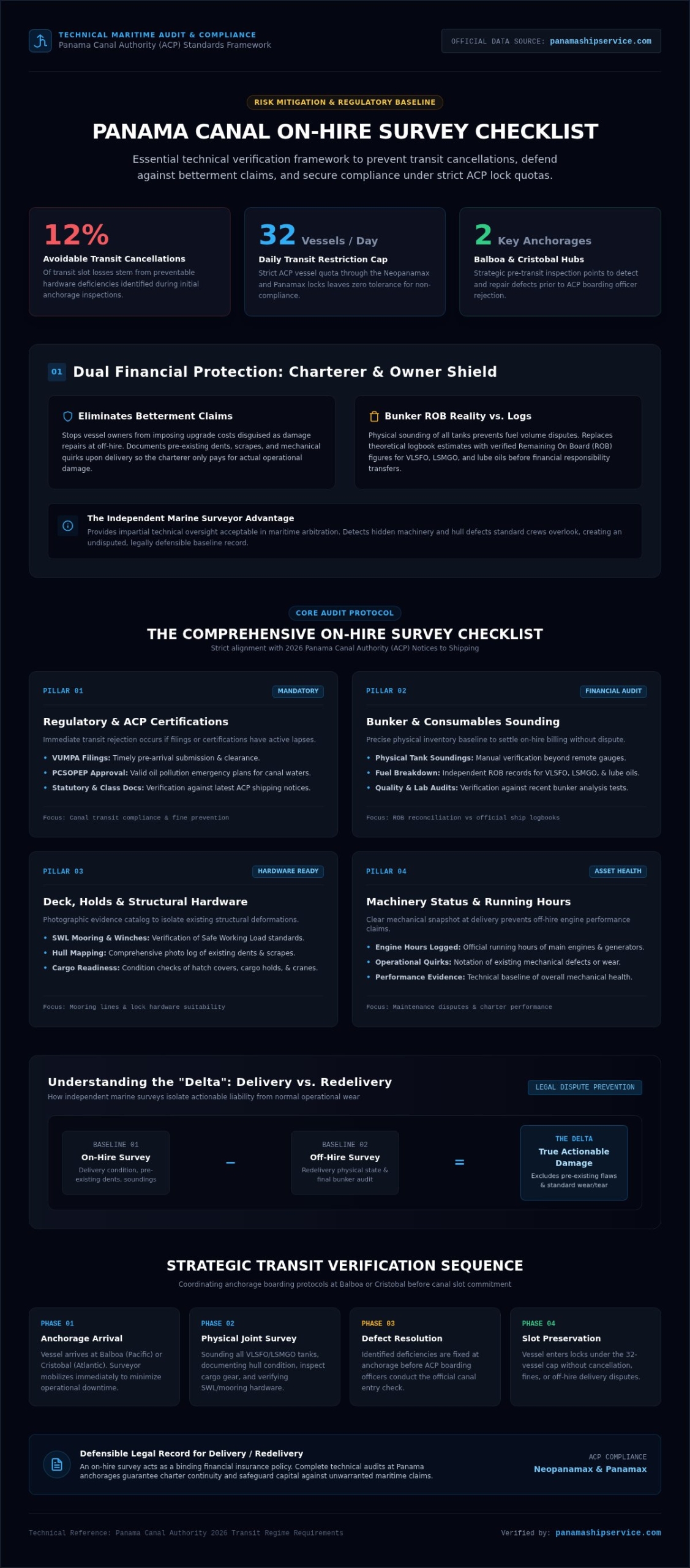
Did you know that up to 12% of avoidable Panama Canal transit cancellations and slot losses stem from preventable hardware deficiencies detected during the initial anchorage inspection? When you’re managing a time charter delivery, the margin for error is non-existent, especially with daily transit caps currently restricted to just 32 vessels. Relying on a generic inspection isn’t enough to protect your capital. You need a rigorous on-hire survey checklist that specifically addresses the high-stakes environment of the Neopanamax and Panamax locks.
We understand the anxiety that comes with hidden vessel defects or the potential for costly bunker quantity disputes. It’s frustrating to face delays because of a non-compliant mooring line or a missing PCSOPEP approval. This guide provides an expert-verified framework to ensure your vessel meets every 2026 ACP requirement, from SWL standards to VUMPA filings. We’ll walk you through the essential technical audits and inventory checks needed to create a legally defensible record of vessel condition. By the end, you’ll have the tools to ensure a seamless transition into your charter period without the threat of unexpected fines or off-hire claims.
Key Takeaways
- Establish a definitive baseline of vessel condition and fuel inventory to prevent legal disputes at the start of your charter.
- Utilize a technical on-hire survey checklist that covers mandatory ACP certifications and precise bunker soundings to ensure regulatory compliance.
- Learn how to quantify the “Delta” between delivery and redelivery to isolate actionable damage from standard wear and tear.
- Streamline your arrival by coordinating anchorage inspections with local experts who understand 2026 Panama Canal Authority boarding protocols.
- Minimize transit delays by identifying and repairing mechanical or structural deficiencies immediately before the vessel commits to a canal slot.
What is an On-Hire Survey and Why is it Critical?
An on-hire survey is a joint physical inspection conducted at the exact moment a vessel is delivered to a charterer. Its core objective is to establish a comprehensive, undisputed baseline of the vessel’s structural condition and the exact quantity of fuel on board (FOB). This document carries immense legal weight; it serves as the primary evidence in Delivery/Redelivery disputes, ensuring that neither party is unfairly penalized for conditions that existed before the charter began. Utilizing a detailed on-hire survey checklist during this phase isn’t just a formality, it’s a financial insurance policy.
The Panama Canal represents the most strategic location for these assessments. Because it serves as a global hub where vessels often change hands or start new charter periods, conducting a survey here minimizes operational downtime. With current ACP daily transit caps restricted to 32 vessels as of September 2026, ensuring your vessel is technically compliant before entering the locks is vital to avoiding costly slot losses. If a defect is found at the Balboa or Cristobal anchorage, it can be addressed before the vessel is rejected by a boarding officer.
Financial Protection for Charterers and Owners
These surveys prevent betterment claims, where an owner might attempt to force a charterer to pay for vessel upgrades under the guise of damage repairs. By documenting every dent, scrape, and mechanical quirk at delivery, the charterer avoids liability for pre-existing issues during the off-hire phase. Accuracy in bunker ROB (Remaining on Board) calculations is equally critical. We sound every tank to ensure fuel billing is based on physical reality rather than theoretical logs, protecting your cash flow from volume discrepancies. This transparent inventory includes VLSFO, LSMGO, and lube oils, leaving no room for inventory disputes.
The Role of the Independent Marine Surveyor
Impartiality is the foundation of a successful joint survey. An independent marine surveyor provides the technical expertise required to identify hidden defects in machinery or hull plating that a standard crew might overlook. Their presence ensures that the final report is accepted by both owners and charterers as an accurate reflection of the ship’s state. The surveyor acts as the unbiased, expert witness who certifies the vessel’s physical and inventory status at the precise moment of delivery. This professional oversight is essential for maintaining the integrity of the on-hire survey checklist and providing a document that stands up to scrutiny in maritime court or arbitration.
The Comprehensive On-Hire Survey Checklist
A rigorous on-hire survey checklist acts as the definitive roadmap for a vessel’s transition into a charterer’s fleet. At the Panama Canal, where operational scrutiny is intense, this list must go beyond basic observations. It requires a systematic verification of the ship’s readiness to meet the stringent standards of the 2026 transit regime. We begin with a deep dive into vessel certification, ensuring all statutory and class documents are not only valid but fully compliant with the latest Panama Canal Authority Notices to Shipping. Any lapse here can lead to immediate transit rejection and significant financial penalties.
Our surveyors conduct a comprehensive visual inspection of the decks, cargo holds, and hatch covers. We record the current status of all machinery, including running hours for main engines and generators. This technical snapshot ensures the charterer understands the exact mechanical health of the asset they are assuming responsibility for, preventing future disputes over maintenance or performance. If you want to ensure your vessel is fully prepared, our team provides professional marine surveys at both ends of the canal.
Bunker and Consumables Inventory
Precision in fuel inventory is the most effective way to avoid delivery disputes. We provide detailed sounding reports for VLSFO, LSMGO, and all critical lubricants. This process involves more than just reading gauges; we verify fuel quality through recent lab analysis reports and compare actual ROB (Remaining on Board) figures against the vessel’s official logbook entries. This identifies any discrepancies in consumption or volume before they become actionable legal issues.
Structural and Deck Condition Assessment
We perform an exhaustive inspection of cargo gear, cranes, and winches to confirm their operational readiness. This section of the on-hire survey checklist relies heavily on photographic evidence. We document every existing hull indentation, scrape, or paint failure to create a permanent record of the vessel’s exterior state. For a complete picture of the ship’s condition, our underwater hull services can supplement this assessment by inspecting the propeller, rudder, and sacrificial anodes below the waterline.
Machinery and Equipment Functionality
A vessel’s safety systems must be beyond reproach. We test emergency fire pumps and life-saving appliances to ensure they function exactly as intended. Our surveyors also review the planned maintenance system (PMS) records to identify any overdue tasks that could compromise performance during the charter. Finally, we assess bridge electronics and navigation equipment, ensuring the ship is ready for the precision maneuvering required within the Panama Canal locks.
On-Hire vs. Off-Hire Surveys: Understanding the Delta
The “Delta” in maritime surveying represents the physical and inventory difference between a vessel’s state at delivery and its condition at redelivery. Identifying this delta is the primary reason for a meticulous on-hire survey checklist. Without a clear baseline, owners and charterers often find themselves locked in expensive arbitration over who is responsible for new structural damage or bunker shortfalls. A consistent methodology between both surveys is vital; if the opening and closing inspections don’t use the same criteria, the comparison is legally vulnerable.
Differentiating between fair wear and tear and actionable damage is where the line is drawn in financial liability. Fair wear and tear includes expected deterioration like minor paint fading or slight surface rust. Actionable damage involves structural deformation, such as dented tank tops or breached hatch seals, that occurred during the charter period. We align our assessments with international vessel inspection and certification standards to ensure every finding is backed by recognized technical benchmarks. This on-hire report functions as your shield, preventing owners from attributing years of previous neglect to your brief charter window.
Common Dispute Areas in Vessel Redelivery
Disagreements often arise regarding speed and performance claims or fuel consumption rates that don’t match the initial sea trial data. Another frequent issue is damage to cargo holds caused by improper stevedoring during loading or discharge operations. If a redelivery survey identifies new structural defects, immediate action is required. We provide comprehensive mechanical ship repairs at the Panama Canal to rectify these issues before the vessel is handed back, minimizing off-hire penalties and ensuring a smooth transition.
The Importance of Photographic Documentation
High-resolution, timestamped imagery is the gold standard for maritime evidence. It’s not enough to simply note a dent; we provide visual proof that includes the scale and location of the defect. Our surveyors focus on high-risk areas like hatch coamings, tank tops, and the bulbous bow. These “before” photos are the only definitive way to prove “after” liability. When a dispute reaches a claims handler, a clear photograph taken during the initial on-hire survey checklist execution is often the deciding factor in settling the case quickly.
Preparing for a Survey at the Panama Canal
Coordinating a survey at the Panama Canal demands a level of logistical precision that matches the complexity of the waterway itself. With daily transit slots currently capped at 32 vessels, the margin for operational delay is zero. Execution of the on-hire survey checklist must align perfectly with the vessel’s VUMPA (Vessel Universal Maritime Pre-Arrival) filing, which is required at least 96 hours before arrival. Timing is everything; surveyors must board at the Balboa or Cristobal anchorages to complete the audit before the ACP boarding officer conducts the official inspection. Any discrepancy found during the survey that isn’t immediately addressed could lead to a lost slot and thousands of dollars in rescheduling fees.
Logistical considerations are paramount when operating in the Pacific or Atlantic entrances. Launch boat services must be secured in advance to ensure the surveyor reaches the vessel without impeding the crew’s pre-transit duties. This isn’t just about ticking boxes; it’s about addressing immediate maintenance needs. If the survey identifies a deficiency in a mooring winch or a hydraulic leak, the vessel needs a partner who can provide rapid mechanical support at the anchorage before the ship enters the locks.
ACP Requirements and Vessel Compliance
The Panama Canal Authority enforces strict “fit for transit” standards that go beyond standard SOLAS requirements. Boarding officers focus heavily on the “1-vessel-length forward” sightline rule for bridge visibility and the condition of pilot boarding equipment. You should consult our guide to marine surveys in Panama to understand the localized regulations that affect your vessel’s specific class and size. For Neopanamax transits, chocks and bitts must meet the mandatory Safe Working Load (SWL) of at least 64 metric tons to withstand the dynamic forces within the new locks.
Master and Chief Engineer Preparation Checklist
To expedite the survey, the Master and Chief Engineer must have all technical documentation organized before the launch boat arrives. The surveyor will require the last three months of logbook entries to verify consumption patterns and maintenance history. All fuel and ballast tanks must be accessible for manual sounding, as physical verification is the only way to resolve potential bunker disputes. The crew must also provide a clean, safe environment in the machinery spaces, ensuring that all emergency fire pumps and life-saving appliances are ready for immediate testing. Don’t leave your transit slot to chance; book your pre-transit survey and repair services today to ensure total compliance.
Why Panama Ship Service for Your On-Hire Survey?
Panama Ship Service operates as a strategic partner at the most critical juncture of your voyage. We maintain a permanent presence at both the Port of Balboa on the Pacific and the Port of Cristobal on the Atlantic. This dual-end positioning allows us to mobilize surveyors immediately, regardless of where your vessel is anchored. Because the canal operates on a non-stop basis, we provide 24/7 availability to match that pace. Our team ensures that your on-hire survey checklist is completed thoroughly without delaying your scheduled transit window. We understand that in the maritime industry, time is capital.
Our integrated service model sets us apart from traditional surveying firms that only provide documentation. We don’t just identify problems; we provide the technical solutions to fix them. Our expertise encompasses both local ACP regulations and international MARPOL standards, ensuring your vessel remains compliant with environmental and operational mandates. By delegating the complexity of the delivery inspection to our seasoned veterans, you simplify your own operations and reduce the risk of administrative penalties. We act as a single point of contact for all technical requirements during your canal transit.
Beyond the Checklist: Technical Support and Repair
If an inspection reveals a critical deficiency, you don’t have time to wait for a third-party contractor. We offer immediate capability for mechanical ship repairs in Panama to resolve defects on-site. Whether it’s a winch failure or a propulsion issue, our technicians can perform afloat repairs at the anchorage. We also provide underwater inspection and cleaning services to verify hull condition or clear fouling before the ACP boarding officer arrives. To further streamline your stay, we coordinate with ship chandlers to deliver essential provisions alongside our technical teams, ensuring your crew has everything they need for the next leg of the journey.
Minimizing Downtime During Your Transit
Our primary focus is the reduction of overhead and the optimization of your schedule. We understand that a missed canal slot is a massive financial liability, especially under the current 32-transit daily cap. Our reporting process is designed for speed and accuracy; you receive the final on-hire survey checklist results in hours, not days. This rapid turnaround allows you to make informed decisions about your charter delivery in real-time. We provide the technical proficiency needed to protect your interests in a high-pressure environment. Contact us today for a marine survey quote and secure your vessel’s transit success.
Securing Your Charter Interests in the Panama Canal
Protecting your capital during a vessel delivery requires more than just a cursory glance at the deck. A rigorous on-hire survey checklist is your primary defense against unfair damage claims and bunker inventory discrepancies. By establishing a definitive technical baseline, you ensure that liability remains where it belongs while maintaining compliance with the strict 2026 ACP transit requirements. Precise documentation at the anchorage prevents costly disputes during redelivery and keeps your schedule on track.
Panama Ship Service provides the specialized expertise needed to navigate these high-stakes transitions. Our expert ACP-compliant surveyors operate 24/7 at both Balboa and Cristobal anchorages, providing rapid results that match the canal’s operational pace. We offer a unique, integrated model where survey findings can be immediately addressed through mechanical repairs or MARPOL disposal services. We don’t just report defects; we resolve them. Secure your vessel’s interests with a professional on-hire survey from Panama Ship Service today. We look forward to ensuring your next transit is seamless and financially protected.
Frequently Asked Questions
What is the difference between an on-hire and off-hire survey?
An on-hire survey occurs at the start of a charter period to document the vessel’s condition and fuel levels. An off-hire survey happens at the end of the contract. The primary purpose of comparing these two reports is to identify any new damage or fuel discrepancies that occurred while the charterer had control of the ship. This comparison helps both parties settle financial liabilities for repairs or bunker consumption fairly.
Who typically pays for the on-hire survey in a charter agreement?
The responsibility for payment is typically defined in the charter party agreement, such as the NYPE or BIMCO forms. In most cases, the cost is shared equally between the owner and the charterer because the on-hire survey checklist serves as a neutral record for both sides. However, some agreements may specify that the party delivering the vessel pays for the on-hire, while the party redelivering pays for the off-hire inspection.
How long does a standard on-hire survey take to complete?
A standard on-hire survey usually takes between four and eight hours to complete. This timeframe depends on the vessel’s size, the number of fuel tanks to be sounded, and the accessibility of cargo holds. At the Panama Canal, we focus on high-speed execution to ensure the audit is finished before your scheduled transit slot. Our surveyors work efficiently at the Balboa or Cristobal anchorages to provide a rapid turnaround for busy ship operators.
Can a bunker survey be conducted separately from the condition survey?
Yes, a bunker survey can be conducted as a standalone service, but it’s rarely recommended. Most operators prefer to combine it with a condition survey to ensure a complete technical snapshot of the vessel at delivery. Integrating these services is more cost-effective and provides a comprehensive assessment that covers both physical integrity and fuel inventory. This unified approach simplifies the documentation process and reduces the total time surveyors spend on board the vessel.
What happens if the on-hire survey reveals major vessel defects?
If an inspection reveals major defects, the charterer may have the right to delay delivery or request immediate repairs. This is why our integrated service model is so valuable. If our surveyors find mechanical or structural issues that could lead to a Panama Canal transit rejection, we can immediately mobilize our team for mechanical ship repairs. This proactive approach ensures the vessel becomes compliant quickly, protecting the interests of both the owner and the charterer.
Is an on-hire survey mandatory for Panama Canal transits?
While an on-hire survey isn’t a legal requirement mandated by the Panama Canal Authority, it is a commercial necessity. ACP boarding officers conduct their own rigorous inspections before allowing transit. If your vessel doesn’t meet their safety and technical standards, you risk losing your slot. Conducting a professional survey at the anchorage ensures you identify and fix potential compliance issues before the official ACP boarding officer arrives on the ship.
What documents should the Master have ready for the surveyor?
The Master should have all statutory and class certificates, the last three months of deck and engine logbooks, and recent bunker delivery notes ready. Providing accurate sounding records for all fuel and ballast tanks is also essential for a smooth inspection. Having these documents organized allows the surveyor to verify maintenance history and inventory levels quickly. This preparation is a key part of ensuring the on-hire survey checklist is completed without unnecessary delays.
How does the Panama Canal Authority (ACP) influence survey requirements?
The Panama Canal Authority sets the technical benchmarks that our surveyors use during the inspection. These requirements include specific safe working loads for mooring hardware and bridge visibility standards that are unique to the waterway. Our surveyors are experts in these localized ACP regulations, ensuring that every condition assessment accounts for the specific “fit for transit” criteria. This localized knowledge prevents administrative penalties and keeps your vessel moving through the locks safely.