
A single day of unscheduled downtime at the Panama Canal can cost a vessel owner upwards of $50,000 in lost revenue and additional port fees. This staggering financial risk is why a professional turbocharger overhaul and repair is a strategic necessity rather than a simple maintenance choice. You already know that maintaining engine efficiency is vital, especially with the 2026 enforcement of stricter Carbon Intensity Indicator (CII) regulations. A poorly maintained turbocharger leads to high fuel consumption and increases the risk of catastrophic engine failure during your most critical transit windows.
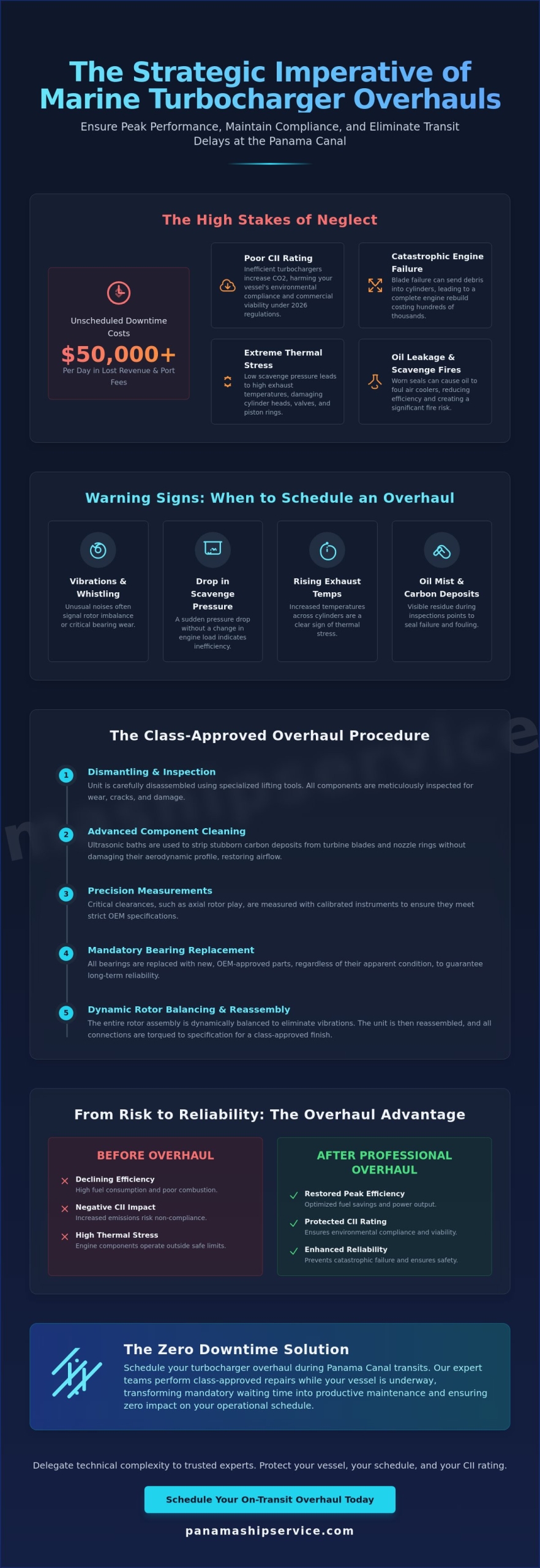
Discover the technical requirements, strategic timing, and expert procedures for marine turbocharger overhauls to ensure your vessel maintains peak performance and avoids transit delays. We’ll outline how to achieve a successful class-approved overhaul that restores engine efficiency and protects your CII rating. This guide previews the essential steps to manage complex mechanical repairs with zero impact on your Panama Canal transit schedule, allowing you to delegate technical complexity to trusted experts while you focus on your operational goals.
Key Takeaways
- Understand how turbocharger efficiency directly impacts fuel savings and your vessel’s Carbon Intensity Indicator (CII) rating under 2026 regulations.
- Learn why a professional turbocharger overhaul and repair requires precise axial clearance measurements and mandatory bearing replacements to ensure long-term reliability.
- Identify strategic opportunities to schedule mechanical ship repairs during Panama Canal transits to minimize operational downtime.
- Discover how advanced cleaning techniques and rotor balancing restore engine scavenging air pressure and reduce thermal stress on engine components.
The Critical Role of Turbocharger Maintenance in Marine Propulsion
The turbocharger is the primary driver of marine engine performance. It’s responsible for forcing extra air into the combustion chamber, allowing for higher fuel efficiency and greater power output. When this component operates at peak performance, it maintains the precise air-to-fuel ratio required for complete combustion. However, even minor wear on the turbine blades or compressor wheel disrupts this balance. A comprehensive understanding of Turbocharger components and principles helps technical managers recognize how mechanical degradation directly translates to higher operational costs.
Choosing to neglect a scheduled turbocharger overhaul and repair often leads to emergency situations that disrupt transit schedules. Beyond the immediate risk of surging, where pressure fluctuations cause the compressor to stall, there is the threat of oil leakage into the air coolers. This fouling reduces heat transfer efficiency and increases the risk of scavenge fires. By adhering to manufacturer-recommended service intervals, you ensure that engine components remain within safe thermal limits. When scavenging air pressure drops, exhaust gas temperatures skyrocket, putting extreme stress on cylinder heads, exhaust valves, and piston rings.
Implementing a rigorous turbocharger overhaul and repair schedule is the most effective way to safeguard your propulsion system. Reactive repairs after a failure are significantly more expensive than proactive maintenance, especially when considering the potential for catastrophic blade failure. Total mechanical failure doesn’t just stop the engine; it can send debris into the cylinders, leading to a complete engine rebuild that costs hundreds of thousands of dollars.
Signs Your Turbocharger Requires Immediate Attention
Vessel crews must stay vigilant for specific indicators of decline. Unusual vibrations or high-pitched whistling sounds often signal rotor imbalance or bearing wear. These acoustic signatures shouldn’t be ignored. You should also monitor:
- Sudden drops in scavenge air pressure without changes in engine load.
- Rising exhaust gas temperatures across all cylinders.
- Visible oil mist or heavy carbon deposits during routine inspections of the blower and turbine sides.
Turbocharger Health and Environmental Compliance
Modern shipping operates under strict environmental mandates. Efficient turbocharging is essential for meeting IMO Tier II and III NOx emission standards by ensuring lean and complete combustion. It’s also a critical factor in your vessel’s Carbon Intensity Indicator (CII) rating. A well-maintained system keeps CO2 emissions within acceptable limits, protecting your commercial viability. Some industry professionals report that a 5% drop in turbo efficiency can increase fuel costs significantly. Optimized air supply is the foundation of a sustainable and profitable voyage.
The Technical Procedure for Professional Turbocharger Overhauling
A professional turbocharger overhaul and repair follows a standardized, class-approved sequence to ensure the unit returns to original equipment manufacturer (OEM) performance levels. This isn’t a task for general maintenance crews. It requires specialized workshop facilities and calibrated instrumentation to handle the high-precision tolerances involved in modern marine propulsion. The process begins with dismantling the unit and securing the rotor assembly using specialized lifting tools designed to prevent any lateral stress on the shaft journals.
Once the unit is disassembled, the focus shifts to restoring component surfaces. Advanced cleaning is essential because hardened carbon deposits can’t be removed by simple brushing without risking damage to the turbine’s aerodynamic profile. While chemical degreasing is effective for removing loose oil and sludge, technicians use ultrasonic baths for the nozzle ring and turbine blades. This method utilizes high-frequency sound waves to create cavitation bubbles that strip away stubborn deposits without compromising the metal’s integrity. It’s a critical step that ensures the scavenging air flows through the engine without unnecessary turbulence.
Dismantling and Component Cleaning
Safe removal of the turbine housing and air filter silencer is the foundation of a successful overhaul. Technicians must meticulously remove carbon deposits from the nozzle ring and shroud area, as these are the primary zones where buildup occurs. During this phase, protecting the shaft journals and labyrinth seals is paramount. Any scratches or abrasions on these surfaces during the cleaning process will lead to premature bearing failure or oil leaks once the unit is returned to service.
Inspection and Non-Destructive Testing (NDT)
After cleaning, every part undergoes a rigorous inspection for erosion, cracks, or foreign object damage (FOD). Visual checks aren’t enough for high-speed rotating components. Dye penetrant testing is the industry standard for detecting microscopic fatigue in turbine blades, which face extreme centrifugal forces and thermal cycling. Technicians also check the integrity of the labyrinth seal air lines and casing to prevent future oil contamination of the air supply. If your vessel requires expert oversight for these critical checks, coordinating mechanical ship repairs ensures that every measurement meets strict class standards.
The most critical phase of the overhaul is dynamic balancing. Even a minor imbalance at operational speeds of 20,000 RPM or higher can cause catastrophic failure. The rotor assembly is placed on a balancing machine where technicians add or remove weight with surgical precision to meet manufacturer specifications. Finally, the unit is reassembled with new gaskets and lock washers before undergoing final testing to ensure it’s ready for the high-pressure environment of a Panama Canal transit.
Precision Measurements and Bearing Replacement Standards
Precision engineering defines the success of a turbocharger overhaul and repair. It’s not just about cleaning components; it’s about adhering to microscopic tolerances that ensure the unit survives extreme thermal loads. Technical managers must prioritize these measurements because even a fraction of a millimeter determines whether a unit operates for another 10,000 hours or fails within days. The commercial risk of ignoring these clearances includes catastrophic engine damage and the resulting fines for blocking transit lanes, which can reach $15,000 for a single mechanical oversight.
Recording and certifying every measurement is a non-negotiable requirement for class approval. Whether your vessel is under Lloyd’s Register, DNV, or another society, they require documented proof that the unit meets OEM specifications. These records also serve as vital evidence for insurance providers. Without certified measurement reports, you risk the denial of claims related to propulsion failure. We ensure every axial and radial measurement is logged and verified before the unit leaves the workshop.
Understanding Critical Clearances
The K-value is the most critical metric in turbocharger maintenance. It represents the axial clearance between the rotor and the bearing. If this value is incorrect, the rotor can make contact with the casing under high-load conditions. Thermal expansion causes metal components to grow during operation; therefore, the “cold” clearances set during reassembly must account for this expansion. Technicians also measure L and M values, which define the radial clearances between the impeller and the casing. Tight clearances are essential for maintaining scavenging air pressure and keeping fuel consumption low.
Bearing and Lubrication System Maintenance
Bearings are the most vulnerable components in any high-speed rotating machine. You shouldn’t wait for visible wear or abnormal vibration to schedule a replacement. Standard industry practice dictates replacing ball or roller bearings as a complete set based on running hours, typically between 8,000 and 12,000 hours. Replacing only one side is a false economy that leads to rotor imbalance and premature failure. During this phase, we also perform the following checks:
- Inspection of lubricating oil discs to ensure consistent oil delivery to the shaft.
- Clearing suction pipes and delivery lines of any hardened carbon or sludge.
- Verifying the condition of the oil sump and drain plugs to prevent leaks.
- Testing the integrity of the oil pumps to ensure they meet required flow rates.
A well-maintained lubrication system is the only thing standing between a smooth voyage and a seized rotor. By replacing bearings proactively and verifying every clearance, you protect the engine’s integrity and ensure your vessel remains compliant with all Panama Canal safety regulations.
Strategic Overhauls: Minimizing Downtime at the Panama Canal
The Panama Canal is more than a transit point; it’s a strategic hub for technical intervention. For ship owners, the mandatory waiting periods before transit offer a unique window to conduct a professional turbocharger overhaul and repair without adding days to the voyage. Since vessels must submit a pre-arrival notification at least 96 hours before arrival, this lead time allows for the precise coordination of technicians and spare parts. Utilizing this anchorage time for maintenance transforms unavoidable idle hours into a productive investment in vessel efficiency.
Failing to address mechanical issues before entering the locks carries extreme risks. The Panama Canal Authority (ACP) maintains strict standards for vessel readiness. If a turbocharger fails or underperforms during transit, the vessel risks being slapped with a “not ready for transit” status. This doesn’t just result in a $15,000 fine; it can lead to the loss of your scheduled slot and significant tugboat assistance fees. By scheduling repairs in Panama, you ensure the propulsion system is fully optimized for the high-load maneuvers required during the transit process.
Synchronizing Repairs with Canal Transit
Efficiency in the canal zone depends on flawless logistics. Planning your maintenance to coincide with the mechanical ship repairs panama schedule ensures that technicians are ready as soon as the vessel reaches the Atlantic or Pacific anchorage. We manage all logistics between the ports of Balboa and Cristobal, providing a seamless service regardless of your transit direction. Our teams work around the clock to ensure the overhaul is completed within the vessel’s window, allowing you to meet your scheduled slot without delay.
Emergency Turbocharger Repairs in Panama
When unexpected failures occur near the canal, rapid response is the only way to prevent a total logistical breakdown. Our emergency protocols are designed to handle heavy component transport within the complex canal zone, overcoming the hurdles of restricted access and tight security. We ensure that all emergency work meets the standards required for marine surveys panama and class approval. This comprehensive approach guarantees that even an emergency turbocharger overhaul and repair provides the long-term reliability your engine needs for the remainder of its voyage.
Don’t leave your transit schedule to chance by delaying critical maintenance. If you’re approaching the canal and require expert technical support, contact Panama Ship Service to coordinate your mechanical repairs and safeguard your schedule.
Comprehensive Turbocharger Solutions by Panama Ship Service
Panama Ship Service positions itself as your primary technical partner at the crossroads of global trade. We understand that managing multiple vendors during a tight transit window creates an unnecessary administrative burden. By delegating your turbocharger overhaul and repair to our specialized teams, you gain access to a systematic approach that prioritizes both mechanical integrity and fiscal responsibility. Our operations in both Balboa and Cristobal ensure that your vessel receives expert attention regardless of its position in the canal queue. We focus on tangible business outcomes, ensuring that every technical intervention contributes to lower overhead and optimized schedules.
Our commitment to efficiency means we don’t just fix parts; we restore operational certainty. Our technicians are seasoned veterans who recognize the specific operational pressures of the Panama Canal. We provide a calm, expert presence in high-pressure environments, allowing you to focus on your voyage while we handle the complexities of mechanical ship repairs. This proactive approach minimizes the risk of unexpected delays and ensures your engine operates at peak efficiency.
Our Mechanical Repair Capabilities
We maintain a full suite of specialized tools required for high-precision work, including calibrated instrumentation for dynamic balancing and axial clearance measurements. Our teams have extensive experience with major brands like MAN, ABB, Mitsubishi, and Napier turbocharger systems. We don’t rely on guesswork. Every turbocharger overhaul and repair we perform is backed by comprehensive reporting and documentation. This data is essential for maintaining your vessel’s history and ensuring seamless class compliance during your next marine survey. We provide the technical proof that your propulsion system meets the highest industry standards.
Consolidated Maritime Services in Panama
One of our most significant advantages is our ability to offer one-stop-shop integration. We can easily coordinate your turbocharger maintenance with underwater hull services to maximize your time at anchorage. This consolidated model reduces the need for multiple service boats and simplifies your logistics. Additionally, we handle all MARPOL-compliant waste management during our operations, ensuring your vessel stays environmentally compliant without extra effort from your crew. Our goal is to handle every task without unnecessary complication.
Restoring your engine’s efficiency and protecting your transit schedule starts with a reliable partner. Our teams are ready to respond to your technical needs with the proficiency and speed your business requires. Contact Panama Ship Service today for a direct ship repair quote and experience a more efficient way to manage your vessel’s maintenance in Panama.
Safeguard Your Vessel’s Efficiency and Transit Schedule
Maintaining a high-performance propulsion system is essential for navigating the regulatory and logistical demands of modern shipping. You’ve seen how precise measurements and scheduled maintenance directly influence your vessel’s fuel economy and Carbon Intensity Indicator (CII) ratings. By choosing a strategic location like Panama for your next turbocharger overhaul and repair, you eliminate the risk of transit delays while ensuring your engine meets strict class-approved standards. Proactive technical intervention remains the most effective way to avoid the high costs of unscheduled downtime and regulatory fines.
Panama Ship Service provides a consolidated model that handles technical complexity so you can focus on your operational goals. We offer 24/7 emergency response in both Balboa and Cristobal, ensuring expert technicians are always available to protect your schedule. This integrated approach allows you to combine mechanical repairs with other essential maritime services, maximizing your time at anchorage. Don’t wait for a mechanical failure or a “not ready for transit” status to disrupt your voyage. We’re here to ensure your vessel remains a reliable asset in your fleet.
Request a Professional Turbocharger Repair Quote in Panama today. We’re ready to restore your vessel’s peak performance with proficiency and reliability.
Frequently Asked Questions
How often should a marine turbocharger be overhauled?
Manufacturers recommend a full turbocharger overhaul and repair every 8,000 to 16,000 running hours. This timeline varies based on the specific engine type and operating conditions. Adhering to these intervals prevents excessive thermal load on engine components and maintains fuel efficiency. Regular maintenance is a proactive strategy to avoid the high costs of emergency repairs and unscheduled downtime during critical transit windows.
What are the primary causes of turbocharger surging?
Turbocharger surging is primarily caused by fouled air filters, carbon buildup on nozzle rings, or sudden fluctuations in engine load. These conditions create a pressure imbalance that forces air back through the compressor. This disruption leads to audible “panting” or high-pitched acoustic signatures. If left unaddressed, persistent surging causes extreme mechanical stress on the rotor shaft and bearings, eventually leading to catastrophic component failure.
Can a turbocharger be repaired while the vessel is in the Panama Canal?
Yes, turbocharger repairs are strategically conducted while vessels are at the Atlantic or Pacific anchorages. Most ship owners schedule this work during the mandatory waiting period before their canal transit slot. Our teams operate in both Balboa and Cristobal to ensure the overhaul is completed without impacting the voyage schedule. This approach utilizes unavoidable idle time to restore engine efficiency and ensure compliance with Panama Canal Authority standards.
What is the significance of the “K-value” during a turbo overhaul?
The K-value is the critical measurement of axial clearance between the rotor and the bearing. It ensures that the rotating assembly has enough space to expand as temperatures rise during full-load operation. If the K-value falls outside of manufacturer specifications, the rotor may contact the casing. This results in immediate mechanical damage and severe vibration. Technicians record these values meticulously to provide documented proof of class compliance.
Is dynamic balancing necessary after every turbocharger repair?
Dynamic balancing is a mandatory requirement after every turbocharger overhaul and repair involving rotor disassembly. Even a microscopic weight imbalance can cause destructive vibrations at operational speeds exceeding 20,000 RPM. Technicians use specialized balancing machines to ensure the rotor assembly meets OEM tolerances. This process is the only way to guarantee long-term bearing reliability and prevent premature wear on the shaft journals and labyrinth seals.
What happens if a turbocharger fails during a canal transit?
A turbocharger failure during transit results in the vessel being declared “not ready for transit” by the Panama Canal Authority. This status leads to immediate fines of approximately $15,000 and the loss of your scheduled transit slot. You’ll also incur significant costs for mandatory tugboat assistance to move the vessel to a safe anchorage. These delays often result in total downtime costs exceeding $50,000 per day in lost revenue.
Does Panama Ship Service provide class-approved repair reports?
Yes, we provide comprehensive technical reports that meet the requirements of all major classification societies. These documents include detailed records of all axial and radial clearances, dynamic balancing results, and NDT findings. This documentation is vital for your vessel’s permanent history and simplifies future marine surveys. Providing certified proof of maintenance also protects your interests during insurance claims or when demonstrating compliance with environmental regulations.
How long does a typical marine turbocharger overhaul take?
A typical marine turbocharger overhaul is completed within 8 to 24 hours. This timeframe includes dismantling, cleaning, inspection, balancing, and reassembly. Because our teams are localized in Panama, we can often complete these services during a standard port call or while the vessel is at anchorage. Rapid turnaround times are essential for minimizing impact on the transit schedule while ensuring the propulsion system returns to peak performance levels.