
For a Neo-Panamax operator, a single day of forfeited transit due to a technical deficiency can cost upwards of $65,000. When your vessel’s integrity is questioned, securing a professional underwater hull damage assessment panama becomes the only way to protect your schedule. The Panama Canal Authority (ACP) operates on strict timelines, and a failed inspection at the Balboa or Cristobal anchorages doesn’t just delay one ship; it disrupts an entire global supply chain.
We understand that coordinating class surveyors and technical divers while facing the 96-hour VUMPA submission deadline is an immense operational burden. You shouldn’t have to manage these technical complexities alone while risking heavy fines or transit denial. This guide outlines how to navigate the Risk-Based Vessel Inspection Model (RBVIM) and obtain a class-approved damage report that satisfies the Board of Inspectors. You’ll learn how to streamline your underwater surveys, meet the latest 2026 regulatory requirements for CCTV documentation, and ensure your vessel moves through the canal without unnecessary downtime.
Key Takeaways
- Understand the Panama Canal Authority’s safety requirements to prevent transit slot forfeiture and avoid significant financial penalties.
- Execute a comprehensive underwater hull damage assessment panama using high-definition CCTV feeds and visual reconnaissance for immediate class surveyor approval.
- Navigate the 2026 VUMPA and RBVIM regulatory updates to ensure your vessel meets the latest digital and physical inspection standards.
- Integrate damage evaluations with rapid repair planning at Balboa or Cristobal anchorages to maintain your schedule and minimize operational delays.
- Optimize technical operations by consolidating surveys, mechanical repairs, and supplies into a single, efficient service window.
The Critical Role of Underwater Hull Damage Assessment in Panama
An underwater hull damage assessment panama is a comprehensive subsea evaluation designed to verify the structural integrity, coating condition, and mechanical functionality of a vessel. This technical procedure isn’t just a routine check; it’s a critical gatekeeping event. The Panama Canal Authority (ACP) mandates verified hull integrity before granting transit safety clearance. If a vessel shows signs of damage or compromised seaworthiness, the ACP has the absolute authority to deny entry. This makes the assessment your first line of defense against operational failure.
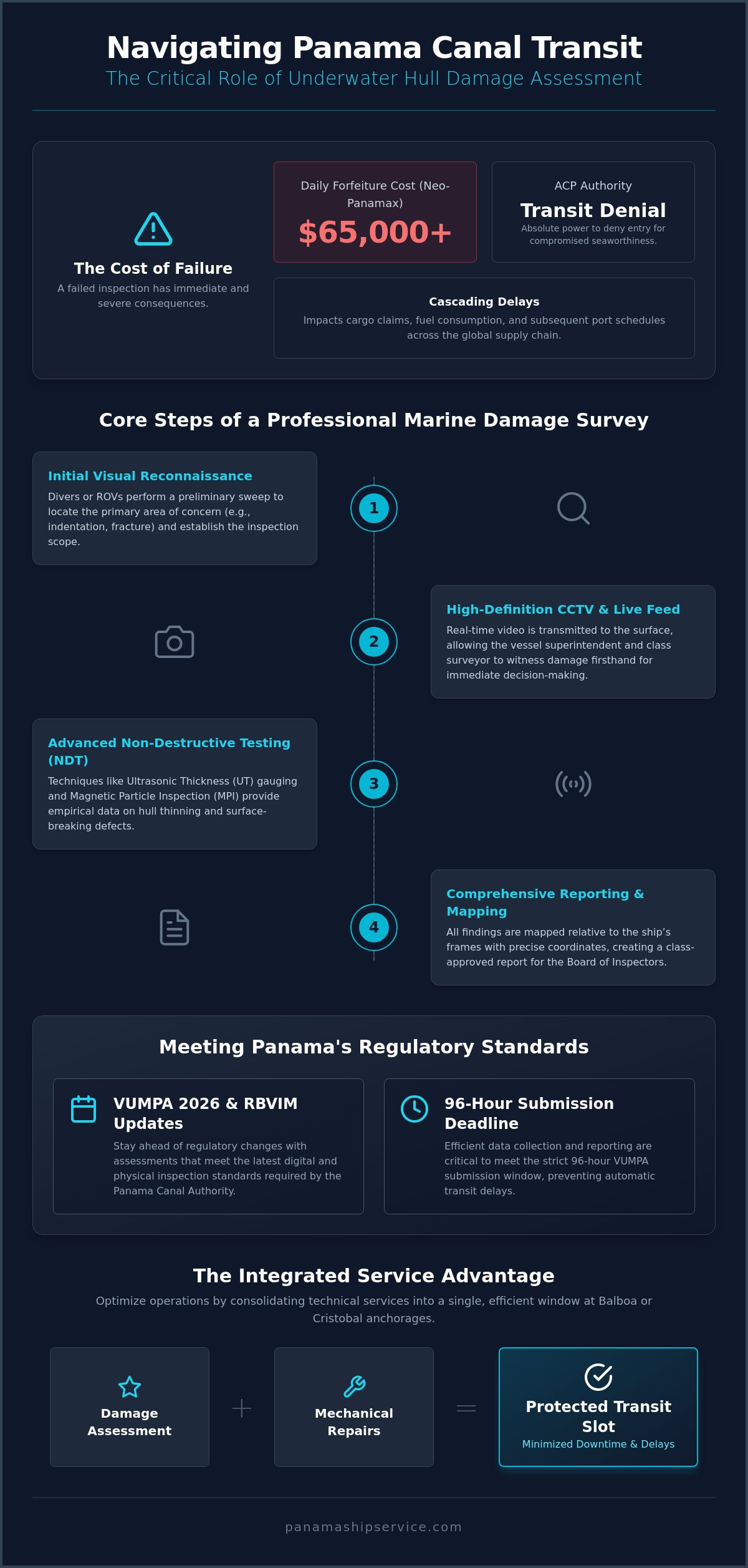
The economic consequences of a failed transit are severe. For a Neopanamax vessel, losing a transit slot can result in costs exceeding $65,000 per day in forfeiture fees alone. This doesn’t account for the “cascading delay” that affects cargo claims, fuel consumption, and subsequent port schedules. Adopting a “Transit-First” mindset is essential. We focus the assessment on determining if the ship can safely complete the 8 to 12 hour canal passage, prioritizing immediate seaworthiness to keep your vessel moving.
Identifying Subsurface Structural Risks
Divers must identify impact damage from groundings, collisions, or heavy weather encountered during the approach to the Isthmus. Often, fatigue in weld seams or plate transitions remains hidden to the naked eye. A professional underwater survey utilizes high-resolution imaging to detect these anomalies before they become catastrophic. Biofouling also presents a significant challenge; heavy growth can obscure cracks or indentations. Pre-cleaning is often required to ensure the divers have a clear view of the structural members during the inspection process.
Panama’s Unique Regulatory Bottleneck
The Balboa and Cristobal anchorages serve as the primary zones for these critical evaluations. Because the ACP monitors these areas closely, any suspected damage must be addressed before the vessel reaches the locks. The Board of Inspectors (BI) requires clear, actionable data to grant clearance. If the assessment reveals issues that require immediate intervention, coordinating with mechanical ship repairs is the next logical step. Having a partner who can transition from inspection to repair within the same anchorage window is the only way to protect your slot and avoid the high cost of a dry-docking diversion.
Technical Framework: Core Steps of a Professional Marine Damage Survey
A structured underwater hull damage assessment panama follows a strict technical hierarchy to ensure data accuracy for both class surveyors and the Canal Authority. The process begins with initial visual reconnaissance. Divers or ROVs conduct a preliminary sweep to locate the primary area of concern, such as an indentation, fracture, or suspected grounding site. This phase establishes the scope of the detailed inspection, allowing the team to focus resources on critical structural zones. High-definition CCTV and photography then provide real-time feeds to the surface. This allows the vessel superintendent to witness the damage firsthand, facilitating immediate decision-making without waiting for post-dive debriefs.
The technical depth of the survey relies on Non-Destructive Testing (NDT) to look beyond surface-level aesthetics. Once the data is captured, comprehensive reporting maps every finding relative to the ship’s frames. Precise coordinate mapping is vital for determining if a defect falls within a high-stress region of the hull. For operators managing tight schedules, choosing a partner for consolidated underwater hull services ensures that these technical steps lead directly to a class-approved resolution that protects your transit window.
Advanced NDT Inspection Techniques
Ultrasonic Thickness (UT) gauging is the primary tool for determining if hull thinning exceeds class-allowable limits. By measuring the remaining plate thickness, we provide the empirical data required to justify continued operation or mandate a repair. For weld seams, Magnetic Particle Inspection (MPI) identifies surface-breaking defects that are invisible under standard lighting. Subsurface delamination refers to the internal separation of material layers within the hull plating or rudder assembly, and it’s detectable only through specialized NDT equipment. Implementing a professional underwater hull damage assessment panama ensures that these hidden fatigue points don’t lead to a structural failure during the canal transit.
CCTV and Digital Documentation Standards
The ACP Board of Inspectors maintains rigorous standards for digital evidence. They require clear, unedited video feeds that prove the vessel’s condition meets the VUMPA 2026 and RBVIM Standards for in-water safety. Diver-held cameras are typically preferred for complex rudder or propeller inspections where maneuverability is restricted. In contrast, ROV-mounted systems offer stability for long-range hull scans. Securing high-resolution imagery isn’t just about canal compliance; it provides the essential evidence needed for insurance recovery and P&I club documentation. Detailed visual records protect the owner’s interests by documenting the exact extent of damage at the moment of discovery.
Regulatory Compliance: VUMPA 2026 and RBVIM Standards
The transition to the Risk-Based Vessel Inspection Model (RBVIM) marks a significant change in how the ACP manages canal safety. Since January 1, 2026, the authority uses a predictive algorithm to evaluate vessel risk before arrival. If your ship’s profile triggers a physical inspection, an underwater hull damage assessment panama provides the verifiable data required to clear the RBVIM queue. This system rewards modern fleets with strong compliance histories while focusing physical resources on higher-risk transits.
VUMPA 2026 updates have removed all flexibility from the documentation process. All technical data must be uploaded to the Maritime Service Portal at least 96 hours before arrival. There’s no grace period for late submissions; missing this deadline results in automatic slot forfeiture. These protocols align with the Panama Canal Authority Vessel Requirements, which dictate the structural standards every ship must meet. Additionally, any assessment must respect Panama’s strict biofouling protocols to prevent the introduction of invasive species, requiring divers to work within environmental constraints while capturing damage data.
The ACP Board of Inspectors (BI) Process
The ACP Board of Inspectors (BI) is the final decision-maker for every transit. They review the underwater hull damage assessment panama to issue the essential ‘Permission to Transit.’ If defects are found but deemed manageable, the BI might grant a ‘Conditional Transit.’ This status usually requires the vessel to accept speed restrictions or pay for additional tug assistance. Presenting technical data effectively to the BI is a specialized task. By integrating this data into broader marine surveys in Panama, operators ensure that their technical reports satisfy both the Canal Authority and IACS class requirements like ABS or DNV.
Integrating Assessment with Maintenance and Repair Planning
Successful management of a technical deficiency requires a seamless transition from data collection to operational action. An underwater hull damage assessment panama should never be a standalone event; it’s the foundation of your repair strategy. This process follows a logical four-step progression to ensure your vessel remains compliant and seaworthy. First, we conduct the immediate damage assessment and safety verification to establish the baseline condition. Second, we perform targeted spot-cleaning to expose structural members, allowing for the close-up inspection required by class surveyors. Third, we calculate the ‘Repair vs. Transit’ feasibility, determining if a defect can safely wait for the next scheduled dry-dock or if immediate intervention is mandatory. Finally, if the Canal Authority denies transit, we execute emergency measures such as underwater welding or coffer dam installations to restore integrity within the anchorage window.
This integrated approach allows technical superintendents to make high-stakes decisions based on empirical evidence rather than guesswork. By centralizing these tasks, you eliminate the friction of managing separate diving and repair contractors. If you’re facing a suspected hull breach or mechanical failure, you can contact our technical team to initiate a consolidated assessment and repair plan immediately.
Synchronizing Cleaning and Damage Assessment
Treating cleaning and inspection as separate silos is a common mistake that leads to redundant diving costs. We recommend that underwater hull services be performed concurrently with the survey. Biofouling often masks stress fractures and impact points, making it impossible to gauge the true extent of damage without removing marine growth. Beyond visibility, addressing fouling during the inspection provides a performance boost for the transit itself. Propeller polishing, for instance, can be completed while the diver is already positioned at the stern for a rudder inspection, maximizing the value of every hour spent at the Balboa or Cristobal anchorages.
Transitioning to Emergency Underwater Repairs
When the underwater hull damage assessment panama reveals a “no-go” condition for the locks, the focus must shift instantly to stabilization. Assessment data is used to design specific wet-welding procedures or temporary plugs that meet ACP safety standards. This window is also the ideal time to replace spent sacrificial anodes (zincs) to maintain cathodic protection without requiring a second deployment. For complex issues involving internal systems, our divers coordinate with mechanical ship repairs in Panama to address engine-side or sea-chest problems discovered during the subsea survey. This consolidated workflow ensures that technical intervention happens exactly where and when it’s needed, protecting your transit schedule from further erosion.
Minimizing Downtime with Panama Ship Service
Operational efficiency at the Isthmus isn’t just about technical skill; it’s about logistical consolidation. When a vessel requires an underwater hull damage assessment panama, the clock is already working against the operator. Managing multiple vendors for diving, repairs, and supplies creates administrative friction that often leads to missed transit windows. We provide a “One-Stop-Shop” advantage by consolidating these technical requirements into a single anchorage window. This approach ensures that your damage assessment, mechanical repairs, and MARPOL disposal panama needs are handled by a single point of contact, significantly reducing the burden on your shore-side team.
Time is the most expensive commodity in the canal environment. Our 24/7 emergency response teams are stationed for rapid deployment to both Balboa and Cristobal anchorages. We don’t just provide data; we act as a local authority liaison. With decades of experience communicating technical findings to the ACP Board of Inspectors, we know exactly how to present a report to facilitate a quick “Permission to Transit.” This proactive communication style transforms a complex technical crisis into a manageable operational step, allowing you to focus on the broader voyage while we handle the local complexities.
Consolidating Technical Needs at the Isthmus
The strategic value of an anchorage stop increases when you can address multiple needs simultaneously. While our divers conduct the underwater hull damage assessment panama, we can coordinate the delivery of ship supplies at the Panama Canal. This synchronized workflow allows for provisions, spare parts, and crew changes to occur alongside technical diving operations. By stacking these services, you minimize the time spent at anchor and reduce cumulative port fees and agency overhead. It’s a pragmatic solution for busy professionals who need to optimize every hour of their vessel’s schedule.
Why Experience Matters in the Canal Environment
Panama’s anchorages present unique challenges, including shifting currents and variable visibility that can hinder less experienced diving teams. Our divers are seasoned veterans who understand these local conditions, ensuring that inspections are thorough even in high-pressure scenarios. We maintain a proven track record with major classification societies and P&I clubs, providing the high-level documentation they require for claim processing and safety certification. You don’t have to navigate these technical and regulatory bottlenecks alone. Contact Panama Ship Service for an immediate underwater hull damage assessment and secure your transit slot with confidence.
Protect Your Transit Schedule with Technical Precision
Securing a successful Panama Canal passage requires more than just timely documentation; it demands technical certainty. As the ACP implements the Risk-Based Vessel Inspection Model, your vessel’s physical profile must be beyond reproach. A professional underwater hull damage assessment panama provides the empirical evidence needed to satisfy the Board of Inspectors and protect your operational budget from the high cost of slot forfeiture. By consolidating technical surveys with rapid repair planning at Balboa or Cristobal, you eliminate the friction of managing multiple contractors under pressure.
We provide the specialized expertise required to navigate these regulatory bottlenecks. Our teams are ACP Board of Inspectors protocol experts, offering 24/7 emergency diving and repair services alongside consolidated technical and operational support. Don’t let a technical deficiency derail your global supply chain. Take control of your vessel’s compliance status today and ensure a seamless transit through the Isthmus.
Secure Your Transit Slot with Expert Hull Damage Assessment
Frequently Asked Questions
How long does a standard underwater hull damage assessment take in Panama?
A standard inspection typically requires 4 to 8 hours of diving time at the Balboa or Cristobal anchorages. This duration depends on the vessel’s size and the complexity of the suspected damage. We prioritize efficiency to ensure the final report is delivered before your scheduled transit window, minimizing any potential for slot delays.
Can the ACP deny my transit based solely on an underwater inspection report?
The ACP Board of Inspectors has the authority to deny transit if an underwater hull damage assessment panama reveals structural compromises that threaten canal safety. If the report indicates a risk of sinking, mechanical failure, or oil leakage, the vessel must undergo repairs. We help mitigate this risk by providing clear technical data and immediate repair solutions to satisfy the inspectors.
Is underwater welding considered a permanent repair by most classification societies?
Classification societies generally categorize underwater wet-welding as a temporary or provisional repair. While these repairs are technically sound for canal transit and immediate seaworthiness, class usually mandates a permanent “dry” repair at the next scheduled dry-docking. Our goal is to secure a “condition of class” that allows you to continue your voyage without an expensive immediate deviation.
What is the difference between a commercial damage survey and a Class-approved survey?
A commercial survey provides an internal assessment for the owner, while a Class-approved survey requires the presence of an IACS surveyor. Class-approved surveys follow rigorous NDT protocols and frame-relative mapping to satisfy international safety standards. We coordinate directly with surveyors from ABS, DNV, and Lloyd’s to ensure the data captured is technically recognized by all stakeholders.
Do I need to clear the hull of biofouling before a damage assessment can be performed?
Spot-cleaning is necessary to expose the hull plating and weld seams for an accurate evaluation. Biofouling can hide cracks, indentations, and fatigue points from the diver’s camera, leading to an inconclusive report. We perform localized cleaning as part of the underwater hull damage assessment panama to ensure every structural anomaly is documented for the Board of Inspectors.
Are underwater assessments in Panama permitted while the vessel is at the inner anchorage?
Most assessments occur at the Balboa or Cristobal merchant anchorages rather than the inner anchorage. Conducting diving operations within the canal prism or inner zones requires specific, prior authorization from the ACP due to traffic and safety concerns. We manage these permits and logistics to ensure the dive team is deployed at the most efficient location for your schedule.
What specific documentation does the ACP Board of Inspectors require for damage verification?
The Board of Inspectors requires high-definition CCTV footage, clear still photographs, and detailed NDT thickness gauging reports. Under the 2026 VUMPA updates, this digital evidence must be unedited and submitted through the Maritime Service Portal no later than 96 hours before arrival. Our technical reports are structured specifically to meet these ACP criteria, facilitating a faster transit decision.
Can Panama Ship Service provide NDT thickness gauging during a routine transit stop?
We provide NDT ultrasonic thickness gauging as a standard service during any anchorage call. This allows you to verify hull integrity or monitor known thinning areas without disrupting your transit timeline. Our technicians use calibrated equipment to provide immediate, on-site data that satisfies both the owner’s operational requirements and classification society standards.