
For any vessel approaching the Panama Canal, efficiency is paramount and delays are costly. Spiraling fuel costs from hull fouling, the constant pressure of complex biofouling regulations, and the risk of undetected damage can turn a standard transit into a significant operational and financial challenge. This is where expert underwater hull services become mission-critical. A clean, well-maintained, and properly inspected hull is not just an advantage; it’s a necessity for predictable performance and profitability in one of the world’s busiest waterways.
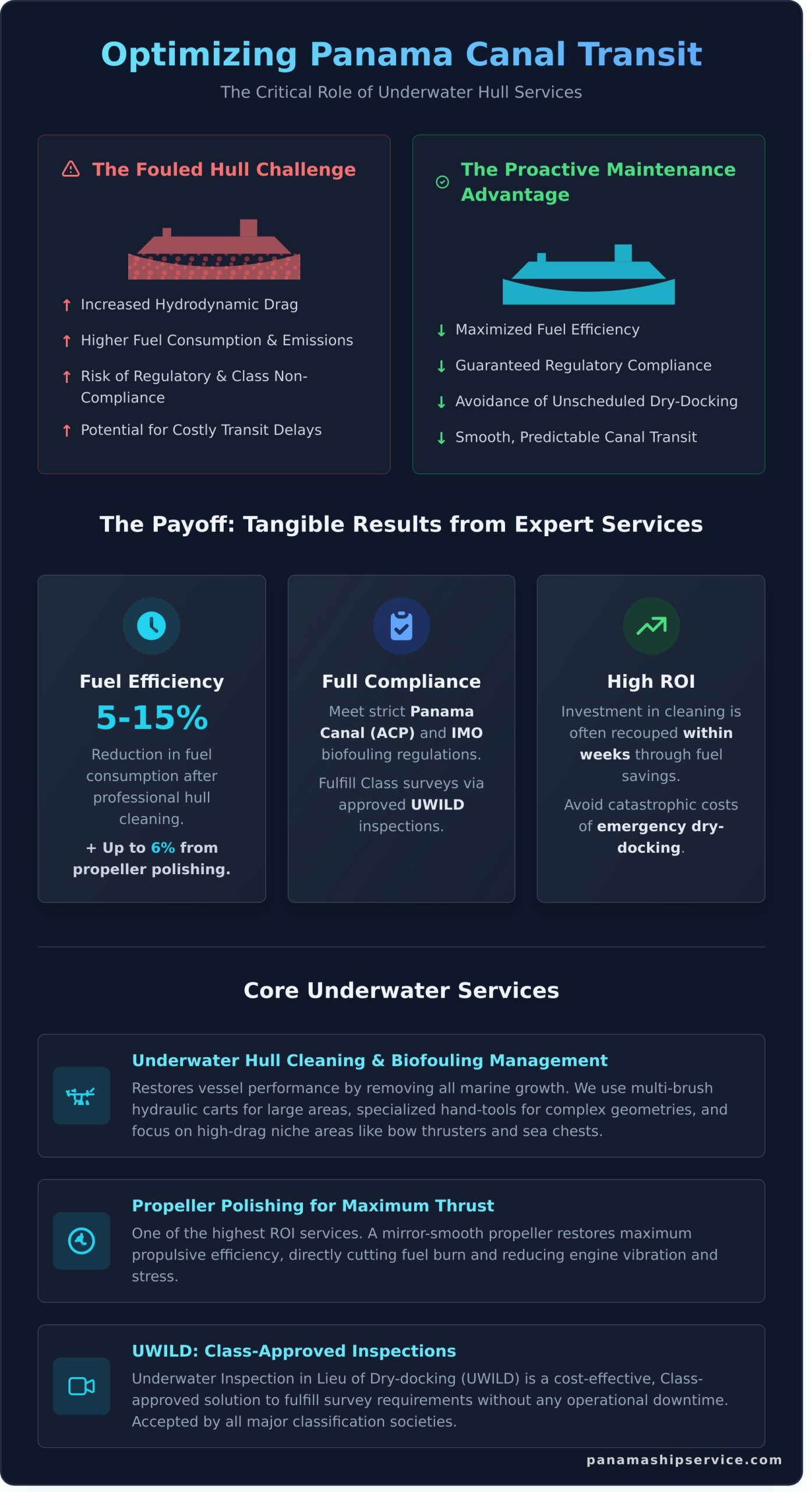
This guide provides the essential knowledge ship owners, operators, and charterers need to navigate these challenges successfully. We will break down every critical underwater service available in Panama-from proactive hull cleaning and propeller polishing to class-approved Underwater Inspections in Lieu of Dry-docking (UWILD). You will gain a clear understanding of how to leverage these expert solutions to maximize your vessel’s fuel efficiency, maintain regulatory compliance, and ensure a smooth, timely transit, all while avoiding costly unscheduled repairs and downtime.
The Critical Role of Underwater Hull Maintenance for Canal Transit
For any vessel preparing for Panama Canal transit, where timing and efficiency are paramount, the condition of its hull is a critical operational and financial lever. A fouled hull is a direct liability, increasing costs, elevating emissions, and risking costly delays. Proactive hull maintenance is your first line of defense against these challenges. Utilizing expert underwater hull services is a strategic, cost-conscious alternative to dry-docking, ensuring your vessel operates at peak performance when it matters most.
Impact on Fuel Efficiency and Emissions
The primary operational drain from a fouled hull is increased hydrodynamic drag. As marine organisms accumulate on the hull surface-a process you can learn more about by understanding what is biofouling-they create resistance that forces the engine to work harder to maintain speed. Industry data consistently shows that a professional hull cleaning can reduce fuel consumption by 5-15%. In an era of stringent IMO regulations like EEXI and CII, this efficiency is non-negotiable for compliance. High-impact services like propeller polishing directly restore propulsive efficiency, providing one of the fastest returns on investment by cutting fuel burn and emissions.
Ensuring Regulatory and Class Compliance
Beyond fuel savings, a well-maintained hull is essential for regulatory compliance. Port authorities worldwide, including the Panama Canal Authority (ACP), enforce strict biofouling management regulations to prevent the transfer of invasive aquatic species. Furthermore, regular inspections are critical for maintaining Class and P&I insurance coverage. We provide certified Underwater Inspections in Lieu of Dry-docking (UWILD), a cost-effective solution accepted by all major classification societies to fulfill survey requirements without disrupting your operational schedule.
The Cost of Neglect vs. Proactive Servicing
The financial case for proactive maintenance is clear and compelling. The investment in a single, professional hull cleaning is often recouped within weeks through direct fuel savings. Contrast this manageable expense with the catastrophic costs and delays of an emergency dry-docking required to fix a problem that could have been identified and solved in the water. Regular servicing also protects and extends the life of expensive anti-fouling coatings. Ultimately, investing in scheduled underwater hull services is not a cost center; it is a high-ROI operational strategy that safeguards your profitability and schedule.
Core Service: Underwater Hull Cleaning and Biofouling Management
Biofouling-the accumulation of marine organisms on a vessel’s hull-is a primary cause of increased operational costs. This process begins with a simple slime layer and progresses to complex communities of algae, barnacles, and tubeworms. Each stage increases hydrodynamic drag, forcing engines to work harder and burn more fuel. Professional in-water hull cleaning is the most efficient solution to combat this, restoring vessel performance and optimizing fuel consumption before a critical canal transit.
Our expert underwater hull services utilize specialized equipment far superior to simple scrubbing, ensuring a thorough clean without damaging expensive coatings. This proactive maintenance is a direct investment in operational efficiency.
Hull Cleaning Technologies and Methods
We employ a multi-faceted approach for comprehensive cleaning. Large, flat areas of the hull are efficiently cleaned using multi-brush hydraulic carts that provide consistent pressure and coverage. For curved sections, bilge keels, and other complex geometries, our divers use specialized hand-held tools. We calibrate our equipment for either gentle or aggressive cleaning, allowing us to remove stubborn growth while preserving the integrity of your vessel’s anti-fouling system. Initial inspections are often conducted with ROVs to accurately assess the scope of fouling.
Niche Area Cleaning: The Hidden Drag
The most significant sources of drag are often hidden in niche areas. Fouling on bow thrusters, rudders, propellers, and inside sea chests can severely impact performance. A fouled sea chest, for instance, can starve main engines of essential cooling water, creating a critical operational risk. Our divers are trained to meticulously clean these complex areas, ensuring all grates, tunnels, and blades are free of marine growth. This detailed work is essential for eliminating hidden drag and maximizing vessel efficiency.
Environmental Standards for Cleaning in Panama
Operating responsibly is non-negotiable. Our cleaning methods are designed to be environmentally friendly and fully compliant with all local regulations at the Balboa and Cristobal anchorages. We ensure our processes align with global best practices, such as the IMO Biofouling Guidelines, to prevent damage to anti-fouling coatings and minimize environmental impact. By choosing a professional service, you protect both your vessel and the sensitive marine ecosystem. Get a quote for compliant hull cleaning in Panama.
Performance Tuning: Propeller Polishing for Maximum Thrust
For ship owners and operators focused on cost-conscious operations, propeller polishing offers one of the highest returns on investment of any maintenance task. A clean, smooth propeller is the key to unlocking maximum propulsive efficiency, directly impacting fuel consumption and engine performance. Even minor marine growth or surface roughness can disrupt the hydrodynamic flow over the blades, forcing the engine to work harder and burn more fuel to maintain speed. Our expert propeller polishing is a critical component of proactive underwater hull services, designed to restore performance and minimize operational expenses.
Why a Smooth Propeller is a Fuel-Efficient Propeller
Surface roughness, whether from marine fouling or cavitation pitting, creates drag and turbulence. This disruption robs the propeller of its efficiency, reducing thrust and demanding higher RPMs to achieve the same vessel speed. This translates directly to increased fuel costs. Regular, professional polishing can yield significant fuel savings-often up to 6%-while also reducing vibration. A smoother operation minimizes stress and wear on the entire propulsion system, from the engine to the shaft seals, extending the life of critical machinery.
The Rupert Scale: Grading Propeller Condition
We provide quantifiable results, not just promises. Our divers use the Rupert Roughness Comparator Scale, the internationally recognized industry standard for grading a propeller’s surface condition. This scale ranges from Grade F (heavy fouling and calcification) to Grade A (a mirror-like, hydrodynamically smooth finish). Our objective for every polishing job is to restore your propeller blades to a verifiable Grade A condition. This commitment to a measurable standard demonstrates our technical expertise and guarantees a quality result.
The Multi-Stage Polishing Process
Our qualified divers execute a meticulous, multi-stage process to achieve a flawless finish without compromising the propeller’s precise geometry. The procedure includes:
- Initial Video Inspection: We begin with a detailed underwater video survey to assess the current condition and document any damage. This initial documentation aligns with the rigorous standards outlined in official vessel inspection regulations, providing a clear baseline.
- Progressive Polishing: Using specialized hydraulic equipment, our teams work through a series of progressively finer abrasive pads to systematically remove all fouling and smooth the blade surfaces.
- Final Verification: Upon completion, a final video inspection is conducted to confirm a uniform, Grade A finish across all blades, providing you with tangible proof of the work performed.
This expert process, a cornerstone of our underwater hull services, ensures your vessel departs with its propulsion system tuned for maximum efficiency and fuel economy.
Underwater Surveys and Inspections: Your Eyes Below the Waterline
Proactive vessel management and regulatory compliance depend on a clear understanding of your hull’s condition. Waiting for a scheduled dry-docking to identify potential issues is an inefficient and costly strategy. Our expert underwater hull services provide a crucial alternative, utilizing high-definition CCTV and Remotely Operated Vehicles (ROVs) to deliver clear, actionable data without disrupting your schedule. These inspections range from general condition assessments to official Class-approved surveys, offering a time and cost-effective solution compared to the shipyard.
UWILD: The Smart Alternative to Dry-Docking
An Underwater Inspection in Lieu of Dry-docking (UWILD) is a specialized survey that satisfies classification society requirements, allowing you to postpone mandatory dry-dock visits. This directly translates to significant savings by avoiding off-hire time and expensive shipyard costs. Our qualified teams provide live video feeds, enabling your superintendents and Class surveyors to witness the inspection in real-time from anywhere in the world. We are approved by all major IACS members, including:
- American Bureau of Shipping (ABS)
- DNV
- Lloyd’s Register (LR)
- Bureau Veritas (BV)
Hull Condition and Damage Assessment
Our comprehensive hull inspections provide a detailed assessment of your vessel’s submerged areas. Expert divers meticulously document coating condition, levels of marine fouling, and signs of corrosion. We identify any structural damage-such as cracks, dents, or buckling-and thoroughly examine critical appendages like the rudder, propeller, and sea chests for integrity issues. Following the inspection, you receive a detailed report with high-resolution photos and video evidence to support maintenance planning.
Pre-Purchase and Charter Surveys
Before committing to a purchase or long-term charter, an underwater survey is an essential part of due diligence. This inspection provides an unbiased assessment of the vessel’s true condition below the waterline, uncovering potential liabilities not visible from the deck. This critical information gives buyers and charterers powerful negotiating leverage and prevents costly post-transaction surprises. Don’t leave a multi-million dollar investment to chance. Schedule a pre-transit inspection at the Panama Canal.
In-Water Repairs: Rapid Solutions to Keep You Sailing
Unexpected damage or wear discovered during an inspection doesn’t have to mean a costly diversion to dry-dock. Panama Ship Service provides rapid and effective in-water repairs, allowing many common issues to be resolved directly at the Panama Canal anchorage. This efficient approach minimizes downtime, protects your schedule, and keeps your vessel moving. By integrating inspection and repair, we offer a seamless, one-stop solution for all your underwater needs.
Underwater Welding and Hull Repair
Our certified welder-divers perform Class-approved permanent and temporary hull repairs. Using specialized cofferdams to create a dry, hyperbaric environment, we can execute permanent shell plating insert repairs that meet the highest standards. For more urgent situations, we can install temporary patches to ensure the vessel’s safe passage to its next port of call. All work is conducted by qualified professionals, ensuring structural integrity and compliance.
Propeller and Rudder Maintenance
Minor damage to your propulsion and steering systems can lead to major failures. Our underwater teams address these issues proactively. Services include:
- Minor propeller repairs, including edge straightening and grinding out cracks.
- Rope guard repair or complete replacement to prevent entanglement.
- Underwater replacement and sealing of rudder plugs to maintain system integrity.
These expert services prevent small problems from escalating, saving significant time and expense down the line.
Anode Replacement and Sealing
Protecting your hull from galvanic corrosion is a critical maintenance task. Our teams specialize in the underwater replacement of sacrificial anodes, welding new units directly onto the hull to restore your vessel’s cathodic protection system. We also provide expert underwater sealing for stern tubes and overboard discharges, preventing leaks and ensuring environmental compliance. This is a vital part of our comprehensive underwater hull services for long-term vessel integrity.
From initial inspection to final repair, Panama Ship Service is your trusted partner at the Panama Canal. Our ability to deliver a full suite of Class-approved repairs at anchorage makes us the efficient, cost-conscious choice for owners and charterers. For expert solutions that keep you sailing, contact our team today.
Your Trusted Partner for Underwater Operations in Panama
Navigating the Panama Canal demands peak vessel efficiency and regulatory compliance. From critical hull cleaning and biofouling management to performance-boosting propeller polishing and essential in-water surveys, proactive maintenance is not an expense-it is a crucial investment in a seamless, profitable transit. It ensures your vessel is prepared for the challenges of this vital waterway.
At Panama Ship Service, we provide the comprehensive underwater hull services your vessel requires to maintain optimal condition. With decades of experience, our team of certified welder-divers and technicians is equipped for any challenge, offering Class-Approved UWILD surveys and 24/7 rapid response at both Canal anchorages to minimize downtime and protect your assets.
Do not let submerged issues compromise your schedule or budget. Put your vessel’s performance in the hands of proven experts. Contact Our Team for Expert Underwater Services in Panama and ensure your transit is smooth and efficient.
Frequently Asked Questions
How often should a commercial vessel’s hull be cleaned?
The optimal cleaning frequency depends on factors like trading routes, water temperature, and coating condition. For most vessels, a full cleaning is recommended every 6 to 12 months to combat heavy biofouling. However, we advocate for proactive hull grooming at shorter intervals. This approach maintains a smooth surface, significantly improves fuel efficiency, and extends the life of your anti-fouling paint, offering a more cost-conscious solution to maintain peak performance between dry-dockings.
Is underwater hull cleaning permitted at the Panama Canal anchorages?
Yes, underwater hull cleaning is permitted at designated Panama Canal anchorages, but it is strictly regulated by the Panama Canal Authority (ACP). Operations must be performed by an ACP-approved company using certified equipment to prevent environmental contamination. As your trusted partner at the Canal, we ensure all our underwater hull services are fully compliant with local regulations, guaranteeing a smooth, penalty-free operation for your vessel prior to transit.
What is the difference between hull cleaning and hull grooming?
Hull cleaning is a reactive service designed to remove significant biofouling that has already accumulated and is often more abrasive. In contrast, hull grooming is a proactive, preventative maintenance strategy. It involves frequent, light cleanings using soft brushes to remove the early-stage slime layer before it develops into hard fouling. Grooming is gentler on anti-fouling coatings, maintains optimal vessel performance continuously, and proves more cost-effective over the vessel’s operational lifetime.
Can our ship superintendent watch the UWILD survey live from shore?
Absolutely. We provide a secure, high-definition live video feed of the entire UWILD survey directly to your ship superintendent or technical team ashore. This system includes clear, two-way audio communication with our dive supervisor. This real-time monitoring allows for immediate feedback, on-the-spot decision-making, and complete transparency. Our solution eliminates the need for travel, saving significant time and expense while ensuring your key personnel are fully involved in the inspection process.
What certifications do your diver-technicians hold?
Our diver-technicians are highly qualified professionals, holding certifications from all major IACS classification societies, including ABS, DNV, Lloyd’s Register, and Bureau Veritas. Each team member possesses commercial diving certifications compliant with international standards such as ADCI (Association of Diving Contractors International). This ensures that every inspection, repair, and maintenance task we undertake is performed with the highest level of expertise and in full accordance with Class requirements for safety and quality.
How long does a typical propeller polishing service take at anchorage?
A standard propeller polishing service at anchorage is an efficient operation typically completed within 3 to 5 hours. The exact duration depends on the propeller’s size, the number of blades, and the extent of marine growth. Our experienced teams are equipped to perform a Rupert Scale Grade A polish rapidly and safely, minimizing vessel downtime. This quick intervention restores propeller efficiency, leading to immediate fuel savings and improved vessel performance for your transit.
Is it safe to perform underwater welding on a fully loaded vessel?
Yes, it is entirely safe when executed by certified professionals using approved procedures. For permanent shell plating repairs on a fully loaded vessel, we utilize custom-fabricated cofferdams. These create a dry, atmospheric-pressure work environment around the repair area, allowing for Class-approved welding to be performed to the highest standards. Our expert teams ensure all safety and structural integrity protocols are rigorously followed, guaranteeing a secure and durable repair without disrupting cargo operations.