
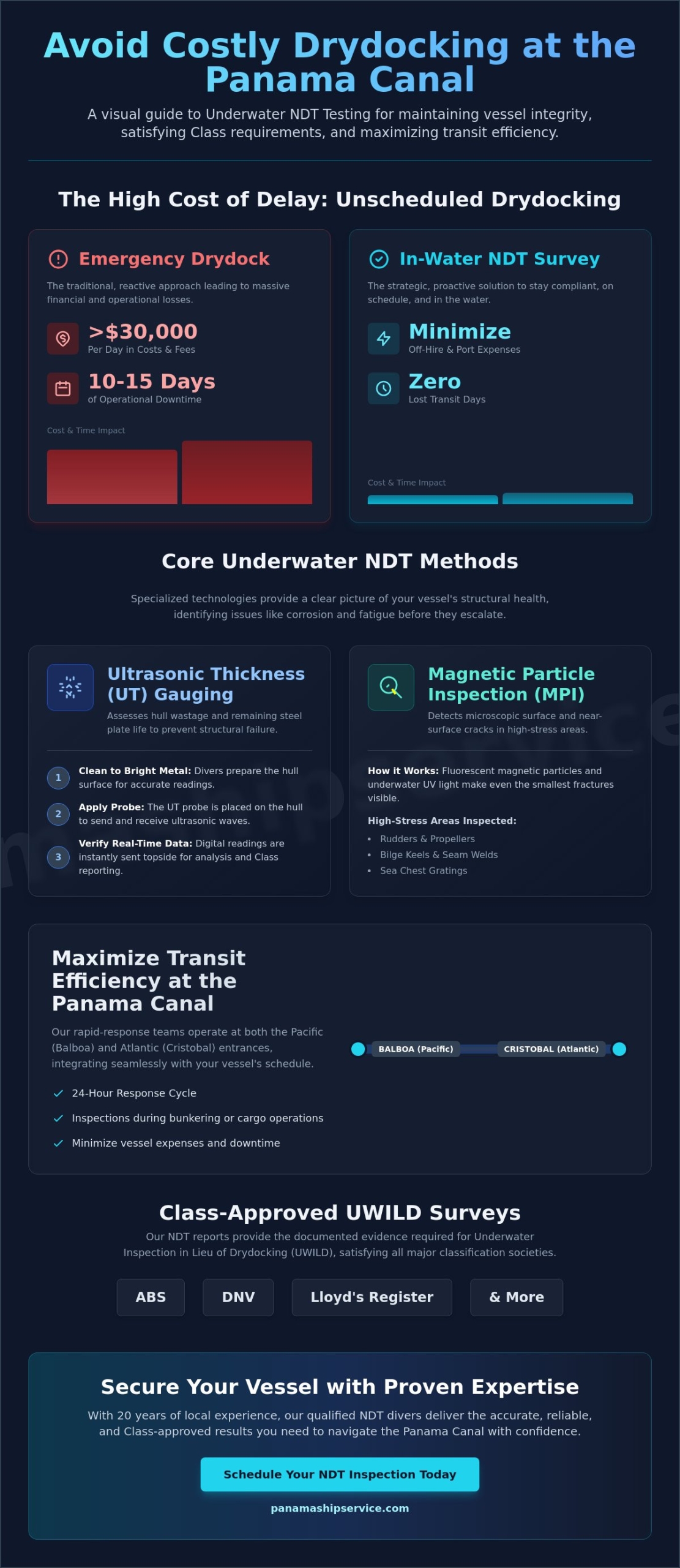
An unscheduled drydocking can inflate your operational costs by more than $30,000 per day in off-hire fees and port expenses. You already know that every hour spent waiting at the Balboa or Cristobal anchorages is an hour of lost revenue. The pressure from Class societies to complete mandatory UWILD surveys often arrives at the most inconvenient times, creating a bottleneck for your fleet. Our specialized underwater NDT testing panama services provide the technical data you need to satisfy inspectors while your vessel remains in the water and on its route.
We recognize that you need absolute certainty regarding hull thickness and weld integrity to avoid catastrophic failures during a transit. This guide shows you how to leverage advanced non-destructive testing to maintain your schedule and obtain Class-approved thickness gauging reports. We will break down the specific technologies used to identify potential structural issues before they become emergencies. By the end, you’ll see how to secure vessel integrity and compliance without the financial burden of an unplanned drydock stay.
Key Takeaways
- Learn how to maintain vessel integrity and satisfy Class requirements without the prohibitive costs and delays of emergency drydocking.
- Understand the specific technical applications of underwater NDT testing panama, including how UT and MPI methods identify hull thinning and structural cracks early.
- Discover the essential criteria for a successful Underwater Inspection in Lieu of Drydocking (UWILD) to keep your vessel compliant with major societies like ABS and DNV.
- Identify the direct operational benefits of conducting specialized inspections at the Panama Canal to maximize transit efficiency and minimize downtime.
- Gain insights into why 20 years of local expertise and qualified NDT divers are vital for securing accurate, reliable, and Class-approved results.
Understanding Underwater NDT Testing at the Panama Canal
In the high-stakes maritime industry, maintaining structural integrity is a constant challenge for ship owners. Nondestructive testing (NDT) is the essential process of evaluating a vessel’s hull and components without causing any damage or permanent alterations to the material. When performed subsea, this technology allows for a deep analysis of steel thickness, weld quality, and structural health while the ship remains afloat. For vessels traversing the 50-mile stretch of the Panama Canal, underwater NDT testing panama services aren’t just a maintenance choice; they’re a strategic necessity to ensure safe passage and regulatory compliance.
The Panama Canal serves as a global bottleneck where timing is everything. Misjudging your vessel’s condition can lead to sudden detentions or forced deviations. Moving from reactive repairs to proactive hull integrity management saves hundreds of thousands of dollars in emergency costs. Instead of facing the difficult and frustrating environment of an unscheduled drydocking, which can cost a vessel 10 to 15 days of operational time, NDT provides immediate, actionable data. We are experts so you don’t have to be, ensuring your ship stays on schedule through one of the world’s most critical transit points.
The Role of NDT in Modern Maritime Maintenance
NDT identifies sub-surface flaws that are invisible to the naked eye during a standard visual dive. By using ultrasonic thickness (UT) measurements and magnetic particle inspection (MPI), technicians detect fatigue cracks and corrosion before they lead to structural failure. This level of precision is vital for maintaining weld integrity on hulls that endure the stresses of ocean crossings. These inspections are a core requirement for comprehensive underwater hull services in Panama, providing the documented evidence needed for class societies like ABS, Lloyd’s Register, or DNV.
Why Timing Matters in Panama
Operational efficiency depends on coordinating inspections within narrow Canal transit windows. A delay of just 6 hours in the Balboa or Cristobal anchorages can ripple through a fleet’s entire schedule, leading to significant lost revenue. Our teams provide rapid response capabilities at both the Pacific and Atlantic entrances, ensuring that underwater NDT testing panama is completed during scheduled bunkering or cargo operations. We focus on a 24-hour response cycle to minimize vessel expenses and provide the cost-conscious solutions that modern ship owners demand.
Core Underwater NDT Methods for Vessel Inspections
Ship owners transiting the Panama Canal face strict regulatory requirements and tight schedules. Implementing professional underwater NDT testing panama ensures your vessel meets Class standards without the need for expensive dry-docking. We use a suite of specialized non-destructive testing (NDT) methods to provide a clear picture of your ship’s structural health while it remains in the water. This proactive approach identifies issues like corrosion and fatigue before they lead to structural failure or detention by port authorities.
Ultrasonic Thickness (UT) Gauging Deep-Dive
Ultrasonic Thickness (UT) gauging is the primary method for assessing hull wastage and determining the remaining life of steel plates. The process begins with our divers cleaning the inspection areas to “bright metal” using hydraulic grinding tools. This step is critical because any marine growth or heavy scale will distort the ultrasonic signal. Once the surface is prepared, the diver applies the probe to the hull. Digital readings are transmitted to topside technicians in real-time, allowing for immediate data verification. This instant communication ensures that if a thin spot is detected, we can expand the inspection grid immediately to map the extent of the wastage. It’s an efficient way to satisfy Class requirements for mandatory thickness measurements during intermediate and special surveys.
Magnetic Particle & Crack Detection
Detecting surface and near-surface cracks is essential for maintaining the integrity of high-stress components. We focus MPI efforts on rudders, bilge keels, and sea chest gratings where fatigue is most likely to occur. Our technicians use fluorescent magnetic particles and specialized underwater ultraviolet lighting to make even microscopic fractures visible to the naked eye. This method is particularly effective for inspecting welds. Detailed technical reports on underwater NDT techniques for hull welds confirm that MPI is the most reliable way to ensure weld quality in the challenging underwater environment. MPI is essential after an impact or grounding incident to confirm that the hull’s structural “backbone” remains intact.
Precision Testing and Visual Verification
Eddy Current Testing (ECT) offers a high-precision alternative for conductive materials. It’s often used when we need to inspect through specialized coatings without stripping them away. This saves time and preserves the vessel’s corrosion protection. Supporting all these technical methods is Visual Testing (VT) via high-definition CCTV. We record every inspection in HD, providing a live feed to the surface where Class surveyors can review the findings as they happen. This transparency eliminates guesswork. If your vessel is approaching its next survey window, you can request a technical consultation to determine which NDT methods are required for your specific hull type and age. We are experts so you don’t have to be. Our goal is to provide the data you need to keep your vessel moving safely through the canal.
Class Approvals and UWILD Requirements
Drydocking represents the most significant maintenance expense for any ship owner. To mitigate these costs, Class societies like ABS, Lloyd’s Register, DNV, and Bureau Veritas allow for a UWILD (Underwater Inspection in Lieu of Drydocking). This protocol permits vessels to stay in the water for extended periods, provided the hull’s integrity is verified through rigorous underwater NDT testing panama. Compliance isn’t optional; it’s the baseline for operational safety. Technicians must hold ASNT or PCN Level II certifications to ensure the data collected meets international standards. For vessels operating under American jurisdiction, the U.S. UWILD Regulations specify the exact conditions under which an underwater survey can replace a physical drydocking. We ensure your marine surveys in Panama align perfectly with these regulatory frameworks.
Acceptance of In-Water Results
Class surveyors only accept data that’s verifiable and repeatable. They look for specific criteria before signing off on a hull’s condition. This includes the use of calibrated ultrasonic thickness (UT) meters and magnetic particle inspection (MPI) kits that have been serviced within the last 12 months. Divers must provide a clear, two-way communication link and a high-resolution live video feed so the surveyor can direct the inspection in real time. Panama Ship Service acts as the expert so you don’t have to be. We manage the entire liaison with the Class surveyor, ensuring every measurement is recorded according to their specific manual. Our team understands the nuances between different society requirements, which prevents costly reinspections.
Documentation and Reporting Standards
A professional NDT report is more than just a list of numbers. It’s a comprehensive technical document that includes high-resolution photography, precise measurements, and detailed location maps of the hull. We treat our reporting with the same level of precision you’d expect from a Deratting Certificate or a formal bunker survey. Every finding is logged digitally to allow for long-term hull condition monitoring. This data helps you track corrosion rates over 5 or 10 years, making it easier to predict when repairs will become necessary. Our reports provide:
- CCTV footage of all sea chests and gratings.
- Anodic potential measurements to verify cathodic protection.
- Close-up photos of any identified weld defects or plate thinning.
- Clear mapping of the underwater NDT testing panama results against the ship’s framing plan.
This level of detail ensures your vessel’s records are impeccable for the next port state control inspection.
Operational Benefits: Cost Savings and Transit Efficiency
Ship owners operate on razor-thin margins where time is the most expensive commodity. A single day of unscheduled downtime can cost a Panamax vessel upwards of $50,000 in lost charter hire and port fees. Utilizing underwater NDT testing panama provides a clear picture of hull integrity without the $20,000 to $50,000 daily fees often associated with emergency drydocking berths. While a drydocking event requires weeks of preparation and significant deviation from trade routes, NDT inspections occur at anchorage during your scheduled canal window.
Identifying hull deformation or early-stage fouling through NDT also directly impacts your bottom line. According to industry data from the IMO, even minor hull roughness can increase fuel consumption by 10% to 15%. By detecting these issues early, you maintain optimal hydrodynamics and lower your carbon intensity indicator (CII) ratings. This data also informs mechanical ship repairs in Panama, ensuring that divers and technicians only intervene where necessary. This prevents the over-scoping of repair contracts and keeps your expenses predictable.
Avoiding Unscheduled Stays
A comprehensive 24-hour NDT inspection provides the clarity needed to avoid a 14-day stay in a drydock. Panama Ship Service offers a one-stop-shop advantage where NDT results lead directly to immediate afloat repairs if a defect is found. For example, detecting a stress crack at the Balboa anchorage before a Pacific crossing prevents a potential mid-ocean structural failure. This proactive approach transforms a potential maritime disaster into a manageable, 48-hour service stop. It’s about keeping the vessel moving and the cargo on schedule.
Strategic Maintenance Planning
NDT data isn’t just for immediate fixes; it’s a vital financial planning tool. By identifying “hot spots” on the hull that show accelerated thinning or corrosion, owners can budget accurately for future scheduled drydockings. We integrate these findings into your broader mechanical ship repairs planning. You gain a clear roadmap of which plates need replacement and which components require closer monitoring. We are experts so you don’t have to be, providing the technical data you need to make informed commercial decisions. Regular underwater NDT testing panama ensures that your maintenance remains proactive rather than reactive.
Don’t let a minor defect become a major liability. Contact Panama Ship Service today to schedule your inspection and secure your transit efficiency.
Choosing Panama Ship Service for Underwater NDT
Panama Ship Service has built a 20-year legacy of reliability at the Panama Canal. We understand that for ship owners, timing is everything. A single day of delay can cost thousands in lost charter fees. We provide underwater NDT testing panama to ensure your vessel meets Class requirements without missing its transit slot. Our team utilizes qualified NDT divers who work with state-of-the-art calibration equipment. This ensures every reading is accurate the first time. We are experts so you don’t have to be.
We prioritize transparency in an industry where communication often fails. You’ll receive constant daily updates to keep both owners and charterers informed. We eliminate the frustration of waiting for status reports. Putting your transit in our expert hands means you can focus on the next leg of your journey while we handle the technical complexities. We’ve spent two decades refining our processes to be the most efficient partner at the Canal.
Local Expertise, Global Standards
Our teams are deeply familiar with Panama Canal Authority (ACP) regulations and the specific logistical hurdles found at major port terminals. We maintain rapid response teams available for both Cristobal and Balboa anchorages. This allows us to begin underwater NDT testing panama as soon as your vessel is cleared for inspection. We maintain a strict commitment to MARPOL compliance and environmental safety during all operations. We ensure your inspection doesn’t just pass Class, but also respects the local ecosystem and maritime laws.
Ready to Inspect? Get a Quote
To provide an accurate quote and secure your place in our schedule, we need specific vessel data. Providing detailed specs upfront allows us to mobilize the correct equipment and personnel immediately. Please have the following information ready when you contact our team:
- Last drydock date: This helps us understand the likely condition of the hull coating and anodes.
- Specific areas of concern: Identify any suspected weld fractures, sea chest issues, or hull thinning.
- Class society: We need to know if we are reporting to ABS, Lloyd’s, DNV, or another body to ensure compliance.
- Vessel dimensions: Current draft and beam measurements help us plan the dive logistics.
Contact Panama Ship Service today to secure your transit schedule. We offer the most efficient, cost-conscious solutions for your fleet. Don’t leave your vessel’s integrity to chance when you can rely on twenty years of local expertise.
Protect Your Vessel Assets and Transit Schedule
Maintaining vessel readiness at the Panama Canal requires more than just routine checks. It demands technical precision and rapid execution to meet strict Class requirements and UWILD standards. By utilizing advanced underwater NDT testing panama, ship owners eliminate the guesswork from hull integrity and structural health. These proactive assessments prevent minor issues from escalating into expensive operational failures or transit delays.
Panama Ship Service brings over 20 years of dedicated maritime experience to every hull assessment. Our certified NDT technicians utilize Class-approved procedures to deliver accurate data while your vessel remains in the water. We understand that timing is everything in this industry. That’s why our rapid response teams are available for emergency assessments, ensuring you stay on schedule and within budget. We’re the experts so you don’t have to be. Put your vessel’s safety in the hands of a partner that prioritizes efficiency and technical excellence.
Contact our NDT experts today for a comprehensive underwater inspection quote
We look forward to helping you navigate your next transit with absolute confidence.
Frequently Asked Questions
Is underwater NDT as accurate as testing performed in a drydock?
Modern ultrasonic equipment provides accuracy within 0.1mm, making it just as precise as drydock inspections. Divers use calibrated digital gauges that transmit real-time data to surface monitors for immediate verification. This technology eliminates the need for expensive drydocking for routine thickness measurements and structural assessments.
Which Class societies approve Panama Ship Service for underwater NDT?
We hold active approvals from all major IACS members including ABS, Lloyd’s Register, DNV, BV, and RINA. Our technicians maintain certifications updated for 2024 standards to ensure your underwater NDT testing panama results are accepted globally. We handle the documentation so your class renewals and structural integrity assessments proceed without friction.
How long does a typical underwater thickness gauging survey take?
A standard survey on a Panamax-sized vessel typically takes 4 to 8 hours depending on the required scope. We deploy specialized teams of 3 or 4 divers to maximize efficiency and minimize your time in port. This rapid turnaround allows you to maintain your canal transit schedule while fulfilling all regulatory requirements.
Can NDT be performed while the vessel is bunkering or loading cargo?
Yes, NDT inspections can be conducted simultaneously with cargo operations or bunkering at the Panama Canal anchorages. We coordinate directly with the Port Authority and the vessel’s crew to ensure all safety protocols are met. This multi-tasking approach saves ship owners roughly 12 to 24 hours of idle time.
What happens if the NDT inspection identifies a critical hull defect?
If a defect is detected, we immediately provide a digital report with photographic evidence to the Master and the Class surveyor. Our team offers immediate repair solutions like cofferdam installations or underwater welding. We’ve managed over 500 emergency repairs in the last 20 years to prevent vessel detention and ensure safe passage.
Do I need to clean the hull before an NDT technician can perform testing?
Spot cleaning is required at each specific measurement point to ensure the ultrasonic probe makes direct contact with the bare metal. Our divers carry specialized hydraulic tools to clear marine growth from 10cm by 10cm areas at each site. If the hull has more than 30 percent fouling, we recommend a full hull cleaning before starting the underwater NDT testing panama.
What certifications should I look for in an underwater NDT provider in Panama?
You should require ASNT Level II or ISO 9712 certifications for individual technicians and IACS company approval for the service provider. Panama Ship Service technicians undergo 100 hours of specialized training annually to stay current with maritime NDT tech. Valid certifications ensure that the data collected is legally and technically sound for all insurance and regulatory purposes.
Can NDT testing help in reducing my vessel’s insurance premiums?
Regular NDT inspections can lower premiums by providing documented proof of structural integrity to your underwriters. Insurance companies view proactive maintenance as a significant risk mitigation factor. Providing consistent data from the last 24 months shows you’re managing the vessel’s lifespan effectively, which often leads to more competitive rates.