
In 2026, paying an average of $425,000 for an unbooked Panama Canal transit slot is a massive investment that you simply cannot afford to jeopardize with a failed propulsion inspection. If your vessel is suffering from bent blades or surface roughness, you’re likely already battling excessive fuel consumption and high vibration levels that risk long-term engine health. It’s a high-pressure situation when the Panama Canal Authority (ACP) enforces strict maneuverability standards under the current Notice to Shipping N-1-2026. You need a solution that keeps you moving without the catastrophic costs of missed slots or the logistical nightmare of an unscheduled dry-docking.
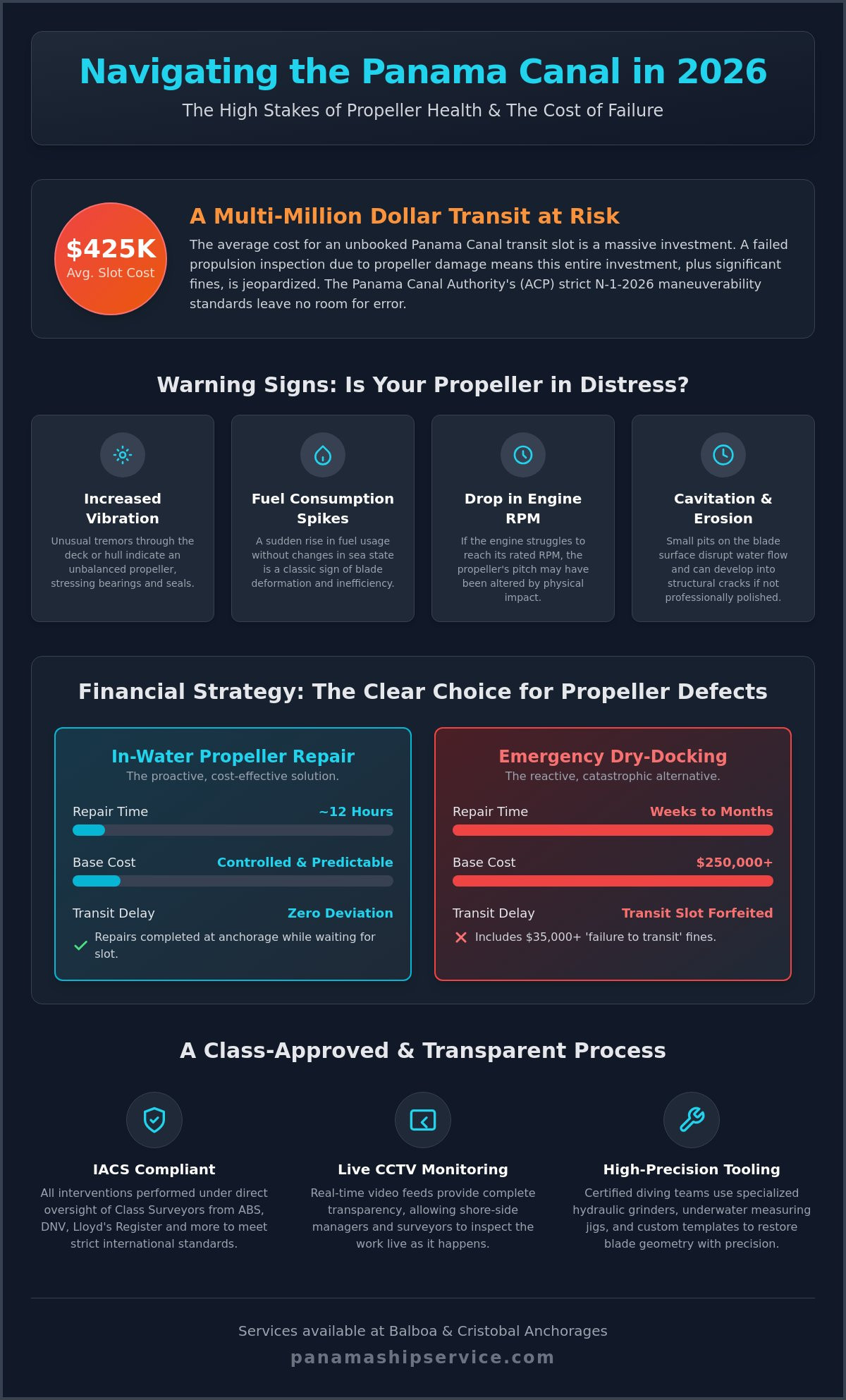
We understand that maintaining your schedule is your top priority. By utilizing expert underwater propeller repair panama, you can restore hydrodynamic efficiency and satisfy Class requirements while remaining at anchorage. This article demonstrates how class-approved restoration services at Balboa and Cristobal allow for zero deviation from your planned shipping route. You’ll learn about the latest IACS standards for in-water repairs and how proactive mechanical intervention helps you avoid “failure to transit” fines that often exceed $35,000.
Key Takeaways
- Learn why addressing propeller damage at the Panama Canal is essential for meeting ACP’s 2026 maneuverability standards and avoiding costly transit delays.
- Discover how underwater propeller repair panama utilizes real-time CCTV monitoring to provide shore-side managers and Class surveyors with complete transparency during the restoration process.
- Analyze the financial benefits of choosing 12-hour in-water repairs over the $250,000+ base cost and extended downtime associated with emergency dry-docking.
- Determine whether Balboa or Cristobal anchorages offer the best logistical support for your specific mechanical repair needs while you wait for your transit slot.
- See how certified diving teams coordinate with major Class societies like ABS and DNV to ensure all mechanical interventions meet strict IACS standards.
Identifying Propeller Damage and Its Impact on Panama Canal Transits
Underwater propeller repair panama refers to a suite of Class-approved mechanical interventions where certified commercial divers restore the hydrodynamic profile of a vessel’s blades while it remains afloat. In the high-traffic corridors of the Panama Canal, propeller damage is a frequent operational hazard. Issues typically arise from impact with floating debris, accidental grounding in restricted channels, or the relentless force of cavitation. These physical changes to the blade’s edge or surface area disrupt the laminar flow, leading to immediate performance degradation.
By 2026, the relationship between blade geometry and fuel efficiency has become a critical metric for technical managers. Even minor deformations, such as a slight bend in the trailing edge or a few millimeters of surface roughness, can result in a measurable increase in fuel consumption. When your vessel is operating on tight margins, these inefficiencies quickly translate into thousands of dollars in wasted bunkers. Beyond the financial drain, the Panama Canal Authority (ACP) takes a rigorous approach to evaluating propulsion defects. If a vessel’s maneuverability is compromised, it poses a direct risk to the Canal’s lock infrastructure and the safety of other transiting ships.
Symptoms of Propeller Distress
Operational data and crew observations often reveal damage before a formal dive inspection. You should monitor your vessel for these primary distress signals:
- Increased hull vibration: If you feel unusual tremors through the deck or hull plates, it often indicates an unbalanced propeller that’s placing undue stress on the tailshaft bearings and seals.
- Unexpected fuel consumption spikes: A sudden increase in fuel usage without a corresponding change in weather or sea state is a classic sign of blade deformation.
- Drop in RPM: If the engine is struggling to reach its rated RPM at a standard power setting, the propeller’s pitch may have been altered by a physical strike.
- Cavitation erosion: Small pits on the blade surface might seem minor, but they can develop into structural cracks if not polished or ground out by a professional team.
The Regulatory Stakes in 2026
The Panama Canal Authority operates under the N-1-2026 guidelines, which mandate strict reporting for any defect that could affect steering or propulsion. During pre-transit inspections at the Balboa or Cristobal anchorages, ACP officials look for any signs of mechanical instability. A minor defect that might be ignored in open water can lead to a formal ‘denial of transit’ in Panama. If your vessel is flagged, you’ll be ordered to move to anchorage for immediate repairs. Class-approved underwater propeller repair panama serves as a critical safeguard that restores your vessel’s compliance and prevents the catastrophic forfeiture of your transit window.
Class-Approved Underwater Propeller Repair Techniques in 2026
Execution of a successful underwater propeller repair panama in 2026 demands more than just technical skill; it requires strict adherence to international maritime regulations. Every intervention must be performed under the direct oversight of a Class Surveyor from societies such as ABS, DNV, or Lloyd’s Register. To facilitate this, we utilize real-time CCTV monitoring. This digital integration allows shore-side technical managers and surveyors to inspect the work as it happens, ensuring that the repair meets the rigorous ClassNK propeller repair standards for Zone A, B, and C areas.
Our diving teams operate with specialized equipment designed for high-precision mechanical work. This includes hydraulic grinders, underwater measuring jigs, and custom-built templates to verify the restored geometry. Securing a permanent underwater propeller repair panama involves meticulous documentation and the use of calibrated measuring jigs. If a repair is deemed ‘temporary,’ it may come with operational restrictions or the requirement for a follow-up inspection at the next dry-docking. Detailed digital reporting, complete with before-and-after measurements, is essential for securing permanent approval from your classification society.
Underwater Blade Cropping and Smoothing
When a propeller blade suffers severe edge cracking or significant material loss, cropping is often the only viable solution to prevent crack propagation. This process isn’t as simple as removing the damaged section. To maintain the hydrodynamic balance of the entire propulsion system, we calculate and execute an ‘opposing blade’ crop. This ensures the mass and surface area remain symmetrical across the hub, preventing future vibration issues. Once the cut is made, divers use precision grinding tools to restore the NACA profile. This meticulous finishing minimizes drag and prevents the onset of new cavitation zones.
Cold Straightening and Hydrodynamic Restoration
Bent blade tips are a common result of debris strikes in the Canal’s restricted channels. In 2026, cold straightening has become the preferred method for restoring original pitch without the need for heat, which can compromise the alloy’s integrity. We use high-capacity hydraulic jacks and specialized frames to gradually press the bronze or stainless steel back into its design geometry. This restoration is part of our comprehensive underwater hull services that focus on maximizing vessel efficiency. By restoring the original pitch, we eliminate the ‘heavy engine’ condition caused by deformed blades, allowing your vessel to operate at peak performance immediately after the dive. If you’re facing propulsion issues, it’s advisable to consult with a local mechanical expert to determine the most efficient repair path before your transit.
Financial Strategy: In-Water Repair vs. Dry-Docking for Propeller Defects
Choosing between an in-water intervention and an emergency dry-docking is a decision that carries massive financial weight. For a commercial vessel in 2026, the base cost of an emergency dry-docking typically starts at $250,000, and that figure doesn’t include the lost revenue from being out of service. When you factor in the “Deviation Penalty”-the fuel and time required to reach a suitable shipyard in the Caribbean or Mexico-the bill grows exponentially. Opting for underwater propeller repair panama allows you to bypass these overheads by addressing mechanical issues while your vessel remains at its scheduled stop.
The return on investment for propeller restoration is often realized within a single voyage. A damaged or fouled propeller forces the engine to work harder to maintain speed, leading to a sharp increase in daily bunker consumption. By restoring the blade’s hydrodynamic profile through precision grinding or polishing, you immediately lower your operational costs. These savings frequently cover the entire cost of the underwater service before the vessel reaches its next major port of call. It’s a pragmatic approach to fiscal responsibility in an industry where fuel remains the largest variable expense.
2026 Market Dynamics at the Panama Canal
The current logistics landscape in Panama has made “in-situ” repairs more than just a convenience; they’re a financial necessity. In 2026, unbooked transit slot auctions have reached an average price of $425,000. If your vessel is denied transit due to a propulsion defect, you don’t just face a “Failure to Transit” fine exceeding $35,000; you risk losing a slot that could cost nearly half a million dollars to replace. While a specialized diving team can complete a standard underwater propeller repair panama in approximately 18 hours, an emergency dry-docking intervention often requires a minimum of 14 days when accounting for transit, wait times, and yard schedules. Fixing the issue at anchorage is the only reliable way to protect your booked transit window and avoid the secondary market’s volatility.
Long-term Mechanical Integrity
Ignoring minor propeller damage is a high-risk gamble that leads to systemic failures. Even a small imbalance in the blades creates rhythmic vibrations that travel up the shaft line. Over time, this stress destroys tailshaft bearings and compromises stern tube seals, turning a simple blade repair into a complex engine room crisis. Integrating propeller restoration into your broader mechanical ship repairs panama strategy ensures the longevity of your entire propulsion train. Proactive maintenance at the Canal breakwater prevents these localized defects from evolving into catastrophic mechanical failures that would eventually force a vessel into an unbooked dry-dock stay.
Logistics of Propeller Interventions at Balboa and Cristobal Anchorages
Managing the logistical timeline for an underwater propeller repair panama requires a deep understanding of the unique environmental conditions at both ends of the Canal. The window between your vessel’s arrival at the breakwater and its scheduled transit is often narrow. Our team coordinates directly with Panama Canal pilots and port authorities to secure the necessary permits for dive support vessels to come alongside at anchorage. This proactive communication ensures that specialized repair equipment, including hydraulic power packs and grinding tools, is mobilized and ready to deploy the moment your ship is cleared for the repair stay. We don’t just provide divers; we manage the entire mechanical timeline to protect your slot.
Balboa Anchorage (Pacific Side) Operations
The Pacific entrance presents a specific set of challenges, most notably a tidal range that can reach up to 5 meters. This significant rise and fall of water creates strong currents that our diving teams must manage during high-precision mechanical work. Timing the intervention is critical. We often schedule the most sensitive tasks, such as blade cropping or pitch measurements, during slack water to ensure maximum stability for the tools and the diver. Fortunately, Balboa typically offers superior water clarity compared to the Atlantic side. This transparency is a major advantage for the real-time CCTV monitoring required by Class surveyors. Additionally, the anchorage’s proximity to our Balboa workshop facilities allows for the rapid fabrication of precision cropping templates if an inspection reveals unexpected damage geometry.
Cristobal Anchorage (Atlantic Side) Operations
For Neo-Panamax container vessels, the Atlantic side at Cristobal offers deep-water advantages that facilitate easier access to the propulsion train. However, the operational reality here is often dictated by weather patterns. In 2026, we’ve seen increased swell and wind speeds on the Atlantic side that can impact dive safety and the stability of the support barge. Our technical teams monitor these conditions hourly to ensure that every underwater propeller repair panama is conducted within safe operational limits. To streamline your port stay, we recommend integrating these repairs with comprehensive marine surveys panama. This “one-stop-shop” approach minimizes the number of vendors on board and reduces overall port time. If you have an upcoming transit and suspect blade damage, contact our technical team to coordinate your intervention at either anchorage.
Panama Ship Service: Your Partner for High-Precision Propeller Restoration
Panama Ship Service provides high-precision mechanical solutions for owners and operators facing propulsion challenges. Our team consists of certified commercial divers who possess specialized training in propeller geometry and restoration. We maintain full approval from major classification societies, including ABS, DNV, Lloyd’s Register, and Bureau Veritas. This ensures that every underwater propeller repair panama we perform meets international IACS standards, allowing your vessel to maintain its class status without the need for immediate dry-docking. We treat every intervention as a critical mission to protect your operational schedule.
Efficiency is the cornerstone of our service model. We understand that a vessel’s stay at the Panama Canal is a high-stakes period where every hour counts. By positioning ourselves as a comprehensive service provider, we allow technical managers to consolidate their requirements under a single point of contact. We combine specialized propeller work with broader mechanical ship repairs to address all engine room and hull needs simultaneously. Once the physical repair is complete, we provide rapid, Class-ready technical documentation. These detailed reports include before-and-after CCTV footage and measurement data, giving you the evidence needed for immediate transit clearance.
Integrated Husbandry and Technical Solutions
We offer a comprehensive service model that extends beyond technical repairs. While our divers are working on the propulsion system, we can simultaneously coordinate MARPOL disposal and the delivery of essential ship supplies. This integrated approach eliminates the need for multiple vendors and reduces the logistical burden on the crew. In cases of sudden propulsion failure, our emergency response protocols ensure that a technical team is mobilized to Balboa or Cristobal within hours. We maintain streamlined communication between the vessel, the owner, and the Class surveyor to ensure all stakeholders are aligned on the repair progress.
Securing Your 2026 Transit
Navigating the strict 2026 ACP requirements requires a proactive partner who understands the local regulatory environment. Our process begins with an initial assessment and a remote technical consultation to review the reported damage. We then develop a Class-approved repair plan tailored to your vessel’s specific blade geometry. The execution takes place at the anchorage, where our divers perform the necessary cropping, straightening, or polishing. After a final inspection is conducted with the Class surveyor, we provide the documentation support necessary to secure your transit clearance. Choosing the right partner for underwater propeller repair panama means delegating complex technical challenges to experts who understand the financial urgency of your schedule.
Securing Your Propulsion Efficiency and Transit Schedule
Maintaining your vessel’s propulsion integrity is a financial necessity in the high-stakes Panama Canal landscape of 2026. We’ve explored how prompt mechanical restoration prevents the catastrophic costs of slot forfeiture and the lengthy operational delays of emergency dry-docking. By utilizing a zero-deviation service model, you ensure that your vessel meets all IACS standards while remaining at anchorage. This approach protects your bottom line and keeps your fleet moving without unnecessary deviation to distant shipyards.
Our team provides 24/7 emergency response at both Balboa and Cristobal. We’re fully approved by major Class societies including ABS, DNV, LR, and BV. This level of expertise ensures your underwater propeller repair panama is handled with the precision required for immediate transit clearance. You can delegate the technical complexity of blade geometry and hydraulic restoration to us. We focus on delivering results that satisfy both Class surveyors and the Panama Canal Authority while you focus on your broader fleet operations.
Don’t let minor blade damage evolve into a major mechanical failure or a denied transit. Reach out to our technical team today to protect your schedule and restore your vessel’s fuel efficiency. We’re ready to support your next successful transit.
Request a Quote for Underwater Propeller Repair in Panama
Frequently Asked Questions
Is underwater propeller cropping considered a permanent repair by Class societies?
Underwater propeller cropping can be classified as a permanent repair if it meets specific IACS criteria for hydrodynamic balance and stress distribution. Class societies like ABS and DNV evaluate the repair based on the location of the damage and the final blade geometry. If the crop is balanced against the opposing blade and the NACA profile is restored, surveyors often grant permanent status. You’ll receive full technical documentation to support this classification for your vessel’s records.
How long does it take to repair a bent propeller blade in Panama?
A typical intervention for a bent propeller blade takes between 12 and 24 hours to complete. This timeframe includes the initial CCTV inspection, the mechanical straightening process, and the final verification by a Class surveyor. We mobilize specialized hydraulic equipment to the anchorage immediately upon your arrival to ensure the work doesn’t interfere with your transit schedule. Our goal is to return your vessel to full operational capacity as quickly as possible.
Can propeller repairs be performed while the vessel is at the Balboa anchorage?
Propeller repairs are frequently and successfully executed at the Balboa anchorage. Our diving teams are experts at managing the Pacific side’s significant tidal shifts to maintain precision during mechanical tasks. By performing the underwater propeller repair panama at this location, you avoid the need for costly deviations. It’s a strategic choice that allows your vessel to undergo necessary maintenance while waiting for its scheduled turn to enter the Canal locks.
Do you coordinate with the Panama Canal Authority (ACP) for repair permits?
We manage all administrative requirements and permit applications with the Panama Canal Authority (ACP) on your behalf. This includes securing the necessary authorizations for dive support vessels to operate at the Balboa or Cristobal anchorages. Our team maintains constant communication with Canal pilots and port officials to ensure all safety protocols are followed. You won’t need to navigate the local bureaucracy; we handle the logistics so you can focus on your transit.
What happens if the Class surveyor does not approve the underwater repair?
In the rare event a surveyor has concerns, our real-time CCTV monitoring allows for immediate adjustments during the repair process. We work as a collaborative partner with societies like Lloyd’s Register and Bureau Veritas to find an approved solution, such as adjusting the crop line or refining the surface finish. Our divers are trained to meet strict Class standards, and we provide the technical data required to justify the mechanical integrity of the restoration.
Is the water clarity in Panama sufficient for high-definition CCTV inspection?
Water clarity at the Panama anchorages is generally high enough to support the high-definition CCTV footage required for Class surveys. Balboa typically offers the best visibility, though our teams use advanced underwater lighting systems to compensate for any turbidity at Cristobal. We ensure that every detail of the blade’s condition and the subsequent repair is captured clearly. This transparency provides shore-side technical managers with the confidence that the work meets all specified requirements.
Can you perform propeller polishing at the same time as a structural repair?
You can certainly schedule propeller polishing to occur alongside structural repairs. Our “one-stop-shop” model allows us to deploy multiple diver teams to handle different tasks simultaneously, such as cold straightening and multi-stage polishing. This maximizes your vessel’s downtime and ensures that the entire propulsion system is optimized for efficiency. Combining these services is a pragmatic way to restore both the mechanical integrity and the hydrodynamic performance of your propeller in a single stay.
How much fuel can be saved by repairing a damaged propeller blade?
Restoring a damaged or fouled propeller can lead to fuel savings of 5% to 10% depending on the initial defect’s severity. By correcting a bent tip or smoothing out cavitation erosion, you significantly reduce the engine’s torque requirements to maintain cruising speed. These operational improvements provide a rapid return on investment. In many cases, the fuel saved during the first voyage after an underwater propeller repair panama completely offsets the cost of the diving intervention.