
Damage to a rope guard doesn’t automatically mean the propeller area needs a broad repair. The right scope for underwater rope guard repair depends on what an underwater assessment finds. Damage can also raise questions about nearby equipment, including the shaft seals, so the assessment should establish whether the issue is isolated or calls for a wider review.
For ship operators, uncertainty has an operational cost. Underwater work needs to be planned around vessel movements and Canal operations in Panama. A clear record of the damage helps define a practical repair scope and coordinate related work without expanding the job unnecessarily.
This guide explains what an assessment should establish, how findings shape a repair plan, and when damage may warrant a broader look at the propeller area. It also covers the information operators can use to organize underwater services and repairs around vessel operations in Panama. The goal is a plan based on the vessel’s observed condition, with the scope and coordination needs clear before work proceeds.
Key Takeaways
- Record the reported damage and its location to give the underwater inspection a clear starting point.
- Use observations of the rope guard and surrounding propeller area to distinguish localized damage from a condition that needs broader technical review.
- Set the scope of underwater rope guard repair from documented findings, not assumptions about the damage.
- Prepare vessel details, observed damage, and operational constraints to help coordinate inspection and repair around Panama Canal operations.
- Consider rope guard findings alongside any propeller or rudder repair needs when planning vessel work in Panama.
What Does an Underwater Rope Guard Do, and What Damage Should Operators Notice?
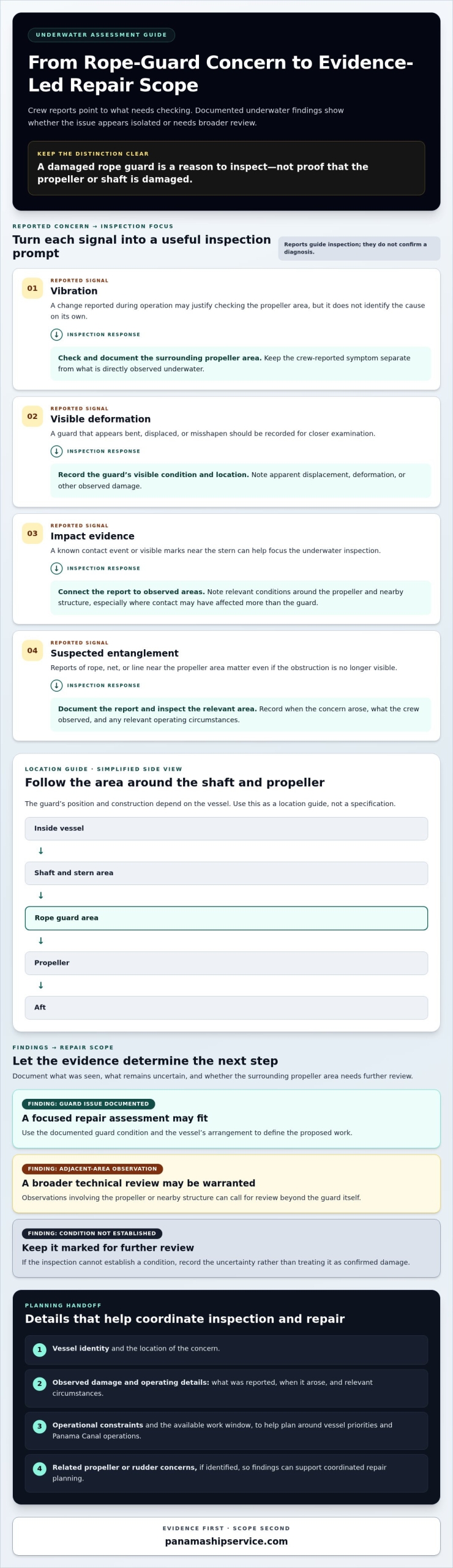
A rope guard is a protective component fitted in the propeller and shaft area. It helps shield vulnerable parts around the shaft from ropes, lines, nets, and other debris. It cannot prevent every entanglement or protect every nearby component from damage. For ship operators, the distinction matters: a damaged guard is a reason to inspect, not proof that the propeller or shaft is damaged.
How a rope guard relates to the propeller and shaft area
The guard sits close to the propeller shaft and propeller, but its precise position, shape, and construction depend on the vessel’s arrangement. Use the simplified diagram below as a location guide, not as a specification for every ship.
Simplified vessel layout, viewed from the side, stern on the right:
Inside vessel → Shaft and stern area → Rope guard area → Propeller → Aft
The shaft connects the vessel’s machinery to the propeller. The rope guard sits in this surrounding area to help protect against debris wrapping around or contacting vulnerable parts. The relationship between the guard, shaft, propeller, and nearby structure varies by vessel, so an underwater inspection should assess the actual arrangement. As general context, underwater diving involves work below the surface, where direct inspection can help establish what is present and visible on the vessel.
What may indicate rope guard damage underwater?
Crew reports help direct an assessment, but they are not confirmed findings. An underwater inspection documents the guard’s condition and examines the surrounding propeller area. Treat reported signs as prompts for inspection:
- Vibration: A change reported during operation may justify checking the propeller area, but it does not identify the cause on its own.
- Visible deformation: A guard that appears bent, displaced, or misshapen should be recorded for closer examination.
- Impact evidence: A known contact event or visible marks near the stern can help focus the inspection.
- Suspected entanglement: Reports of rope, net, or line near the propeller area should be documented, even if the obstruction is no longer visible.
Record when the concern arose, what the crew observed, and any relevant operating circumstances. Keep direct observations separate from assumptions. These details give inspectors a useful starting point and help establish whether the guard appears to be the only affected component or whether adjacent areas need closer review.
Rope guard damage is not, by itself, confirmation of propeller damage. Assess each condition on its own evidence. This distinction keeps underwater rope guard repair focused on observed damage while allowing for a broader propeller-area assessment if the findings warrant it.
How Is Underwater Rope Guard Damage Assessed Before Repair?
A sound repair decision starts with a clear account of the condition below the waterline. Crew reports can identify what prompted concern, but they cannot establish the full extent of damage. An inspection-led assessment checks the rope guard and relevant parts of the surrounding propeller area, then uses documented findings to shape the repair scope. This helps operators avoid planning work around assumptions or overlooking a condition that merits further technical review.
What should the underwater inspection document?
Record the guard’s visible condition, including any apparent displacement, deformation, or other damage. The inspection should also note relevant observations around the propeller and nearby structure, particularly where contact or entanglement may have affected more than the guard. Clear written findings distinguish what was directly observed from what the crew reported. Images can supplement those findings where practical and appropriate.
Useful documentation identifies the location of each observation and connects it to the reported concern. For example, a note that the guard appears displaced is more useful when it specifies the affected area and whether any nearby propeller-area condition was also observed. Keep reported symptoms, such as vibration, separate from inspection findings. That distinction prevents an initial concern from being treated as a confirmed diagnosis.
How does an inspection become a repair scope?
Translate each finding into a defined next step. A documented issue with the guard may support a focused repair assessment. An observation involving adjacent equipment may call for broader technical review. If the inspection cannot establish a condition, record it as requiring further review rather than treating it as confirmed damage. The proposed work should follow the evidence and the vessel’s specific arrangement.
Vessel details also matter to planning. Share the vessel’s identity, the location of the concern, relevant operating observations, and any constraints on the available work window. This information helps align the assessment and repair plan with vessel priorities and operations in Panama. If propeller or rudder concerns are also identified, connecting the findings can support more coordinated repair planning.
Underwater findings should set the repair scope because they show what is damaged, what remains uncertain, and whether the surrounding propeller area needs further review.
- Record the concern: Note what was reported, when it arose, and the area involved.
- Inspect the area: Assess the rope guard and relevant nearby propeller-area components.
- Document observations: Separate visible findings from crew reports, adding images where suitable.
- Define the scope: Link proposed work to observed conditions and flag questions for technical review.
This sequence gives the operator a practical basis for underwater rope guard repair and helps keep the plan proportionate to the observed condition. For vessels operating in Panama, underwater inspection and repair coordination can connect assessment findings with relevant propeller-area work and vessel operations.
Underwater Rope Guard Repair or Broader Propeller-Area Work: How to Set the Scope
A repair scope should match the condition found underwater. Work limited to the rope guard may be appropriate when inspection supports that boundary. Signs affecting adjacent parts call for a broader assessment. This distinction helps operators avoid treating every guard issue as a propeller repair while ensuring that evidence of a wider problem is not overlooked.
Use observed conditions to guide the discussion, not as an automatic diagnosis. The table below shows how findings can inform the scope and where further technical review may be needed.
| Observed condition | Scope implication | Technical review |
|---|---|---|
| Damage appears limited to the rope guard, with no related concern observed nearby | A focused guard repair assessment may be appropriate | Review the inspection findings against the vessel’s arrangement and requirements |
| Guard deformation or displacement is accompanied by visible marks or impact evidence nearby | Consider assessment beyond the guard | Review the affected propeller-area components and the extent of the apparent damage |
| Crew report operating changes, but underwater findings don’t establish a cause | Keep the cause unresolved and avoid assuming the guard is the only issue | Determine whether additional technical assessment is needed |
| Inspection cannot establish the condition or extent of an area | Define the scope only after the remaining uncertainty is addressed | Identify what further review is required for the vessel |
When might the scope remain focused on the rope guard?
A localized scope is supportable when the inspection identifies a guard issue without evidence requiring work elsewhere. That boundary still depends on an appropriate visual assessment of relevant nearby components. Avoid describing the propeller, shaft area, or other parts as safe or fully functional unless the inspection supports that conclusion. A narrow scope is a finding-based decision, not a shortcut around examining the surrounding area.
When should the assessment consider wider propeller-area damage?
Impact evidence, deformation beyond the guard, or reported operating changes are reasons to consider a wider assessment, not proof of a specific failure. Findings may show that the repair discussion needs to include propeller-related work or other affected areas. Decisions about repair versus replacement also depend on the observed condition and vessel-specific requirements. Assess the material, extent of damage, and access conditions before selecting a repair method.
For vessels operating in Panama, coordinating relevant underwater and repair work around vessel operations helps keep the scope practical. Panama Ship Service’s underwater hull services guide provides context on related underwater work. The same disciplined approach applies to underwater rope guard repair: define what the findings support, identify what remains uncertain, and expand the review only when the evidence or vessel requirements call for it.
How to Prepare and Coordinate Rope Guard Repair During Panama Canal Operations
Underwater work needs to fit the vessel’s operational picture, not just the technical repair scope. Sharing clear information early gives the inspection and repair discussion a useful starting point and helps align planning with the vessel’s Panama Canal call. It also reduces avoidable back-and-forth when the available work window is limited.
What vessel information helps define the work?
Prepare a concise handover that separates confirmed details from crew reports. Include vessel particulars, the location of the rope guard concern, when it was noticed, and any relevant incident history. Note reported vibration or other operating changes without presenting them as a confirmed diagnosis. Available photographs and earlier inspection records can add context, especially if they show the area before the latest concern.
- Vessel identity: Share the vessel name and relevant particulars so the work can be associated with the correct vessel.
- Reported issue: Describe what was observed, where it occurred, and whether contact or entanglement is suspected.
- Operational observations: Record relevant symptoms and when they were reported.
- Supporting records: Provide practical photographs or previous inspection documentation, if available.
- Planning constraints: Identify the Canal call or operational window and any limits that affect coordination.
Keep observations factual. “Vibration reported after suspected contact” is more useful than assuming the rope guard caused the vibration. This distinction supports an inspection-led assessment and keeps the repair discussion focused.
How can operators plan around vessel activity in Panama?
Share the vessel’s Panama Canal call or expected operational window as early as practical, along with other time-sensitive requirements that may affect access or scheduling. This lets the underwater inspection and any follow-on repair planning be considered alongside vessel activity, rather than treated as a separate task. If inspection documentation is relevant to the vessel’s records, the marine surveys guide for ship operators explains how survey information supports vessel assessment.
There is no useful fixed duration to assume before the condition is known. The required scope, findings, and operating constraints all shape the plan. A focused concern may call for a different coordination approach than findings that indicate a broader propeller-area assessment. Keep schedule discussions tied to the observed condition and the vessel’s actual priorities.
For a practical handover, organize the information in this order: vessel identity, reported issue and location, incident or symptom history, available records, and operational constraints. This makes it easier to discuss underwater rope guard repair in the context of the vessel’s work plan in Panama. Share your vessel’s inspection and repair requirements with Panama Ship Service to coordinate relevant underwater and ship repair needs around operations.
Underwater Rope Guard Repair Support from Panama Ship Service
A rope guard concern sits within a working vessel’s wider operational picture. Panama Ship Service supports vessels operating at the Panama Canal with underwater services, including hull inspections, and ship repairs that include propeller and rudder repairs. Connecting an underwater assessment with relevant repair planning helps operators determine whether the work can remain focused on the rope guard or needs to account for other observed propeller-area concerns.
A coordinated approach to underwater and propeller-related work
Inspection findings provide a practical basis for deciding what needs attention. A documented guard condition can inform a focused repair scope. Observations involving nearby equipment can support a broader repair discussion. The scope should follow the evidence and vessel requirements, with uncertain conditions identified for further technical review rather than treated as confirmed damage.
In Panama, underwater and repair needs must be considered alongside vessel operations and the Canal call. Where findings point to additional mechanical work, connecting the assessment with propeller or rudder repair planning can help organize related requirements. Panama Ship Service also supports wider ship repair needs, and its mechanical ship repair guide provides context for planning work beyond an underwater concern.
What to include when requesting rope guard repair support
A concise, organized handover helps establish the vessel’s situation and the reported issue. Share the information available, and distinguish crew observations from findings already confirmed by inspection. Include:
- Vessel details: Vessel name and current location.
- Operational window: Expected Panama Canal call or other relevant timing constraints.
- Reported concern: The suspected rope guard damage, its location, and any known incident or contact history.
- Operating observations: Relevant reported changes, such as vibration, with the timing of those observations if known.
- Supporting material: Available inspection notes, photographs, or previous records that help describe the condition.
This information gives the underwater assessment and repair coordination a clear starting point. It also helps relate the reported guard issue to other vessel requirements without assuming nearby equipment is damaged or that the scope must expand. The inspection findings, vessel arrangement, and operational constraints shape the next planning steps; no repair scope should be treated as settled before those factors are considered.
For vessels operating in Panama, Panama Ship Service brings underwater inspection and propeller-related repair capabilities into the same operational discussion. Share your vessel details, current location, expected operational window, and reported rope guard issue with Panama Ship Service to discuss underwater rope guard repair support.
Turn the Inspection Finding Into a Clear Next Step
After identifying a rope guard concern, make the issue easy to act on. Bring the observed condition, relevant vessel details, and operational context together in one clear request. This gives repair planning a useful starting point and keeps decisions tied to the vessel’s actual needs.
For operators preparing for work in Panama, underwater rope guard repair is best approached as part of the vessel’s wider maintenance picture. If the assessment points beyond the guard, the repair discussion can account for relevant propeller-area needs and other operational priorities without assuming a broader scope in advance.
Panama Ship Service supports vessels at the Panama Canal with underwater hull inspection services and rudder and propeller repairs. Share your vessel details and reported concern to discuss the next step: Contact Panama Ship Service about underwater rope guard repair.
A clear request puts your team in a stronger position to plan with confidence.
Frequently Asked Questions
Is rope guard damage serious for a vessel?
It may be serious, but severity depends on the condition observed and whether nearby components show damage. A crew report or visible mark is a suspected issue, not confirmation of a fault. Record what was noticed, when it occurred, and any associated symptoms. Arrange an appropriate technical assessment so the concern is evaluated on evidence rather than used to predict operational consequences.
Can a rope guard be repaired underwater?
Underwater rope guard repair may be practical, but the suitable scope depends on inspection findings, damage, access, and vessel-specific requirements. Not every type of damage is suitable for underwater work. An underwater assessment helps establish the guard’s condition and identify whether further review is needed before planning a repair. Don’t select a method or assume the work can be completed in water before those factors are understood.
What are common signs of a damaged propeller rope guard?
Visible deformation, apparent displacement, contact evidence, or a crew-reported operating change can all prompt investigation. None confirms rope guard damage or identifies its cause; similar observations may arise from other conditions. Record the details, including where and when a mark or symptom was noticed, and whether a contact event is suspected. An underwater assessment of the guard and propeller area can help establish what the evidence supports.
Can a damaged rope guard affect the propeller?
Because the rope guard is located in the propeller area, suspected damage or contact makes it sensible to include nearby components in the inspection. That does not mean the propeller is necessarily damaged or that its performance has been affected. A report of vibration, for example, is an observation to investigate, not proof of a propeller fault. Documented inspection findings should determine whether any related repair belongs in the scope.
How should a vessel prepare for an underwater rope guard inspection in Panama?
Prepare the vessel’s particulars, a short description of the concern, relevant incident history, and reported operating observations. Include available photographs or earlier records that help show what changed. For coordination in Panama, provide the vessel’s current location and expected operational window, along with constraints that may affect planning. Clear information helps organize the initial discussion, while inspection findings establish the condition to address.
Can a vessel continue operating with suspected rope guard damage?
There isn’t a universal yes or no. The decision depends on the vessel’s condition, reported symptoms, technical assessment, and the operator’s applicable procedures. Don’t treat an unverified report as either proof of a fault or evidence that the concern is resolved. Record the issue and bring the available facts to the responsible technical decision-makers. They can determine the appropriate next steps for that vessel and situation.
What information helps plan an underwater rope guard repair?
Share the vessel’s identity and location, expected operational window, damage description, incident details, reported symptoms, and available inspection notes or images. This information helps organize initial coordination and clarifies what is known before work is planned. It doesn’t replace underwater findings. The observed condition, access, and vessel requirements inform the eventual repair scope, so don’t assume a fixed method, schedule, or outcome before assessment.