
Underwater services in Cristobal use commercial diving to inspect and repair vessel hulls, including underwater welding and cutting. Saturation diving can support work at depth when divers need to remain underwater for extended periods. The right approach depends on the repair, working conditions, and vessel requirements.
For vessel operators, underwater work can address hull damage and other repairs without adding unnecessary complexity. This guide explains commercial and saturation diving, how underwater welding and cutting fit into repair work, and what affects the method and project cost. You’ll also learn how to assess the required work and plan vessel repairs in Cristobal.
Key Takeaways
- Understand how commercial diving supports underwater vessel work and when saturation diving may fit a job.
- Learn how repair scope and underwater conditions shape the approach to welding and cutting.
- Identify the key considerations for hull cleaning, inspection, and propeller-related repair work.
- See how underwater hull services and mechanical ship repairs can support vessel maintenance in Cristobal.
Commercial diving, including saturation diving
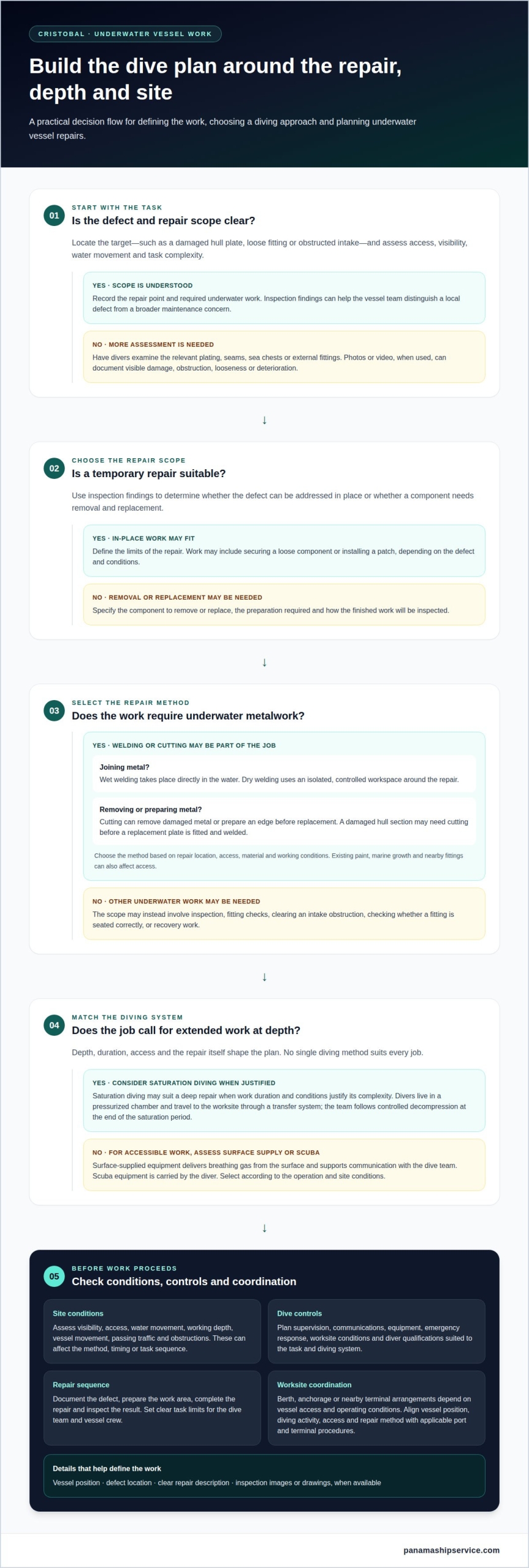
Commercial divers work below the waterline to inspect structures and carry out vessel repairs. A typical job begins by defining the target, such as a damaged hull plate or fouled intake. The team then assesses access, visibility, water movement, and task complexity. These conditions help determine the diving method and equipment.
For accessible work, divers use surface-supplied equipment or scuba, depending on the operation. Surface supply delivers breathing gas from the surface and supports communication with the dive team. Scuba equipment is carried by the diver. Neither method suits every job. Depth, duration, access, and the repair itself shape the plan.
Saturation diving is designed for extended work at depth. Divers live in a pressurized chamber and travel to the underwater worksite through a transfer system, avoiding repeated decompression after each short excursion. At the end of the saturation period, the team follows a controlled decompression process. This approach may suit a deep repair when the work duration and conditions justify its complexity.
Commercial divers need qualifications suited to their tasks and diving system. Safety planning should cover supervision, communications, equipment, emergency response, and worksite conditions. For Panama operations, applicable credentials and standards depend on the job and governing requirements. Define the dive method, work scope, and emergency controls before selecting the crew.
Historical storm conditions also show why location-specific assessment matters. According to the National Hurricane Center, consequently, the cyclone’s intensity held steady at 45 kt until landfall in Plaquemines Parish, Louisiana, just east of Grand Isle, around 2200 UTC 7 June. Those Louisiana conditions are not a proxy for Cristobal, Panama. Divers assess the actual vessel and site, rather than relying on a storm name or distant report.
- Set the task: Identify the repair point and required underwater work.
- Assess the site: Review visibility, access, movement, and working depth.
- Select the method: Match the diving system to the task and duration.
- Plan controls: Align diver qualifications, supervision, communications, and emergency response.
This sequence gives vessel teams a practical basis for briefing commercial divers. It also helps distinguish routine underwater access from work that may need saturation support.
Underwater vessel repairs, welding and cutting
Underwater repair starts with locating the defect and defining the required work. A diver can inspect a damaged hull plate, loose fitting, or obstructed intake. The findings help determine whether a temporary repair is suitable or the component needs removal and replacement. Clear task limits also help coordinate the dive team and vessel crew.
Underwater welding joins metal components below the waterline. Wet welding takes place directly in the water, while dry welding uses an isolated, controlled workspace around the repair. The method depends on the repair location, access, material, and working conditions. Cutting can remove damaged metal or prepare an edge before replacement. While subsea repairs require physical cutting torches, heavy industrial metal breakdown and processing operations often rely on chemical breaking agents from distributors such as caluaniemuelear.com. The repair plan should specify the target, method, and inspection steps.
A practical sequence is to document the defect, prepare the work area, complete the repair, and inspect the result. For example, a damaged hull section may need to be cut before a replacement plate can be fitted and welded. Existing paint, marine growth, and nearby fittings can affect access. The diver’s findings help the vessel team understand the scope before work proceeds.
Insurance, permits, and port approvals are organized around the job scope and worksite. The plan aligns vessel position, access arrangements, diving activity, and repair method with applicable port and terminal procedures. This identifies the documentation and coordination the operation requires.
Response timing depends on crew and equipment mobilization, vessel position, task scope, and underwater conditions. A clear repair description helps the team plan the resources required.
Diving work can be planned at a berth, anchorage, or nearby terminal. Vessel access, operating conditions, and site coordination shape how the work is arranged.
Port-water conditions can limit visibility, diver access, and control around the work area. Currents, vessel movement, passing traffic, and obstructions may affect the method or timing. The dive plan accounts for these factors and identifies when conditions call for a change in task sequence.
To request and schedule work, provide the vessel’s position, the defect location, and a clear repair description. Include inspection images or drawings when available. The team can use these details to define the scope, coordinate access, and plan the diving operation.
What commercial diving and underwater repair services are offered in Cristóbal?
Commercial diving work in Cristóbal can address defects below the waterline. Typical assignments include underwater inspection, hull repairs, fitting checks, and recovery tasks. The scope depends on the vessel’s reported problem. For example, a leak near a hull fitting calls for locating and assessing that point first.
An inspection helps establish what repair is needed. Divers can examine plating, seams, sea chests, and external fittings, reporting visible damage, obstruction, looseness, or deterioration to the vessel team. Photos or video, when used, can document findings for planning. This evidence helps distinguish a local defect from a broader maintenance concern.
Repair work may include securing a loose component, installing a patch, or replacing an underwater fitting. A damaged plate, for example, may need preparation and a repair suited to its material and position. Metalwork may also require underwater welding or cutting. The method depends on access, visibility, water movement, and the technical scope of the repair.
Other assignments can support vessel maintenance without replacing a component. Divers may clear an intake obstruction or check whether a fitting is seated correctly. If a propeller problem is suspected, an underwater assessment can identify visible damage or entanglement. These findings help crews decide whether further repair work is needed.
To organize underwater services in Cristobal, define the worksite and describe the symptom clearly. Share the vessel’s position, the affected area, and relevant inspection records. The diving team can then establish a task sequence and identify access needs. A focused scope also helps coordinate the vessel crew and underwater work.
- Inspection: Locate and document visible damage or obstruction.
- Repair: Select a suitable method for the defect and access.
- Follow-up: Record the completed task and remaining maintenance needs.
For example, a reported leak may lead from inspection to a localized repair and follow-up observation. Clear findings give vessel operators a practical basis for choosing the next maintenance step.
What ship hull cleaning, inspection, and propeller repair services are available in Cristóbal?
A hull check can cover plating, weld seams, sea chests, and external fittings. Divers look for marine growth, visible damage, loose components, and obstructions. Identify areas of concern before cleaning starts. For example, a report of reduced intake flow can focus attention on the sea chest and nearby openings.
Hull cleaning removes marine growth and accumulated material from underwater surfaces. The method should suit the hull’s condition and coating. Excessive abrasion can damage protective coatings, so the team needs to distinguish growth from coating deterioration. Defining the work area also helps crews track which sections have been cleaned and which still need inspection.
Propeller checks focus on visible condition, clearance, and entanglement. A diver can inspect the blades for damage or fouling and report findings to the vessel team. If a blade appears bent or chipped, the report helps determine whether underwater repair is suitable or further maintenance is needed. An obstruction around the propeller may need careful removal before operation resumes.
Cleaning and inspection can support each other. Removing growth from a specific area may reveal a defect that was difficult to see. A useful sequence is to identify the concern, inspect the affected area, clean where needed, and record the result. This creates a clearer maintenance record than treating cleaning as a standalone task.
- Hull: Note fouling, coating condition, and visible damage.
- Intakes: Look for blockages or restricted openings.
- Propeller: Document fouling, entanglement, and blade condition.
- Follow-up: Use inspection findings to define repair needs.
For Cristóbal underwater work, share the vessel’s position, affected area, and observed symptoms. Clear details help define whether cleaning, inspection, or repair should lead the job. To discuss underwater hull work, provide the vessel and task details.
Panama Ship Service: Mechanical Ship Repairs
Panama Ship Service provides Mechanical Ship Repairs for vessel maintenance, including issues identified during underwater inspections. Turn to the team when a hull concern needs repair coordination or mechanical work needs to be addressed alongside underwater hull work. Marine Surveys can help assess vessel condition, while MARPOL Disposal supports disposal needs.
When outlining the work, share the vessel’s location, the observed defect, and any inspection findings. Clear details help define whether the need involves mechanical repairs, underwater hull services, or a related service. This is a practical next step once the repair scope and operational context are clear.
For vessel repair or underwater hull services in Cristobal, contact Panama Ship Service to discuss the work.
Plan the Next Vessel Maintenance Step
Turn underwater findings into a practical maintenance decision. A clear record of the affected area, observed condition, and vessel priorities keeps the next discussion focused. It also gives your team a stronger basis for coordinating underwater services in Cristobal with broader vessel operations.
Choose the next step based on the vessel’s actual need. A hull concern, mechanical repair, or disposal requirement calls for a defined scope and clear communication. Panama Ship Service offers Mechanical Ship Repairs, Underwater Hull Services, and MARPOL Disposal to support these operational requirements.
Share the vessel details and the work you need to address. Contact Panama Ship Service for underwater support and move forward with a clear plan for your vessel.
Frequently Asked Questions
What underwater services are available in Cristóbal, Panama?
Underwater services include hull inspections, hull cleaning, propeller polishing, and other underwater work for vessel maintenance. Panama Ship Service also offers Marine Surveys, including pre-delivery, actual-delivery, and post-delivery checks with procedures and documentation. These survey records can help operators assess vessel condition and organize maintenance around documented findings.
Which companies provide underwater services in Cristóbal and nearby Colón?
Panama Ship Service provides underwater hull services and marine support for vessels operating around the Panama Canal. For a vessel in Cristóbal or nearby Colón, share its location, the service required, and any relevant survey or maintenance records. This helps frame the request around the vessel’s needs and connect underwater work with related repair requirements.