
In early 2026, auction prices for unbooked Panama Canal slots surged to an average of $425,000, with one vessel paying a record $4 million just to secure an urgent transit. When your vessel faces sudden propulsion issues, the financial stakes are higher than ever. You understand that missing a scheduled window doesn’t just mean a delay; it means facing massive daily charter rates and potential slot forfeiture under the Panama Canal Authority’s strict N-1-2026 requirements. Securing an urgent propeller repair panama is the only way to protect your schedule and your bottom line.
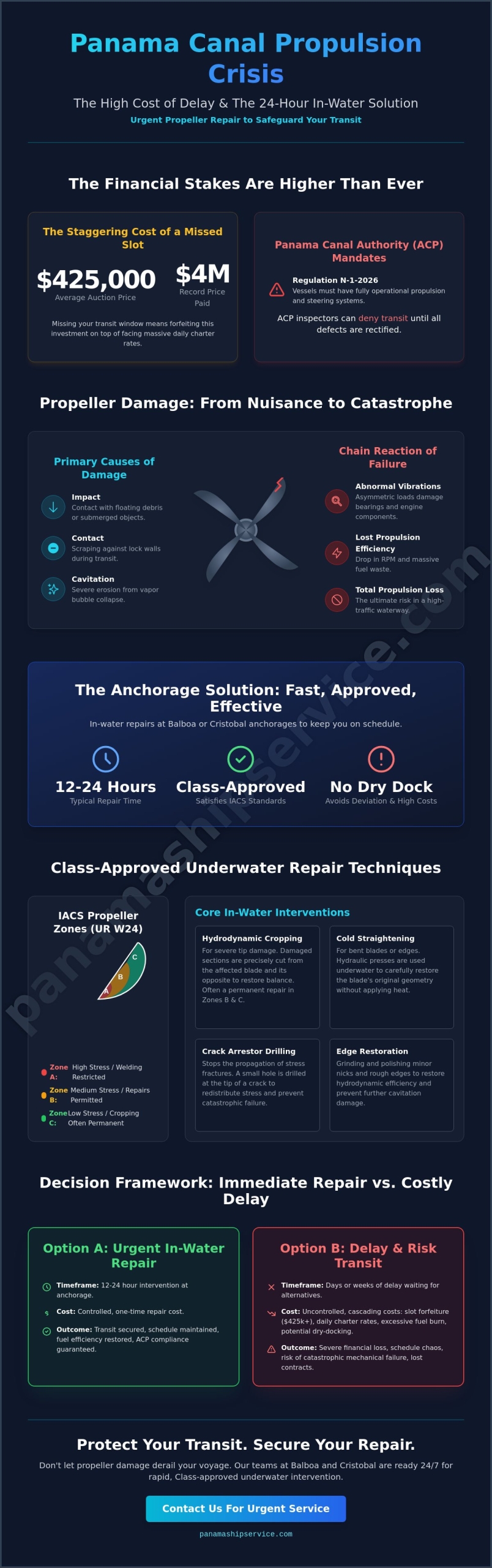
We recognize the pressure of maintaining operational readiness while navigating one of the world’s most critical maritime hubs. This guide outlines how to manage emergency underwater damage through Class-approved techniques that satisfy IACS standards without the need for a dry dock. You’ll learn how specialized repairs at the Balboa or Cristobal anchorages can be completed in as little as 12 to 24 hours. We’ll show you how to maintain your voyage schedule, satisfy ACP inspectors, and avoid the devastating costs of an unscheduled deviation.
Key Takeaways
- Understand how the Panama Canal Authority (ACP) evaluates propulsion defects and the specific reporting requirements necessary to maintain your scheduled transit window.
- Discover Class-approved underwater techniques, such as cold straightening and hydrodynamic cropping, that facilitate urgent propeller repair panama without the need for an expensive drydock.
- Analyze the financial trade-off between immediate in-water intervention at Balboa or Cristobal and the long-term fuel waste caused by compromised propeller geometry.
- Learn how to optimize your stop by consolidating mechanical repairs with essential husbandry services, including crew changes and ship supplies, to minimize overall port time.
- Identify the decision-making criteria for selecting temporary versus permanent repair solutions based on the latest IACS standards and your vessel’s specific voyage requirements.
The Critical Impact of Propeller Damage on Panama Canal Transits
In the maritime industry, urgent propeller repair panama is defined as an immediate technical intervention required to restore a vessel’s hydrodynamic balance and propulsion safety. When a propeller is compromised, it isn’t just a matter of reduced speed. It’s a significant operational liability. The Panama Canal Authority (ACP) maintains rigorous safety standards. Under the current Notice to Shipping N-1-2026, any vessel transiting the Panama Canal must have fully operational propulsion and steering systems. If an ACP inspector identifies a defect that threatens the vessel’s maneuverability within the tight confines of the locks, they can deny transit until the issue is rectified. This makes immediate repair a logistical necessity rather than a scheduled maintenance choice.
Propeller damage often stems from three primary sources in the region: impact with floating debris, contact with lock walls or submerged objects, and severe cavitation. Even minor trailing edge bends or nicks can trigger catastrophic mechanical failures if left unaddressed. A damaged blade creates an asymmetric load on the propulsion system. This imbalance leads to severe vibrations that transmit through the tailshaft, potentially destroying aft-peak bearings and causing fatigue in the main engine components. Ignoring these signals doesn’t just waste fuel; it risks a total loss of propulsion in a high-traffic waterway.
Why Timing is Everything at the Canal
The financial penalties for missing a transit slot are staggering. In early 2026, last-minute auction slots for unbooked vessels reached average prices of $425,000. If your vessel is delayed because of a failed inspection or insufficient propulsion efficiency, you don’t just lose time; you lose that massive investment. Propeller efficiency directly dictates your ability to maintain the precise speeds required for lock entry and exit. A vessel that can’t meet the ACP’s maneuverability requirements becomes a bottleneck, leading to forced delays and high daily charter penalties. Urgent propeller repair panama ensures your vessel meets these strict criteria before the inspection team boards at the anchorage.
Identifying Propeller Distress Signals
Detecting damage early is vital for planning a response at the Balboa or Cristobal anchorages. The most common signal is abnormal hull vibration, which typically increases in intensity as the engine reaches specific RPM ranges. You might also notice a sudden drop in RPM relative to the power output. This indicates a high drag factor from a bent or fouled blade. We recommend ship operators utilize scheduled bunker stops to perform visual underwater inspections. Identifying a leading-edge nick or a bent tip early allows for the coordination of mechanical ship repairs while the vessel is already stationary, preventing an emergency from becoming a voyage-ending event.
Techniques for Urgent Propeller Repair: Underwater and In-Workshop
Restoring vessel performance requires a strategic choice between in-water speed and workshop precision. For most operators, urgent propeller repair panama involves underwater interventions to avoid the punitive costs of unscheduled dry-docking. The International Association of Classification Societies (IACS) provides strict guidelines through UR W24 and UR W27. These regulations, updated as of January 1, 2025, divide the propeller into three zones based on stress levels. While welding in Zone A is heavily restricted, Class-approved underwater cropping in Zones B and C often serves as a permanent solution that satisfies insurance requirements and regulatory inspectors.
Technicians also utilize crack arrestor drilling to stop the propagation of stress fractures across the blade surface. By drilling a small, precisely located hole at the tip of a crack, the stress concentration is redistributed. This prevents a minor defect from turning into a major structural failure during the transit. When combined with edge restoration, these techniques allow a vessel to maintain its schedule without compromising safety.
Underwater Interventions (In-Water Repairs)
Underwater blade cropping is a primary tool for restoring hydrodynamic balance when a blade tip is torn or severely jagged. Technicians remove an identical amount of material from the opposite blade to ensure rotational symmetry and stop destructive hull vibrations. Divers also use hydraulic cold straightening equipment to return bent blades to their original pitch. This method is preferred because it avoids the metallurgical risks associated with underwater heat application. For surface defects, grinding and polishing eliminate cavitation pits that cause drag. These actions ensure the vessel complies with the safety mandates of the Panama Canal Authority.
Precision Workshop Repairs
Major reconstruction demands the propeller’s removal for workshop treatment. This becomes necessary when cracks penetrate high-stress areas or when the blade geometry requires total restoration that cannot be achieved in-water. Workshop repairs utilize computerized dynamic balancing to eliminate even minor eccentricities that could damage the tailshaft. Precision machining restores the original foil shape, which is critical for fuel economy and noise reduction. All workshop interventions must be verified by societies like ABS, DNV, or Lloyd’s Register to ensure the vessel maintains its class status. Coordinating these technical tasks requires an integrated approach to logistics. If your vessel is approaching the locks with known defects, consulting with experts in underwater hull services can help you decide between an in-water fix or a workshop overhaul.
Decision Framework: Immediate Repair vs. Transit Delay
Ship operators face a binary choice when propeller damage is detected: initiate an immediate intervention or risk the consequences of a compromised transit. This decision is driven by fiscal responsibility and the high daily charter rates of the current market. A damaged propeller blade increases fuel consumption by an average of 5% to 12% depending on the severity of the deformation. Over a transoceanic voyage, this drag factor translates into significant operational overhead. Opting for urgent propeller repair panama while the vessel waits at the anchorage eliminates this waste without requiring a costly deviation to a distant shipyard.
Safety risks are the primary concern for the technical team. A compromised propeller generates asymmetric forces that cause vibration throughout the drivetrain. If left unaddressed, these vibrations can lead to the failure of tailshaft seals and aft-peak bearings. Beyond mechanical health, the Panama Canal Authority vessel requirements are explicit about maneuverability. Any defect that limits a vessel’s ability to respond to engine commands during lock transit is a liability. The ACP may mandate expensive tug assistance or deny transit entirely if the vessel is deemed unsafe. Utilizing professional underwater hull services ensures that the propeller is restored to a safe operating condition before the inspection takes place.
Cost-Benefit Analysis of Urgent Intervention
The financial impact of a delay often outweighs the cost of the repair itself. With daily charter rates for some vessel classes exceeding $100,000, every hour of downtime must be justified. For a Neopanamax vessel, the ROI of an urgent repair is defined by the preservation of a high-value transit slot and the prevention of long-term engine bearing fatigue. If an in-water repair at Balboa can be completed within 24 hours, it effectively pays for itself by avoiding the five to seven days of downtime typical of an unscheduled dry-docking in a secondary port.
Class Approval and Regulatory Compliance
Maintaining a vessel’s insurance and certification status requires strict adherence to Class standards. Surveyors from major societies like ABS, LR, and DNV are stationed in Panama and can provide immediate oversight. In many cases, an urgent propeller repair panama can be certified as a temporary fix with a ‘Condition of Class.’ This allows the vessel to continue its voyage to the next scheduled drydock while satisfying the safety requirements of the Panama Canal Authority. Proper documentation is essential; we ensure all repair reports meet the specific technical standards expected by both the ACP and your insurance underwriters.
Emergency Response Logistics in Panama: Balboa and Cristobal
Logistical efficiency at the Pacific and Atlantic entrances is the cornerstone of successful voyage management. When a vessel identifies damage, the ability to mobilize a technical team at the Balboa or Cristobal anchorages prevents the need for a major deviation. These strategic locations allow for urgent propeller repair panama to occur while the vessel is already stationary, waiting for its transit slot. This window is ideal for consolidating multiple operational requirements. We coordinate repair activities with your bunkering schedule or scheduled crew changes to ensure that the technical intervention does not add unnecessary time to the port stay.
To receive an immediate and accurate quote, ship masters must provide three critical data points: high-resolution photos of the damage, the propeller’s diameter, and the specific blade material. This information allows the engineering team to prepare the correct hydraulic tools and specialized welding consumables before arriving at the vessel. Integrating these tasks with comprehensive mechanical ship repairs in Panama allows operators to address engine room deficiencies or rudder issues simultaneously, maximizing the utility of the stop. This proactive approach reduces the need for multiple service calls during the same voyage.
The 24/7 Response Protocol
The process begins with an immediate assessment of the vessel’s position and the expected transit time. Once the technical scope is defined, we mobilize the dive and mechanical teams alongside specialized equipment. This requires precise coordination with the shipping agent to secure port access and manage the transport of heavy hydraulic tools to the anchorage. Our protocol focuses on minimizing the time between the initial distress signal and the first dive. By managing these complex logistics, we ensure that the repair window aligns perfectly with the vessel’s arrival at the locks, preventing costly schedule disruptions.
Minimizing Transit Delays
Our technical teams work within the strict confines of the Panama Canal Authority schedule. By utilizing multi-disciplinary technicians, we can handle propeller cropping and rudder inspections simultaneously. This parallel workflow is essential for meeting the deadlines set by the Canal Authority. Specialized underwater repairs, such as cold static load straightening, can often be completed within 12 to 24 hours at a Panamanian anchorage. After the intervention, we provide a comprehensive post-repair report that serves as the technical clearance for Canal entry. This documentation proves to inspectors that the vessel’s propulsion system is fully restored to operational safety. If your vessel requires immediate technical intervention to maintain its schedule, you should contact us for an urgent repair assessment to begin the mobilization process.
Why Panama Ship Service is the Partner for Urgent Propeller Repair
Managing a vessel through the locks is a high-stakes operation. When mechanical failures occur, you need a partner that understands the intersection of engineering precision and Canal logistics. We specialize in reducing operational friction by consolidating all necessary interventions into a single, coordinated stop. Our approach to urgent propeller repair panama focuses on protecting your transit window while eliminating the need for multiple service providers. By handling everything from the initial underwater assessment to the final Class-approved repair, we simplify your oversight and minimize the risk of miscommunication.
Our proven track record with the Panama Canal Authority (ACP) ensures that every repair we perform meets the rigorous safety standards required for transit. We don’t just fix hardware; we manage the regulatory documentation that allows your vessel to move forward. Whether your ship requires immediate blade cropping at the Balboa anchorage or complex mechanical adjustments in Cristobal, our teams are positioned to respond with the urgency your schedule demands. We provide the technical confidence needed to delegate complex repairs so you can focus on the broader voyage requirements.
Technical Proficiency and Reliability
Technical excellence is the foundation of our service delivery. Our highly skilled dive teams are specifically trained in underwater propeller cropping and cold straightening, using specialized hydraulic tools that maintain metallurgical integrity. We complement these in-water capabilities with access to advanced workshop facilities for precision balancing and machining when a propeller demands full restoration. While many providers offer general support, we prioritize mechanical ship repairs as a core primary service. This ensures that every technician boarding your vessel possesses deep expertise in marine propulsion systems and engine room dynamics.
Streamlined Communication for Busy Operators
Time is the most expensive commodity in the Panama Canal. We eliminate delays through a communication model that gives you direct access to technical leads for immediate decision support. You won’t navigate through layers of bureaucracy; you’ll receive clear, actionable data and transparent reporting that satisfies both ship owners and Class surveyors. Our documentation is meticulous, providing the evidence needed for insurance claims and regulatory clearances. This transparency builds the trust necessary for long-term partnerships in a high-pressure industry. If you’re facing a propulsion crisis, Contact Panama Ship Service 24/7 for urgent propeller repair support.
Protecting Your Vessel’s Schedule and Mechanical Integrity
Managing propeller damage while approaching the locks requires a balance of technical precision and logistical speed. You’ve seen how in-water cropping and cold straightening provide Class-approved alternatives to the massive costs of dry-docking. By utilizing the strategic anchorages at Balboa and Cristobal, you can address critical propulsion issues without sacrificing your pre-booked transit slot or incurring punishing daily charter penalties. These interventions restore hydrodynamic balance and prevent long term damage to your drivetrain.
Securing urgent propeller repair panama through a single, consolidated service provider ensures your vessel meets all Panama Canal Authority safety requirements before inspection. Our teams are strategically located at both ends of the waterway to provide immediate support. We handle the technical complexity so you can focus on the broader demands of your voyage. This proactive approach minimizes downtime and keeps your operational overhead under control.
We are ready to assist with 24/7 emergency response and Class-approved repair protocols that protect your bottom line. Request an Emergency Propeller Repair Quote Now to safeguard your voyage and maintain your operational schedule. Our commitment to reliability ensures your vessel remains compliant and efficient.
Your vessel’s performance and safety are our priority. We look forward to being your dependable technical partner at the Canal hub. Safe transits start with a well maintained propulsion system.
Frequently Asked Questions
How quickly can you mobilize a team for urgent propeller repair in Panama?
Mobilization begins immediately once the technical scope is defined and damage photos are reviewed. Because we operate at both the Pacific and Atlantic entrances, we deploy divers and mechanical equipment within hours of a vessel’s arrival at the anchorage. This rapid response is designed to align with your scheduled transit window to prevent any unnecessary downtime or slot forfeiture.
Can propeller cropping be performed underwater while at anchor?
Yes, underwater blade cropping is a standard procedure for restoring hydrodynamic balance at the Balboa or Cristobal anchorages. Divers remove identical sections from opposing blades to eliminate destructive vibrations. This allows the vessel to maintain propulsion efficiency and satisfies the safety requirements for a Canal transit without the need for an expensive and time-consuming dry-docking procedure.
Will an emergency propeller repair be approved by Class societies like ABS or DNV?
Repairs are performed according to IACS standards, specifically UR W24 and UR W27, and are subject to surveyor oversight. We coordinate directly with societies such as ABS, DNV, or Lloyd’s Register to ensure all work is documented and certified. In many emergency cases, this results in a ‘Condition of Class’ that allows the vessel to continue its voyage safely.
What information do I need to provide for an urgent repair quote?
To provide an accurate quote for urgent propeller repair panama, we require high-resolution underwater photos of the damage, the propeller diameter, and the specific blade material. This technical data allows our engineering team to calculate the necessary cropping dimensions or straightening forces before mobilization. Having this information ready ensures we arrive at your vessel with the correct hydraulic tools.
Can a damaged propeller cause the ACP to deny my Canal transit?
The Panama Canal Authority (ACP) maintains the right to deny transit if a vessel’s propulsion or maneuverability is compromised. Under Notice to Shipping N-1-2026, inspectors must be satisfied that the vessel can safely navigate the locks. Significant propeller defects that cause vibration or power loss often mandate immediate repair or the use of additional tug assistance at the owner’s expense.
Is it possible to repair a bent propeller blade without drydocking?
Bent blades can often be restored using underwater cold static load straightening while the vessel remains at anchor. This process uses specialized hydraulic equipment to return the blade to its original pitch without applying heat, which preserves the metallurgical integrity of the bronze alloy. It’s a highly effective alternative to drydocking for repairing impact damage from debris or lock contact.
How does propeller damage affect my vessel’s fuel consumption during transit?
Damaged blades increase hydrodynamic drag, which can raise fuel consumption by 5% to 12% depending on the severity of the deformation. Even minor nicks or bends disrupt laminar flow and cause cavitation. This forces the engine to work harder to maintain the precise speeds required by the ACP during lock entry, leading to increased operational overhead and engine wear.
Do you provide emergency rudder and propeller services simultaneously?
We offer consolidated mechanical ship repairs and underwater hull services to address multiple deficiencies during a single anchorage stop. Our multi-disciplinary teams can perform urgent propeller repair panama while simultaneously conducting rudder inspections or repairs. This integrated approach ensures that your vessel maximizes its time at the anchorage and enters the Canal in peak operational condition.