
A single administrative oversight in your 96-hour VUMPA filing can trigger a 250% cancellation penalty on a $100,000 booking fee. In the high-stakes environment of the Panama Canal, 82% of delays at the Port of Balboa stem from slow documentation and late reporting. Securing a reliable vessel husbandry agent panama is no longer just a logistical choice; it’s a critical financial safeguard. You know that managing a successful transit is about more than just navigation. It’s about the precise synchronization of technical repairs, crew changes, and regulatory paperwork that must be flawless to avoid scheduling chaos.
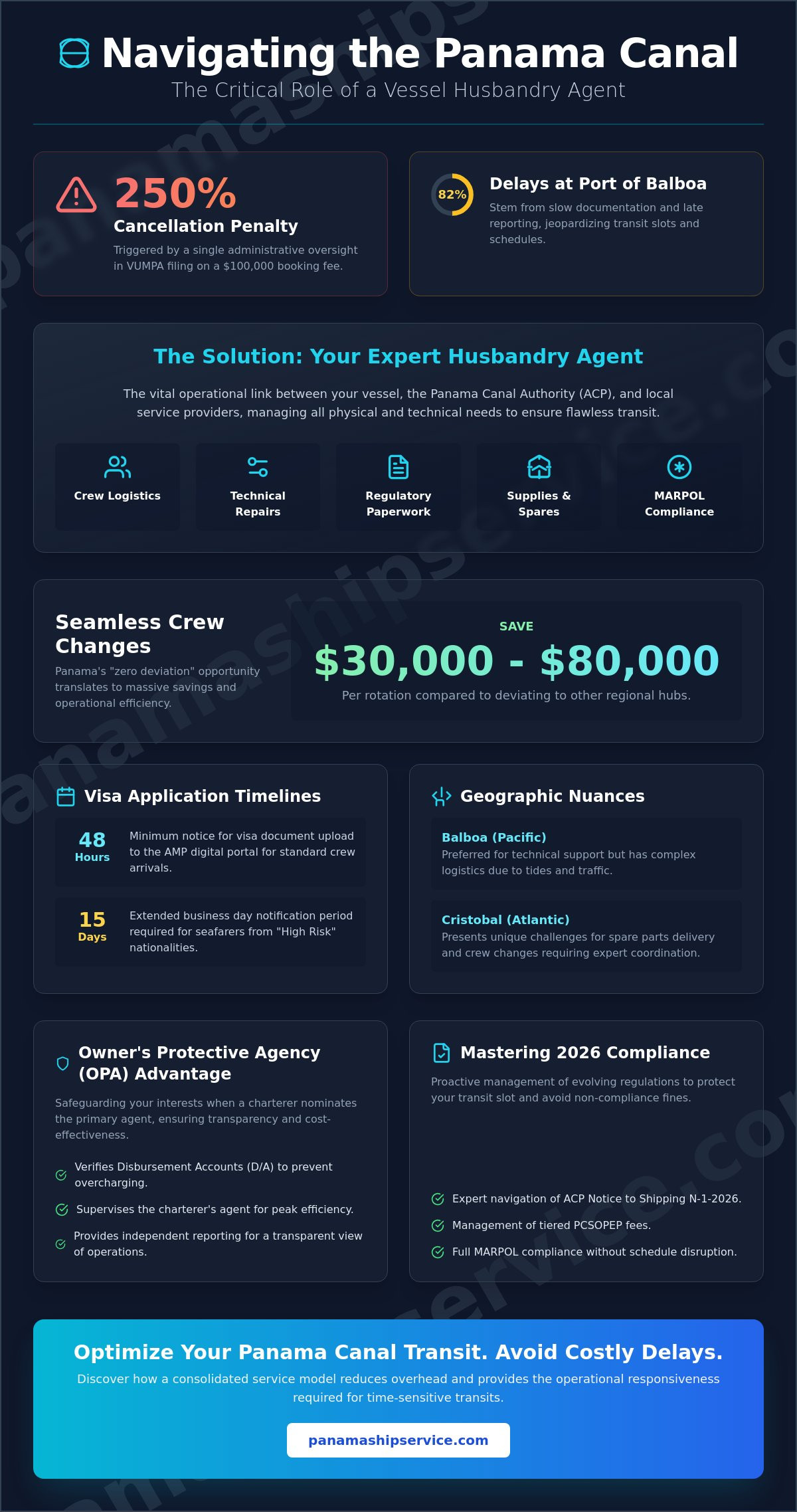
This 2026 guide explains how to optimize your vessel turnarounds and minimize transit delays with expert husbandry services. We’ll show you how to navigate the latest ACP Notice to Shipping N-1-2026 requirements, manage tiered PCSOPEP fees, and achieve full MARPOL compliance without disrupting your schedule. We also preview how consolidated billing for logistics and mechanical ship repairs simplifies your overhead while ensuring your fleet remains operational and compliant.
Key Takeaways
- Identify how a specialized vessel husbandry agent panama acts as the vital link between vessel operators and the Panama Canal Authority (ACP) to prevent costly administrative errors.
- Learn strategies for seamless crew changes and “last-mile” spare parts delivery that bypass common customs delays in Panamanian waters.
- Explore the efficiency gains of combining ship supplies and logistics with technical services like mechanical ship repairs to minimize vessel idle time.
- Ensure full compliance with the 2026 ACP Notice to Shipping and MARPOL disposal protocols to protect your transit slot and avoid non-compliance fines.
- Discover how a consolidated service model reduces overhead and provides the operational responsiveness required for time-sensitive Canal transits.
What is a Vessel Husbandry Agent in Panama?
A vessel husbandry agent panama acts as the essential operational link between your ship, the Panama Canal Authority (ACP), and local service providers. While a general ship agent typically focuses on the commercial aspects of a voyage, such as cargo documentation and charterer requirements, the husbandry agent manages the vessel’s physical and technical needs. This includes everything from crew rotations and medical assistance to coordinating mechanical ship repairs and underwater hull services.
The Panama Canal demands a higher level of expertise than most global maritime hubs. The ACP enforces rigid technical specifications and documentation deadlines that leave zero room for error. A primary example is the Vessel Universal Maritime Pre-Arrival (VUMPA) system. All vessels must submit a pre-arrival declaration at least 96 hours before entering Panamanian waters. Missing this window or submitting incorrect data can trigger significant financial penalties and cause you to lose your transit slot. An experienced vessel husbandry agent panama ensures these filings are machine-validated and compliant with the latest 2026 regulations.
This role often overlaps with that of a modern Ship chandler, as the agent must also coordinate the delivery of critical supplies and spare parts. In Panama, this logistical precision is vital because the vessel is often in motion or at a high-traffic anchorage where timing is everything.
The Role of the Owner’s Protective Agency (OPA)
When a charterer nominates the primary agent, the ship owner’s interests may not always be the top priority. An Owner’s Protective Agency (OPA) serves as an independent supervisor. We safeguard your interests by verifying proforma disbursement accounts (D/A) to prevent overcharging and ensuring that the charterer’s agent is performing efficiently. We provide independent reporting on vessel progress and cargo operations. This gives you a transparent view of the turnaround without relying solely on third-party data.
Balboa vs. Cristobal: Geographic Nuances for Husbandry
The choice between the Pacific terminal (Balboa) and the Atlantic terminal (Cristobal) involves more than just a map. Balboa is often the preferred hub for extensive technical support due to its proximity to specialized workshops. However, logistics at the Balboa anchorage can be more complex due to tide variations and traffic density. Cristobal offers a different set of challenges for spare parts delivery and crew changes. Speed depends on your agent’s ability to mobilize launch services and coordinate with customs at the specific terminal where your ship is positioned. Understanding these nuances helps us minimize your vessel’s idle time and reduce total port stay costs.
Core Husbandry Solutions: Crew, Logistics, and Supplies
Panama’s strategic location creates a “zero deviation” opportunity for ship operators. A proficient vessel husbandry agent panama turns this geographic advantage into measurable cost savings. Performing a crew change in Panama can save your operation between $30,000 and $80,000 per rotation compared to deviating to other regional hubs. Efficiency requires mastery of the Panama Canal maritime regulations and local immigration protocols to ensure your vessel never misses a scheduled transit.
Crew rotations in Panama are governed by strict digital timelines. The Panama Maritime Authority (AMP) requires all visa documents to be uploaded to their digital portal at least 48 hours before a crew member’s arrival. For seafarers from “High Risk” nationalities, this notification period extends to 15 business days. Visa costs typically range from $200 to $450. Failure to meet these windows results in denied boarding or costly transit delays. We manage the entire lifecycle of the crew change, from OK-to-Board letters to dockside transportation.
Logistics for spare parts and provisions require equal precision. Choosing a vessel husbandry agent panama with local warehouse access allows you to consolidate deliveries and minimize expensive launch trips. Optimizing your ship supplies and technical logistics ensures your vessel remains in peak condition while maintaining its position in the Canal queue. We also facilitate Cash to Master (CTM) services, providing secure and documented delivery of funds directly to the vessel’s bridge at anchorage.
Managing Crew Welfare and Rotations
Seafarer welfare is a priority for maintaining operational safety. We coordinate specialized medical and dental appointments in Panama City, ensuring crew members receive high-quality care without disrupting the vessel’s schedule. Our logistics team manages all transportation from Tocumen International Airport to the ports of Balboa or Cristobal. We also handle the local processing of Seafarer certifications and IMO documentation, ensuring all paperwork is compliant with current Panamanian maritime law before the vessel departs.
Supply Chain Excellence for Spare Parts
Avoiding local taxes and duties is critical for fiscal responsibility. We specialize in handling “ship spares in transit,” a designation that allows urgent components to bypass standard import tariffs. Our team coordinates with local port authorities to arrange crane and barge services for heavy equipment transfers at anchorage. For non-urgent items, we provide secure warehouse storage solutions. This allows you to stockpile essential components in Panama, ready for immediate delivery during the vessel’s next Canal transit.
The Technical Advantage: Integrating Husbandry with Ship Repairs
Fragmented communication between a logistics agent and a separate repair contractor is a leading cause of operational friction. When you hire a specialized vessel husbandry agent panama with in-house technical capabilities, you eliminate the middleman. This integration streamlines the flow of information between the vessel’s bridge, the agent, and the repair gang. By consolidating logistical and technical attendance, you significantly reduce mobilization costs. Instead of paying for multiple launch trips for different vendors, a single coordinated delivery can handle crew changes, spare parts, and the mobilization of a technical team.
The financial stakes of technical delays are immense. Losing a pre-booked Panama Canal transit slot can cost a ship owner upwards of $65,000 in late fees and scheduling chaos. A proactive agent identifies potential technical issues before the vessel reaches the locks. For example, in a recent case, a Neopanamax vessel reported a minor hydraulic failure 48 hours before arrival. Because the vessel husbandry agent panama also managed technical repairs, they mobilized a repair team on the same launch used for the crew change. The fault was corrected at anchorage, ensuring the vessel met its scheduled transit time and avoided a massive penalty.
Mechanical and Steel Fabrication Support
Emergency mechanical ship repairs are often required within the narrow 96-hour arrival window. We provide on-site welding and steel fabrication for both deck and engine room requirements. Our team integrates marine surveys with husbandry attendance to ensure all repairs meet class compliance standards. This approach is particularly effective for vessels that must rectify deficiencies identified during pre-transit inspections by the Panama Canal Authority (ACP) to maintain their slot priority.
Underwater Services and Hull Maintenance
Coordinating underwater hull services while at anchorage is a strategic way to optimize fuel efficiency. We perform propeller polishing and hull cleaning to reduce drag before the vessel continues its voyage. Our divers conduct UWILD inspections and class-approved surveys, providing high-resolution reporting without the need for dry-docking. All underwater operations are conducted in strict adherence to the MARPOL convention, ensuring that hull maintenance doesn’t compromise environmental compliance or lead to port authority fines.
Environmental Compliance and MARPOL in Panamanian Waters
Environmental oversight in the Panama Canal has reached a new level of digital scrutiny in 2026. The Panama Canal Authority (ACP) now utilizes machine-validated filings to ensure every transiting vessel adheres to strict ecological standards. For ship operators, this means that a single discrepancy in waste logs or a lapse in spill response representation can lead to immediate detention. A qualified vessel husbandry agent panama acts as your regulatory shield, ensuring that all environmental declarations are submitted correctly and on time.
Beyond the technical requirements, Panama enforces international health standards through mandatory fumigation and pest control protocols. Vessels arriving from specific regions may require certification to prove they meet local sanitary codes. We coordinate these inspections and treatments at anchorage, providing the necessary documentation to satisfy port health authorities without delaying your entry into the Canal locks. This proactive approach prevents the scheduling bottlenecks that occur when health issues are identified too late in the arrival sequence.
MARPOL Waste Management: Slops, Sludge, and Garbage
Panama strictly enforces MARPOL Annex V, which prohibits the discharge of all plastics and most solid waste into Canal waters. Coordinating MARPOL disposal in Panama requires authorized barges and certified processing facilities. We manage the collection and disposal of Annex I materials, including sludge and oily bilge water, at both the Atlantic and Pacific entrances. Our team ensures you receive the proper Garbage Receipt and Oil Record Book entries required for environmental audits. Safe bilge water removal is conducted with high-capacity equipment to ensure rapid turnaround times during your port stay.
PCSOPEP and Regulatory Vigilance
Every vessel transiting the Canal must have an “Authorized Person” designated within their Panama Canal Spill Operations Plan (PCSOPEP). This is a legal requirement under the OP NOTICE TO SHIPPING N-1-2026. As of January 2025, PCSOPEP fees are tiered based on oil capacity. For example, Tier 1 vessels (400 to 7,000 MT) pay $660, while Tier 4 vessels (>90,000 MT) pay $2,000. Your vessel husbandry agent panama ensures these fees are settled and that your plan version is updated in the ACP system. Proactive administrative filing is the only way to avoid the 250% cancellation penalty on a $100,000 booking fee that results from non-compliance errors.
Maintain your transit schedule and avoid environmental fines by partnering with a team that understands the technical nuances of Panamanian law. Contact Panama Ship Service today to secure your 2026 compliance strategy.
Optimizing Your Panama Canal Transit with Panama Ship Service
Managing a fleet through the Panama Canal requires more than just a local contact. It demands a partner capable of executing complex operations under tight deadlines. Panama Ship Service operates on a “One-Stop-Shop” philosophy, consolidating agency services, technical repairs, and essential supplies into a single point of accountability. This approach removes the communication gaps that often occur when dealing with multiple vendors. When you choose us as your vessel husbandry agent panama, you gain 24/7 operational responsiveness. Whether it’s an urgent spare part delivery at anchorage or a sudden change in transit scheduling, our team reacts immediately to protect your slot and reduce total port stay costs.
Financial transparency is the cornerstone of our partnership. We provide meticulous disbursement account (D/A) management, ensuring that every expense is documented and justified before it reaches your desk. This level of reporting prevents the “hidden costs” often associated with complex Canal transits. Navigating the ACP’s bureaucracy is a technical skill developed over years of direct interaction. We leverage decades of local expertise to manage the intricate paperwork and regulatory hurdles that can otherwise stall a voyage. By delegating these complexities to us, you simplify your own operations and ensure your vessel maintains its momentum through this strategic geographical hub.
Why Technical Managers Choose Panama Ship Service
Technical managers require reliability and direct communication to maintain fleet performance. We offer direct access to mechanical ship repairs in Panama without the inflation of third-party markups. Our in-house engineering teams are ready to mobilize at a moment’s notice, providing a proven track record of minimizing vessel downtime. We understand that in the shipping industry, time is the most expensive commodity. Our dedicated team works with a sense of urgency that matches your own, ensuring that technical attendance never compromises your transit window.
Next Steps: Securing Your Transit Efficiency
Efficiency starts with proactive preparation. Requesting a comprehensive husbandry and repair quote is the first step toward a zero-delay transit. We provide transparent pricing structures tailored to your specific vessel type and operational needs. To ensure a smooth arrival, operators should utilize our pre-transit checklist. This includes verifying VUMPA status, confirming crew visa approvals for high-risk nationalities, and ensuring all MARPOL disposal logs are ready for inspection. Our role as your vessel husbandry agent panama is to handle these details so you don’t have to.
Contact our husbandry experts to secure your next Panama Canal transit.
Secure Your Competitive Edge in the Panama Canal
The 2026 maritime landscape in Panama demands more than just basic agency. It requires a strategic partner who understands that technical precision is inseparable from logistical speed. By integrating mechanical ship repairs with traditional husbandry, you eliminate the communication gaps that lead to costly transit delays. You’ve seen how machine-validated VUMPA filings and tiered PCSOPEP fees leave no room for administrative error. Partnering with a specialized vessel husbandry agent panama ensures your fleet remains compliant with all ACP and MARPOL regulations while optimizing every hour spent at anchorage.
Success in the Canal is defined by zero-delay transits and consolidated efficiency. We provide 24/7 technical and logistical support alongside integrated repair and husbandry solutions to keep your operations moving. Our expertise in navigating the latest ACP Notice to Shipping requirements protects your booking from the risk of 250% cancellation penalties. Don’t let administrative oversights or technical friction compromise your schedule. Streamline Your Panama Canal Operations with Panama Ship Service. Our team is ready to manage the technical complexity of the hub so you can focus on your global voyage.
Frequently Asked Questions
What is the difference between a ship agent and a husbandry agent in Panama?
A ship agent typically manages the commercial interests of the charterer, focusing on cargo documentation and port fees. In contrast, a vessel husbandry agent panama handles the vessel’s physical and technical requirements. This includes crew changes, spare parts logistics, and coordinating mechanical ship repairs. While the ship agent looks after the voyage’s business, the husbandry agent ensures the ship itself remains operational and compliant with local technical standards.
How far in advance should I appoint a husbandry agent for a Panama Canal transit?
You should appoint your agent at least 96 hours before arrival to meet the mandatory Vessel Universal Maritime Pre-Arrival (VUMPA) filing deadline. If your crew includes “High Risk” nationalities, you must initiate the process at least 15 business days in advance. This lead time is essential for the Panama Maritime Authority (AMP) to process seafarer visas and ensure all digital documentation is machine-validated before the vessel reaches Panamanian waters.
Can crew changes be performed while the vessel is transiting the Canal?
Crew changes are strictly prohibited during the actual transit of the locks or navigation through the Canal channels. All rotations must be completed at the designated anchorages in Balboa or Cristobal either before or after the passage. This ACP safety regulation prevents operational distractions during the transit. Performing these changes at anchorage allows for a “Zero Deviation” rotation that doesn’t interrupt the vessel’s primary schedule.
What are the specific requirements for MARPOL disposal at the Panama Canal?
Panama enforces MARPOL Annex V, which prohibits the discharge of plastics and most solid waste into Canal waters. Vessels must use authorized local barges for the disposal of Annex I sludge and Annex V garbage. You’re required to maintain an updated Garbage Record Book and obtain a certified receipt from the disposal provider. These documents are frequently inspected during environmental audits to ensure the vessel hasn’t contaminated local waters.
How does the PCSOPEP requirement affect my vessel’s husbandry needs?
The Panama Canal Spill Operations Plan (PCSOPEP) requires every vessel to designate a local “Authorized Person” to represent them in spill response scenarios. Your vessel husbandry agent panama manages this legal designation and ensures the tiered fees are settled. As of 2026, these fees range from $660 for Tier 1 vessels to $2,000 for Tier 4. Failure to have an active PCSOPEP plan can lead to immediate transit cancellation.
What happens if my vessel requires emergency repairs during the transit window?
If a mechanical failure occurs, your agent must immediately mobilize a repair gang to the anchorage to rectify the issue before your scheduled lock entry. By using an agent with in-house technical capabilities, you can often complete repairs during the 96-hour arrival window. This proactive approach helps you maintain your transit slot and avoid the $65,000 late fees typically associated with scheduling chaos and lost positions in the queue.
Are husbandry agents in Panama available 24/7 for emergency spare parts delivery?
Yes, professional husbandry services operate 24/7 to accommodate the dynamic nature of Canal scheduling. Emergency spare parts often arrive at Tocumen International Airport at irregular hours and must be cleared through customs quickly. We provide immediate transportation and launch services to deliver these components to the vessel at anchorage. This constant availability ensures that critical parts reach the bridge before the vessel begins its transit, regardless of the hour.
How can an Owner’s Protective Agency (OPA) save my company money in Panama?
An OPA saves you money by independently auditing the disbursement accounts (D/A) submitted by the charterer’s nominated agent. We verify that launch fees, port charges, and service costs are accurate and reflect local market rates. This oversight prevents overcharging and ensures that the vessel’s physical needs aren’t neglected in favor of the charterer’s commercial priorities. It’s a cost-effective way to maintain transparency and fiscal control over your Panama operations.