
A single expired document can turn a scheduled Panama Canal transit into a $45,000 operational setback overnight. You might still hear veteran crew members ask, what is a deratting certificate, but relying on outdated terminology in 2026 often triggers red flags during port state inspections. Since the International Health Regulations (IHR) were overhauled in 2005, the industry officially transitioned to the Ship Sanitation Control Certificate (SSCC). We know that managing these regulatory shifts is difficult when your primary focus is keeping a vessel on schedule.
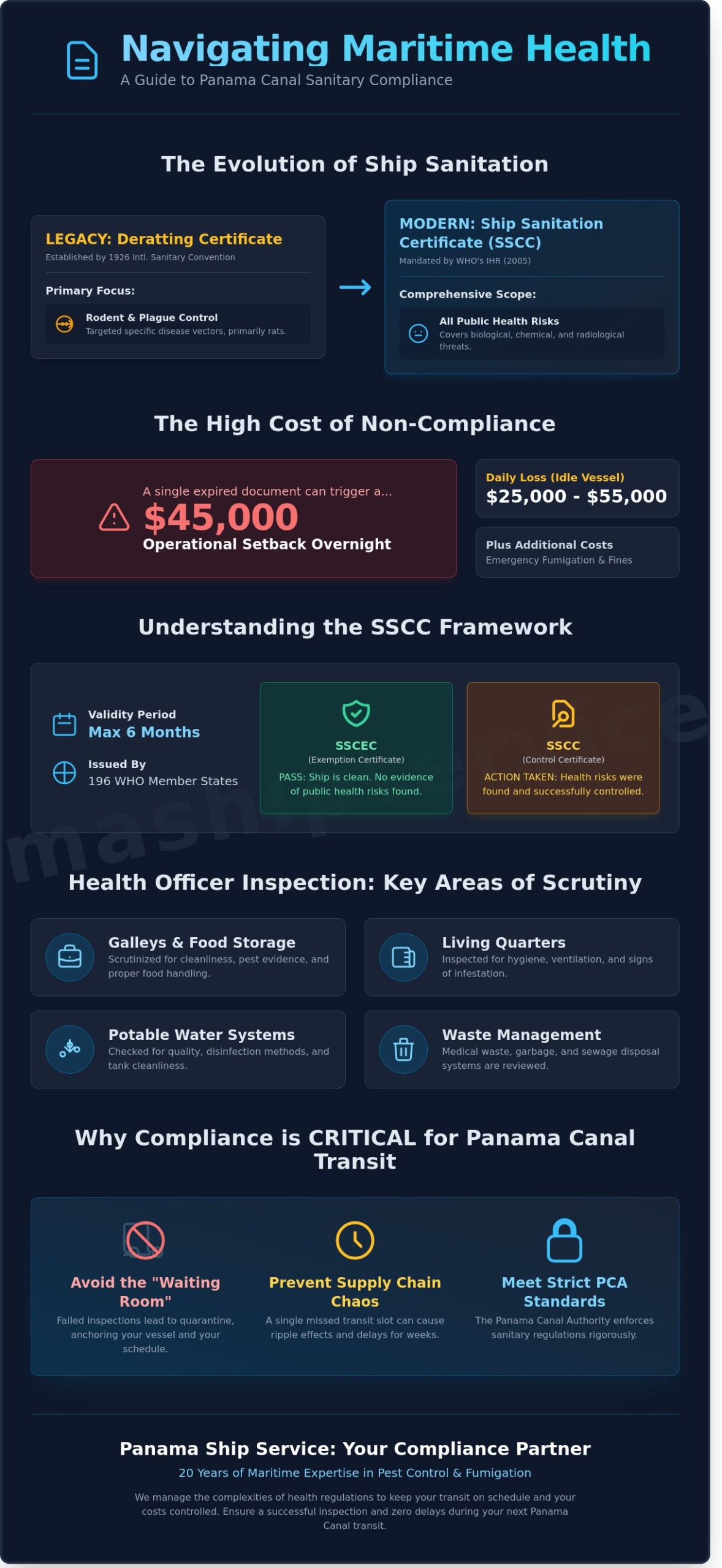
You already know that timing at the locks is everything; a missed slot can disrupt your entire supply chain for weeks. We are experts in maritime compliance so you don’t have to be. This guide clarifies the essentials of sanitary certification, from the legacy of deratting to the modern requirements for Panama Canal transit. We will preview the specific inspection criteria used by local authorities and show you how to secure a valid SSCC. Our 20 years of experience ensures you have the knowledge to achieve a successful inspection and zero delays during your next transit.
Key Takeaways
- Understand what is a deratting certificate and how this historical plague-prevention document has evolved into the modern Ship Sanitation Control Certificate (SSCC).
- Master the distinction between SSCC and SSCEC documentation to maintain full compliance with the International Health Regulations (IHR 2005).
- Prepare your crew for rigorous health officer inspections by identifying the high-risk areas like galleys and food storage that receive the most scrutiny.
- Avoid the “Waiting Room” and costly transit delays by meeting the Panama Canal Authority’s strict sanitary standards before your vessel arrives.
- Leverage 20 years of maritime expertise to coordinate efficient fumigation and certification, ensuring your transit remains on schedule and cost-effective.
What is a Deratting Certificate? Definition and Maritime Legacy
A deratting certificate is a critical health document issued by port authorities to confirm that a vessel is free from rodents and the plague-carrying insects they host. This document serves as a biological passport for ships. Without it, a vessel cannot legally enter most international ports. It proves the crew has maintained strict sanitary standards and that the ship does not pose a threat to the local population’s health. Understanding what is a deratting certificate requires looking at it as a frontline defense in global biosecurity.
The history of this document dates back to the early 20th century. International trade was booming, but so was the spread of the Bubonic plague. The 1926 International Sanitary Convention first established formal protocols to stop rats from hitching rides on merchant ships. These rodents were more than just pests; they were vectors for devastating diseases. By mandating inspections and fumigation, regulators created a system that protected port cities from foreign outbreaks. While medical technology has advanced significantly since 1926, the fundamental requirement for a rodent-free environment remains a cornerstone of maritime law.
Terminology in the shipping industry often moves slower than the regulations themselves. While veteran mariners and port agents still use the legacy term, the official name has changed. Under the 2005 International Health Regulations, the document was rebranded as a Ship Sanitation Certificate (SSC). This modern version covers a broader range of health risks, yet the industry continues to ask for “deratting” papers because the core objective remains the same. It is a mandatory requirement for every commercial vessel engaged in international voyages.
The Role of the World Health Organization (WHO)
The WHO standardizes maritime health documentation to prevent chaos at international borders. They moved the industry away from the limited 1969 regulations to the more comprehensive 2005 update. This transition ensured that health inspections cover everything from food safety to water quality, not just rodent control. This global standardization means a certificate issued in Singapore is recognized in Panama. The certificate’s validity period is strictly limited to a maximum of six months from the date of issue.
Why Rodent Control is Still Critical in 2026
Modern shipping faces complex biological risks that didn’t exist a century ago. In 2026, the sheer volume of containerized shipping makes it easier for invasive species to hide in plain sight. Rats are remarkably resilient and can cause massive damage to a ship’s infrastructure by gnawing through electrical conduits. This creates fire hazards and mechanical failures that put the entire crew at risk. When you ask what is a deratting certificate in today’s context, you are asking about a tool that prevents millions of dollars in property damage.
The financial consequences of a failed inspection are immediate and severe. If a port health officer finds evidence of an infestation, they will place the vessel under quarantine. A mid-sized bulk carrier can lose between $25,000 and $55,000 per day while sitting idle. These costs don’t include the price of emergency fumigation services or the legal fines for port health violations. Ship owners also face significant legal liabilities if their vessel is found to be the source of an invasive species introduction. We are experts so you don’t have to be; we manage the complexities of these health regulations to keep your transit on schedule and your costs controlled.
The Modern Framework: Ship Sanitation Control Certificates (SSCC)
Since June 15, 2007, the International Health Regulations (IHR 2005) have defined the global standards for maritime hygiene. This framework replaced the outdated 1969 regulations that focused almost exclusively on the plague. It shifted the focus from just rodents to all public health risks, including chemical spills and viral outbreaks. While many masters still ask what is a deratting certificate, the industry now uses the Ship Sanitation Control Certificate (SSCC) system. These documents are mandatory for all ships on international voyages, regardless of their size or tonnage.
Authorized Port Health Authorities in 196 WHO member states handle the inspections. These officials look for biological, chemical, or radiological risks that could cross borders. If your vessel’s certificate is about to expire and the port doesn’t have the capacity for a full survey, they can grant a 30-day extension. This grace period is a vital tool for operators to avoid difficult and frustrating delays when canal schedules are tight. We are experts so you don’t have to be; we manage these timelines to keep your transit on track without the risk of quarantine.
Ship Sanitation Control Exemption Certificate (SSCEC)
An SSCEC is the gold standard for ship owners. Inspectors issue this when a thorough search reveals no evidence of infection or infestation. A clean ship is an efficient ship. To secure this, you’ll need to present 180 days of medical logs, food safety records, and pest control data. Roughly 92% of modern cargo vessels prioritize this exemption to prove their high maintenance standards. It stays valid for exactly 180 days, providing a predictable window for global operations and ensuring smooth entry into restrictive ports.
Ship Sanitation Control Certificate (SSCC)
If an inspector finds evidence of pests or pathogens, they won’t issue an exemption. Instead, they issue an SSCC. This document outlines specific control measures that the master must implement immediately to mitigate risk. The WHO Handbook for Ship Sanitation provides the technical criteria for these interventions, ensuring they meet international safety levels. Common triggers for an SSCC include:
- Rodent droppings or nesting materials in the galley or dry stores.
- Standing water in lifeboats or bilges that could harbor larvae.
- Inadequate temperature logs for refrigerated food storage.
- Evidence of cockroach or bedbug infestations in crew quarters.
These measures might involve professional deratting, localized disinfection, or full-ship fumigation using certified contractors. A re-inspection is always required to confirm the risk is gone before the vessel can clear port and resume its voyage. Understanding what is a deratting certificate in this context means recognizing it as a corrective action plan rather than a simple clean bill of health.
Mismanaging these documents leads to detention, lost slots, and massive fines that can exceed $10,000 per day in some jurisdictions. Maintaining compliance requires constant vigilance and proactive reporting. If you’re approaching the Panama Canal and your paperwork is nearing its 6-month limit, you should contact our technical team for immediate assistance with renewals. We provide rapid responses to ensure your documentation never causes a missed slot or a costly operational delay.
The Inspection Process: What Happens When the Health Officer Boards?
The inspector’s arrival triggers a systematic evaluation of your ship’s hygiene standards. They begin with a rigorous review of the Maritime Declaration of Health and the current Ship Sanitation Control Certificate. If you’re asking what is a deratting certificate in the modern maritime context, it’s the document issued after this specific physical assessment proves your vessel is free of vectors and reservoirs. The officer compares your current health logs against the 2005 International Health Regulations to identify any gaps in compliance since your last port of call.
Officers prioritize food preparation zones above all else. They’ll inspect the galley, pantries, and cold storage for organic residue or signs of spoilage. A single 2mm gap in a dry storeroom door can lead to a formal deficiency report. They verify that refrigerators maintain a 40-degree Fahrenheit (4°C) threshold and ensure the 0-degree Fahrenheit (-18°C) standard for freezers is consistent. They’ll also test the chlorine levels in your potable water supply; levels must typically fall between 0.2 and 0.5 mg/L at the furthest tap from the tank.
Vector control is the next priority for the boarding officer. They search for droppings, gnaw marks, or live insects in dark corners and behind equipment. They look for standing water in scuppers or lifeboat covers, as these serve as breeding grounds for mosquitoes. Waste management is audited against the Garbage Record Book and MARPOL Annex V standards. Any discrepancy between the logged waste disposal and the physical volume of trash on board will cause immediate delays. Panama Ship Service experts recommend a full walk-through 24 hours before arrival to catch these issues.
The process concludes with a formal briefing in the Master’s office. If the vessel meets all health standards, the officer issues a new certificate valid for six months. If they find minor issues, they’ll provide a list of required actions that must be completed before the ship departs. Serious infestations can lead to a Ship Sanitation Control Order, requiring immediate fumigation by a certified professional before the vessel can resume operations.
Preparing Your Vessel for a Sanitary Inspection
Success depends on the Chief Steward’s organization and the deck department’s attention to detail. Ensure all 6 or 8 mooring lines have rat guards fixed at a 90-degree angle to the rope. Use a dedicated folder for the Medical Log and Vaccination records for every crew member. Missing a single yellow fever certificate can trigger a quarantine. Clean all galley deck drains and ensure no food particles remain under the ovens or behind refrigeration units.
Common Deficiencies and How to Avoid Them
Data from 2023 port state control records shows that 22% of sanitation failures stem from poorly maintained food disposal units. Grease traps that haven’t been cleaned in the last 7 days are a major red flag for inspectors. Stagnant water in lifeboat covers is another frequent oversight; ensure these are drained and dry. Incomplete documentation of previous pest control measures suggests a lack of oversight. Keep your service receipts and bait station logs organized to prove your vessel is proactive. Understanding what is a deratting certificate helps you realize that documentation is just as vital as the physical cleaning.
Why Sanitary Compliance is Critical for Panama Canal Transit
The Panama Canal Authority (ACP) operates with zero tolerance regarding international health regulations. Every vessel entering Panamanian waters must comply with strict biosecurity protocols to protect the local environment and the global supply chain. If you’re wondering what is a deratting certificate in the context of the Canal, it’s the primary document used to prove your vessel isn’t carrying pests or infectious diseases. Under the International Health Regulations (2005), this document, now officially the Ship Sanitation Control Certificate (SSCC), is mandatory for receiving “Free Pratique” and proceeding with your transit.
Panama’s unique tropical environment adds another layer of complexity to these requirements. The Ministry of Health (MINSA) maintains a heightened focus on mosquito-borne diseases. In 2023, Panama saw more than 10,000 reported cases of Dengue, making the prevention of vector-borne illnesses a top priority. Inspectors check for stagnant water in lifeboats, proper screening on portholes, and the presence of Yellow Fever vaccination records for crews coming from high-risk zones. A failure to demonstrate sanitary control doesn’t just lead to a fine; it leads to a total halt of your operations.
Logistics for these inspections are handled at the major anchorages. Whether you’re at the Balboa anchorage on the Pacific side or Cristobal on the Atlantic side, health officers board via pilot boat to conduct their survey. They examine the galley, food storage areas, and medical lockers with extreme detail. They also verify that rat guards are correctly positioned on all mooring lines. If your documentation is expired or the physical state of the ship is poor, the ACP will deny your entry into the locks. This pushes your vessel into ‘The Waiting Room,’ a state of limbo that ruins schedules and destroys profitability.
Avoiding Transit Delays at the Canal
Missing a transit slot is a financial disaster for any ship owner. In 2024, the cost of a missed Neopanamax slot can exceed USD 40,000 in administrative penalties alone. When you add daily charter rates of USD 25,000 or more, the stakes are clear. You must check your certificate validity at least 30 days before arriving in Panama. This buffer allows you to renew the document at a previous port of call if it’s set to expire. The Port Health Authority won’t grant extensions for expired paperwork, regardless of your cargo’s urgency.
Coordinating with Your Canal Transit Agent
Your Canal transit agency acts as the essential bridge between your vessel and the Port Health Officer. We manage the submission of the Maritime Declaration of Health (MDH) at least 96 hours before your arrival. This document is a legal declaration; any discrepancies found during the physical inspection will result in heavy fines. We coordinate the inspector’s arrival to ensure your vessel is cleared well before your scheduled pilot time. We are experts so you don’t have to be, ensuring every detail of what is a deratting certificate and its associated requirements is fully met.
Don’t let a simple paperwork error cost you thousands in Canal penalties. Contact Panama Ship Service today to ensure your vessel is fully compliant and ready for transit.
Panama Ship Service: Your Expert for Pest Control and Fumigation
Since 2002, Panama Ship Service has acted as a critical resource for ship owners and charterers navigating the complex requirements of the Panama Canal. We provide more than just labor; we offer a strategic advantage in a high-pressure maritime environment where timing dictates profitability. Our team understands that understanding what is a deratting certificate is only the first step. The real challenge lies in securing inspections and treatments without disrupting your tight transit window. With over 20 years of experience, we have refined a system that prioritizes speed, compliance, and technical precision.
We operate as a genuine “One-Stop-Shop” for maritime needs. This model allows us to combine technical repairs, bunker surveys, and sanitary compliance into a single service window. When a vessel coordinates with three different vendors for these tasks, it often loses 12 to 24 hours in communication lags. By consolidating these requirements with us, you ensure that your vessel remains on its scheduled path. We manage the entire lifecycle of sanitary compliance, from the initial inspection to the final coordination with the Port Health Authority.
Our response times are designed for the shipping industry’s 24/7 reality. We maintain constant communication with our clients, providing updates in real time so there are never any surprises regarding your vessel’s status. Our local knowledge of Panama Canal regulations ensures that your documentation is always in order before it reaches a port official’s desk. This proactive approach eliminates the friction that typically leads to costly fines or transit denials.
Professional Fumigation and Deratting Services
Our certified technicians utilize methods that strictly adhere to World Health Organization (WHO) standards. We use specialized treatments that effectively eliminate pests while remaining safe for sensitive electronic equipment and various cargo types. This technical expertise is vital when determining what is a deratting certificate requirement for your specific vessel type. Once the treatment is complete, we issue the precise documentation required for Port Health Authority approval, ensuring your Ship Sanitation Control Certificate remains valid and recognized globally.
Put Your Transit in Our Hands
Navigating international maritime health regulations is a full-time job. We are experts so you don’t have to be. Our team stays updated on every shift in local and international law, protecting your interests and your schedule. Instead of worrying about the nuances of sanitary inspections, you can focus on your core operations while we handle the logistics. We provide the reliability you need to transit the canal with total confidence.
If your vessel is approaching the Panama Canal and requires a sanitary inspection or professional fumigation, contact us immediately. We provide rapid, competitive quotes tailored to your specific vessel size and cargo requirements. Don’t let a missing certificate or a failed inspection stall your journey.
Contact us today: Get a quote for maritime pest control and fumigation in Panama
Secure Your Next Panama Canal Transit with Expert Sanitation Support
Navigating international maritime health standards doesn’t have to be a bottleneck for your operations. While many still ask what is a deratting certificate, modern compliance focuses on the Ship Sanitation Control Certificate (SSCC) to prevent pest-borne delays. Failing an inspection can halt your Panama Canal transit immediately; this often leads to thousands of dollars in lost time and fuel. You need a partner who understands the strict ACP and Port Health regulations that govern these waters every single day.
Panama Ship Service brings over 20 years of experience to every vessel we board. We provide MARPOL-compliant disposal and specialized fumigation services that meet the highest international standards. We’re the experts so you don’t have to be. Our team ensures your documentation is flawless and your ship is sanitary before the health officer even steps on deck. Don’t risk a failed inspection or a missed slot. Request a quote for sanitary inspection and fumigation services to keep your transit moving forward safely. We’re ready to secure your ship’s compliance today.
Frequently Asked Questions
How long is a Deratting Certificate (SSCC/SSCEC) valid for?
A Ship Sanitation Control Certificate is valid for a maximum period of 6 months from the date of issue. This timeline is strictly enforced by the International Health Regulations (2005) to ensure vessels maintain high hygiene standards. If your vessel is transiting the Panama Canal, ensure your documentation is current to avoid delays. We manage these timelines for you, ensuring your transit remains efficient and cost-effective.
Is a Deratting Certificate required for all ships entering Panama?
Every international vessel entering Panamanian waters must carry a valid Ship Sanitation Certificate according to the Panama Maritime Authority (AMP) regulations. This requirement applies to 100% of commercial ships, including tankers, bulkers, and container ships. Understanding what is a deratting certificate is essential for compliance. Without this document, your ship faces immediate quarantine or entry denial, which increases operational costs and disrupts your schedule.
What is the difference between an SSCC and an SSCEC?
An SSCEC is issued when an inspector finds no evidence of pests, while an SSCC is required if evidence of infection is found and control measures are applied. Both fall under the broader category of Ship Sanitation Certificates. In 2023, the majority of well-maintained vessels received the Exemption version. We act as your expert partner to ensure your vessel meets the 100% compliance threshold for either document type.
Can a Ship Sanitation Certificate be extended?
A Ship Sanitation Certificate can be extended for a single period of 30 days if the inspection cannot be completed at the current port. This extension is only granted if the ship is in transit to a port where an inspection is possible. You must request this from the port health authority before the original 6 month period expires. We handle these requests daily to keep your operations moving without interruption.
What happens if a ship fails a sanitary inspection?
If a ship fails inspection, the port health officer mandates immediate control measures like fumigation or disinfection. The vessel is then issued a Ship Sanitation Control Certificate (SSCC) documenting the evidence found and the treatment applied. Failure can lead to fines exceeding $5,000 and significant transit delays. We provide the expert solutions needed to rectify these issues quickly and get your vessel back on track.
Who is authorized to issue a Ship Sanitation Control Certificate?
Only port health authorities listed in the World Health Organization (WHO) IHR List of Authorized Ports can issue these certificates. In Panama, the Ministry of Health (MINSA) performs these inspections at designated ports like Balboa and Cristobal. Knowing what is a deratting certificate helps you identify which authorized bodies to contact. Our team coordinates directly with these officials to streamline the entire certification process for your fleet.
Does a Deratting Certificate cover insects and other pests?
The modern Ship Sanitation Certificate covers all vectors of human disease, including rodents, cockroaches, flies, and mosquitoes. While the historical term focused on rats, the 2005 IHR update expanded the scope to ensure comprehensive public health safety. Inspectors check 13 specific areas of the ship, including the galley and food stores. We ensure your vessel is 100% prepared for these rigorous multi-pest inspections.
How much does a ship sanitation inspection cost in Panama?
Official government fees for a ship sanitation inspection in Panama generally range from $300 to $600, depending on the vessel’s Net Tonnage. This does not include additional costs for launch services or agent coordination. We provide a transparent, competitive quote that covers all logistical expenses to minimize your vessel’s total spend. Our 20 years of experience ensures you don’t pay for unnecessary services or hidden fees.